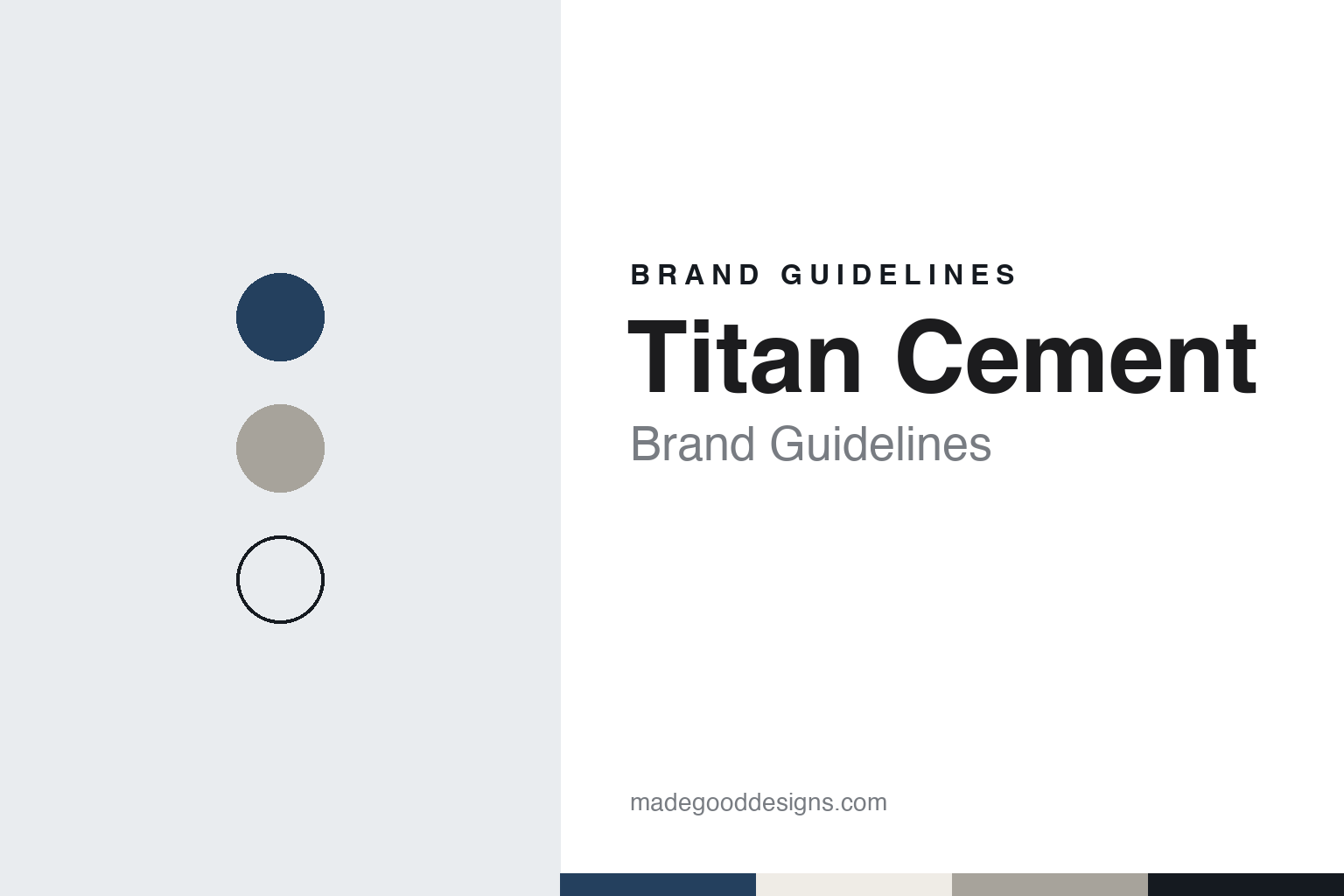
Titan Cement Brand Guidelines
Elefsina, 1902: a Brussels listing and a name in capitals.
Aa
Two constants: an Aegean slate, quarry grey and marble white palette and a classical serif register. Abstract homage — not a Titan Cement product or mark; no logo, bag or plant is reproduced.
Elefsina
A cement plant near Athens, and exports from 1933.
TITAN began in 1902 at Elefsina, near Athens. The company’s history page says three young men founded Greece’s first cement plant there and called it TITAN. The Greek news site News 24/7 reported in October 2018 that the cement company was founded in 1902 with its first installations at Elefsina, and that its shares joined the Athens Stock Exchange ten years later. The company says it became a société anonyme under the name TITAN Cement S.A. in 1911 and was listed in 1912.
Exports came early. Both the company and News 24/7 date the first exports to 1933; the company says the first shipments went to Brazil. TITAN’s timeline says export operations were virtually suspended from 1939 to 1947, during the Second World War, which held back its international growth and kept the business focused on Greece. The sources used for this guide do not say how the company operated during the occupation of Greece from 1941 to 1944. Production at Elefsina then rose sharply: the company says it grew fifteen-fold between 1951 and 1957 to keep up with exports, and News 24/7 reported that by the end of the 1950s some 52 percent of sales came from abroad.
More Greek plants followed, according to the company: Nea Efkarpia near Thessaloniki in 1962, Drepano near Patras in 1968 and Kamari near Athens in 1976. Ready-mixed concrete was added in 1978 through a new company, Interbeton, and in 1979 TITAN opened floating distribution terminals at Jeddah in Saudi Arabia and Alexandria in Egypt, a step News 24/7 also records.
Colour
From Athens to Brussels.
The United States became a major market. The company says exports to the US began in the mid-1980s through a terminal at the Port of Newark, that it took a controlling stake in Roanoke Cement in Virginia between 1989 and 1994, and that in 2000 it bought Tarmac America, including Roanoke and the Pennsuco plant in Florida, and renamed it Titan America. In south-eastern Europe it acquired majority stakes in Plevenski Cement in Bulgaria and Cementarnica Usje in North Macedonia in 1998, Kosjeric in Serbia in 2002 and the Sharr plant in Kosovo in 2010, the year its newly built Antea plant in Albania began operating. Egypt, from 1999, Turkey, from 2008, and Brazil, through a stake in Apodi from 2016, followed, the company says.
The holding structure moved in 2019. News 24/7 reported in October 2018 that the group would move its statutory seat from Athens to Brussels after 116 years, with management exercised from Cyprus and its Greek production unchanged. Kathimerini reported on 24 July 2019 that shares of the new parent, Titan Cement International SA, had begun trading the previous day on Euronext Brussels, the Athens Exchange and Euronext Paris under the symbol TITC. English Wikipedia says the new parent took over after a voluntary share exchange offer to shareholders of the former Greek parent, TITAN Cement Company S.A.
More changes followed. The company says Titan America was listed on the New York Stock Exchange in 2025, that the parent changed its name from Titan Cement International SA to Titan SA the same year, and that it sold its 75 percent holding in Adocim in Turkey in 2025. In January 2026, English Wikipedia says, the group completed the purchase of Vracs de L’Estuaire, a clinker-grinding business at the Port of Le Havre in France, and it reports an agreement, announced in December 2025, to buy Traçim, a cement maker near Istanbul. Pulse 2.0 reported on 3 May 2026 that Titan America had completed its acquisition of Keystone Cement in Pennsylvania.
Typography
Design and documentation.
Cement is sold in bags by the million, so the makers in this guide mostly present themselves through plain, solid wordmarks that have to read on a sack, a lorry, a silo and a dealer’s signboard. Their palettes tend towards greys, reds and greens, often with one strong colour that can be spotted across a building site. Imagery leans on the industry itself: quarries, kilns, grinding units, bulk terminals and finished buildings, more than people or lifestyle scenes.
Their websites are usually split by audience. Pages for individual home builders sit beside pages for engineers, contractors and infrastructure buyers, and products are often listed by cement type — ordinary Portland, Portland pozzolana, slag and composite cements — and by strength class or intended use, alongside ready-mix concrete and building products such as plasters, waterproofing and tile adhesives. Several makers add home-building guides, how-to videos, store locators and calculators for estimating materials.
Sustainability has become a standard section. Many cement groups publish sustainability reports and pages on lower-carbon or blended cements, alternative fuels, waste-heat recovery and water use; this guide reports such material only as the companies or dated sources state it, and makes no claims of its own about emissions or performance. Investor pages, annual reports and capacity figures in million tonnes a year sit close by, because many of these makers are listed companies that grew through acquisitions.
Community and safety programmes complete the picture, from local schools and water projects near plants to training for masons and contractors. For a design reader, the interest lies in how heavy, commodity products are given a recognisable face: a name on a bag, a colour on a truck, and a tone of voice that speaks both to a family building one house and to a highway contractor.
Aa
A classical serif for a name set in capitals. (Specimen set in Source Serif 4, a serif STAND-IN; NOT the Titan Cement logo.)
Titan Cement
A name in capitals, and a parent renamed in 2025.
The company writes its name in capitals, TITAN, throughout its website and reports, and its group site links to local sites for Albania, Bulgaria, Brazil, Egypt, Greece, Kosovo, North Macedonia, Serbia, Türkiye and the United States. The 2025 change of the parent’s name to Titan SA, the company says, reflects a broader, more forward-looking vision tied to sustainability and value-added products and solutions.
Its range has widened beyond grey cement. The company says it added fly ash in 2002 by bringing the US company Separation Technologies into the group, renamed ST Equipment & Technology in 2014, and that it formed a dry-mortar partnership in Greece in 2026. Its group website gives prominent space to net-zero targets, carbon capture, digital plant technology and a corporate venture programme, and the company says it signed a grant agreement with the EU Innovation Fund in 2024 for its IFESTOS carbon-capture project.
TITAN also places itself within industry groups. The company says it was the first Greek company to sign the United Nations Global Compact, in 2002, became a full member of the World Business Council for Sustainable Development in 2003 and joined the Global Cement and Concrete Association when it was set up in 2018; English Wikipedia lists the same memberships.
For a design guide, Titan Cement shows how a Greek industrial name can carry one capitalised word across many countries and a new Belgian parent. Compare Heidelberg Materials, another European group that has changed its name more than once, and Vicat, another European cement maker. For this guide we use Aegean slate, night ink, quarry grey and marble white with a serif, an unofficial interpretation; no product or logo is reproduced.
Explore & save
Keep Titan Cement’s identity on hand — save it to a board in the Made Good inspiration library.
Titan Cement identity set
Pin the Titan Cement Aegean slate, quarry grey and marble white palette and the classical serif register to your own board.


