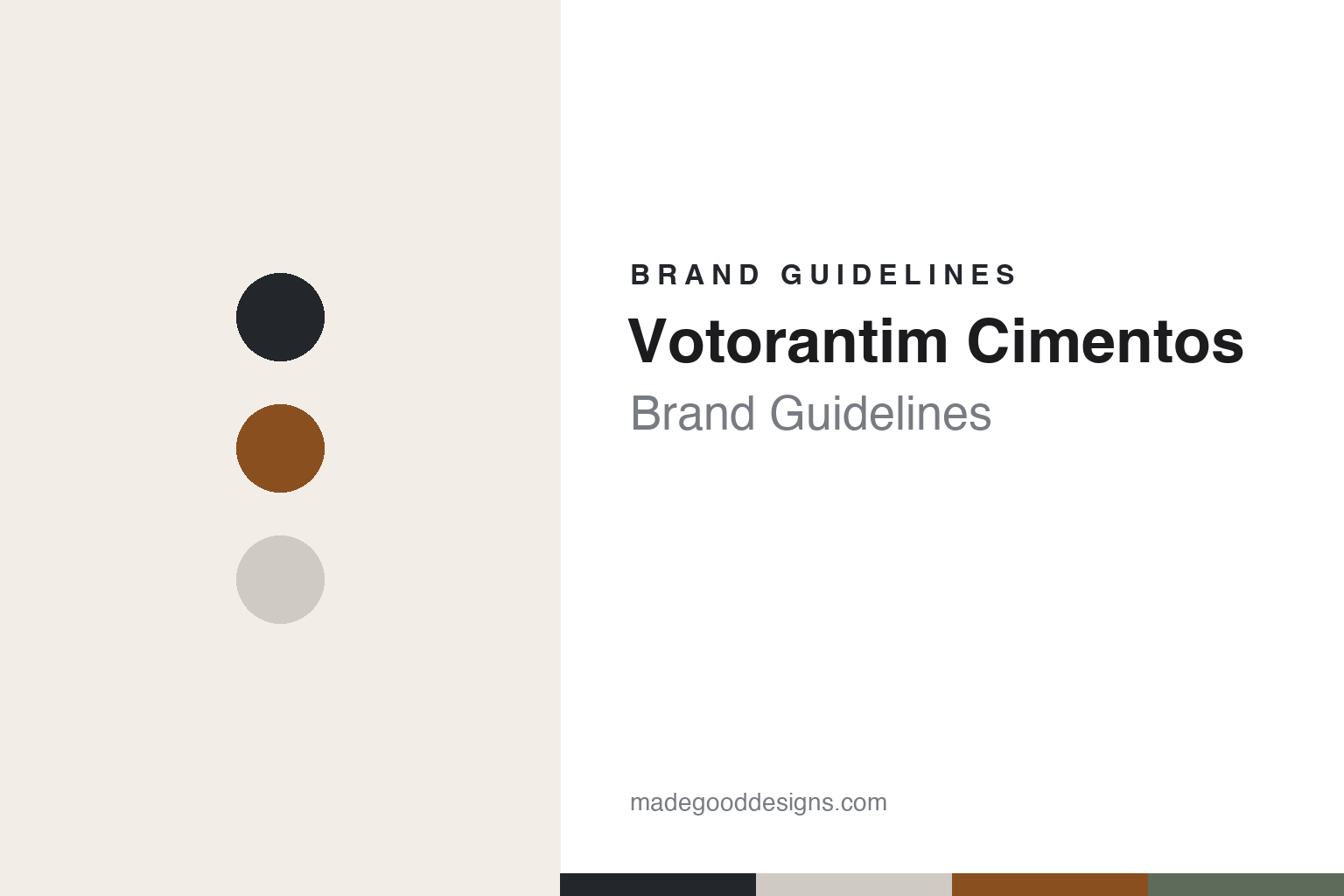
Votorantim Cimentos Brand Guidelines
A Brazilian cement maker that grew from one São Paulo kiln to nine countries.
Aa
Two constants: a basalt, concrete grey and clay ochre palette and an industrial sans register. Abstract homage — not a Votorantim Cimentos product or mark; no bag, plant, logo or nameplate is reproduced.
Santa Helena
One kiln in the interior of São Paulo.
Votorantim Cimentos takes its name from the town of Votorantim, in the interior of São Paulo state, Brazil. The company says construction of its first cement factory there began in 1933, and that on 18 January 1936 the kiln of the Santa Helena plant produced Votoran cement for the first time, at an average of 250 tonnes a day. English Wikipedia gives 1933 as the founding year, while Portuguese Wikipedia and the company date the company to 1936; the company marked its 90th anniversary in January 2026. At the time, the company says, almost all the cement used in Brazil was imported.
Its first major job, the company says, was the Viaduto do Chá in central São Paulo, rebuilt in reinforced concrete between 1936 and 1938 with Votoran cement after the company won the public tender. In March 1942 it opened a plant at Paulista, in Pernambuco, which the company calls the first cement plant in Brazil’s Northeast, and launched a second brand, Poty. The company links the choice of site to Senator José Ermírio de Moraes, who was born nearby.
The cement maker belongs to the Votorantim group, today the holding company Votorantim S.A., whose portfolio also covers aluminium, energy, mining and metals, banking and orange juice. English Wikipedia says the Ermírio de Moraes family holds the strategic controlling positions on its executive board, with professional managers at the head of the business units. Votorantim Cimentos is based in São Paulo, English Wikipedia says.
Colour
Itaú, Engemix and the move abroad.
Growth inside Brazil came through new plants and purchases. The company lists the acquisition of Companhia de Cimento Portland Gaúcho in 1952, later its Esteio plant; a plant at Itajaí in 1953 and another at Sobral, in Ceará, in 1968; and, in 1977, a controlling stake in Companhia de Cimento Portland Itaú, which brought the Itaú and Tocantins cement brands and plants from Paraná to Mato Grosso do Sul. That year, the company says, it supplied 70 percent of the cement used to build the Itaipu hydroelectric plant on the border with Paraguay. In 1986 it bought Cimento Santa Rita from the Italian group Ferruzzi.
The portfolio widened in the 1990s. The company says it began co-processing waste and biomass as kiln fuel in 1991, entered aggregates in 1992 and mortar in 1996, and launched the Votomassa mortar brand for the retail market in 1998. In 2002 it bought the concrete maker Engemix, now its ready-mix business in Brazil.
The move abroad began in 2001 with St Marys Cement and Canada Building Materials, with operations in Canada and the United States, the company says. Stakes in Argentina, Bolivia, Chile and Uruguay followed from 2007. English Wikipedia says the company bought 21.2 percent of the Portuguese cement maker Cimpor in February 2010 and sold the stake in 2012; the company describes the 2012 deal as an asset swap that took it into Spain, Türkiye, Morocco, Tunisia, India and China. It opened a plant at Sivas, in Türkiye, and another at Yacuses, in Bolivia, in partnership with Itacamba Cemento, in 2017, and in 2018 it set up Votorantim Cimentos International in Luxembourg to hold its investments outside Brazil.
Typography
How cement makers present themselves.
Cement is sold in bags by the million, so the makers in this guide mostly present themselves through plain, solid wordmarks that have to read on a sack, a lorry, a silo and a dealer’s signboard. Their palettes tend towards greys, reds and greens, often with one strong colour that can be spotted across a building site. Imagery leans on the industry itself: quarries, kilns, grinding units, bulk terminals and finished buildings, more than people or lifestyle scenes.
Their websites are usually split by audience. Pages for individual home builders sit beside pages for engineers, contractors and infrastructure buyers, and products are often listed by cement type — ordinary Portland, Portland pozzolana, slag and composite cements — and by strength class or intended use, alongside ready-mix concrete and building products such as plasters, waterproofing and tile adhesives. Several makers add home-building guides, how-to videos, store locators and calculators for estimating materials.
Sustainability has become a standard section. Many cement groups publish sustainability reports and pages on lower-carbon or blended cements, alternative fuels, waste-heat recovery and water use; this guide reports such material only as the companies or dated sources state it, and makes no claims of its own about emissions or performance. Investor pages, annual reports and capacity figures in million tonnes a year sit close by, because many of these makers are listed companies that grew through acquisitions.
Community and safety programmes complete the picture, from local schools and water projects near plants to training for masons and contractors. For a design reader, the interest lies in how heavy, commodity products are given a recognisable face: a name on a bag, a colour on a truck, and a tone of voice that speaks both to a family building one house and to a highway contractor.
Aa
An industrial sans for a group of regional cement brands. (Specimen set in Barlow, a sans STAND-IN; NOT the Votorantim Cimentos logo.)
Votorantim Cimentos
A redrawn map and a 2022 corporate brand.
Since then the map has been redrawn. The company says it left Chile, China, California and Florida in 2017, closed its Tunisia divestment in 2024 and completed the sale of its assets in Morocco and Tunisia in 2025. In Spain it bought Cementos Balboa, in Extremadura, in 2021 and in 2022 completed the purchase of the southern Spanish businesses of Heidelberg Materials, including a cement plant in Málaga; in April 2026 it completed the purchase of Áridos La Melera, a quarry in Huelva. In North America, St Marys Cement and McInnis Cement began joint production, distribution and sale of cement in 2021. In January 2026 the company described itself as operating in nine countries, namely Argentina, Bolivia, Brazil, Uruguay, Canada, the United States, Luxembourg, Spain and Türkiye, with more than 13,000 employees.
Its record includes a competition case. In May 2014 Brazil’s competition authority, CADE, ruled against Votorantim Cimentos and other cement makers, including Holcim do Brasil and InterCement, in what the press called the cement cartel case; CADE rejected their administrative appeal in July 2015, the Diário do Grande ABC reported, noting that the companies could still turn to the courts.
The corporate brand was reworked in 2022, when the company introduced a new corporate brand and visual identity that it describes as more contemporary and more representative of its people, products and businesses. Its product names remain largely regional cement brands, such as Votoran, Poty, Itaú and Tocantins, alongside Engemix for concrete, Verdera for waste management and Viter for agricultural inputs.
For a design guide, Votorantim Cimentos shows one corporate name standing above regional cement brands that go back decades, from Votoran in 1936 to Poty in 1942. Compare Heidelberg Materials and Holcim. For this guide we use basalt, concrete grey, quarry green and clay ochre with a sans, an unofficial interpretation; no product or logo is reproduced.
Explore & save
Keep Votorantim Cimentos’s identity on hand — save it to a board in the Made Good inspiration library.
Votorantim Cimentos identity set
Pin the Votorantim Cimentos basalt, concrete grey and clay ochre palette and the industrial sans register to your own board.


