WeRide Brand Guidelines
A Silicon Valley start, a Guangzhou base and driverless vehicles in many countries.
Aa
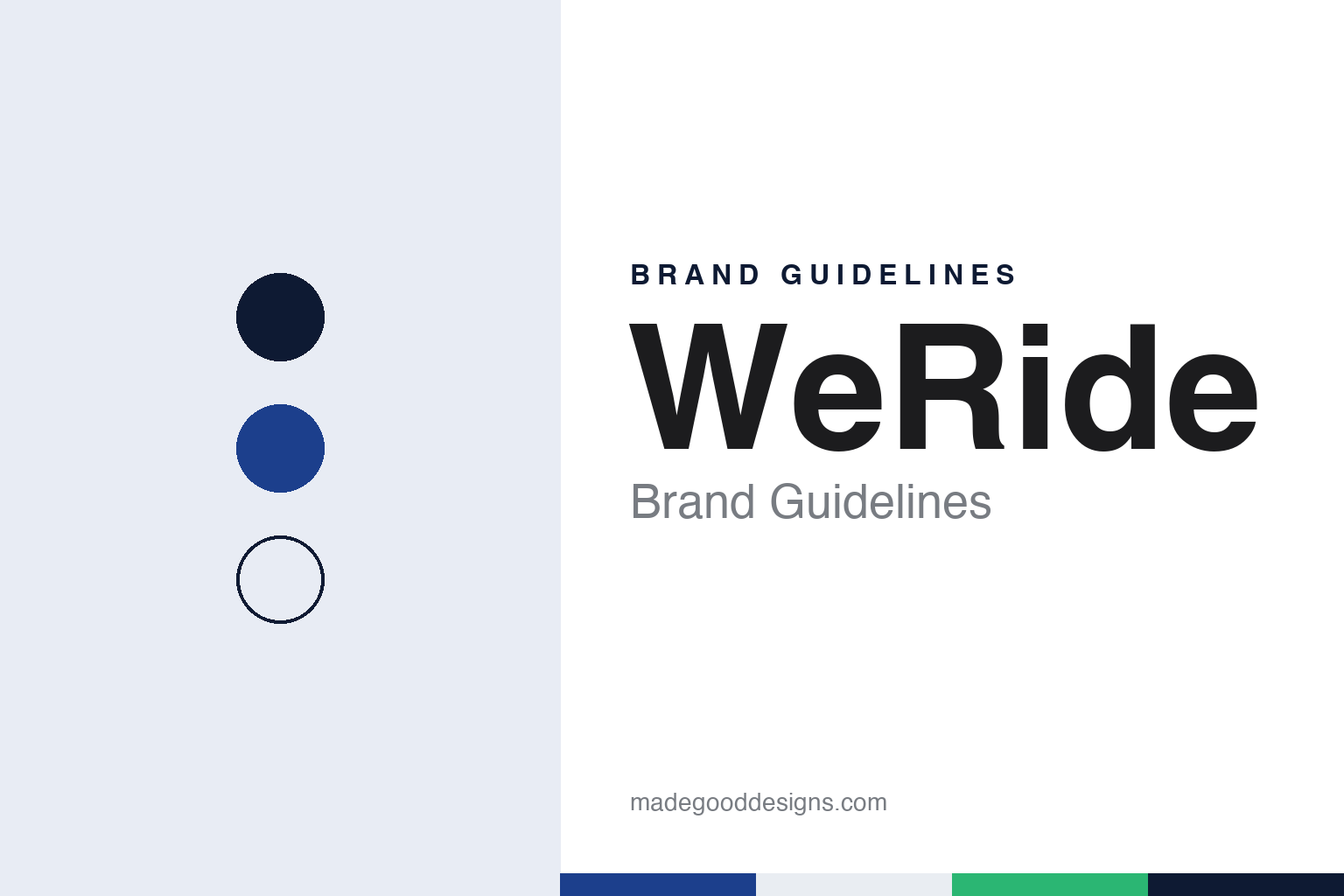
Two constants: a blue, grey and green palette and a geometric sans register. Abstract homage — not a WeRide product or mark; no vehicle, logo or interface is reproduced.
A 2017 start
A former Baidu scientist and a Silicon Valley start.
WeRide was founded in 2017. English and Chinese Wikipedia both say it was established in Silicon Valley by Tony Han (Han Xu), formerly chief scientist of Baidu’s autonomous-driving unit. The company’s website adds that he had been a tenured professor of electrical and computer engineering at the University of Missouri, with a doctorate from the University of Illinois Urbana-Champaign, and it names Yan Li, who worked at Facebook and Microsoft and holds a doctorate from Carnegie Mellon University, as co-founder and chief technology officer. Its Chinese name is 文远知行, Wenyuan Zhixing.
The company grew up largely in China. Caixin Global described it in October 2024 as Guangzhou-based, and English Wikipedia lists offices in San Jose, Abu Dhabi, Singapore, Guangzhou, Beijing, Shanghai and Shenzhen. The company’s website describes it as a commercial-stage developer of autonomous driving “from Level 2 to Level 4,” and gives its mission as “To Transform Urban Living with Autonomous Driving.”
Carmakers and suppliers were among its early backers. English Wikipedia says the Renault-Nissan-Mitsubishi Alliance led its Series A round in October 2018, that the bus maker Yutong led a later round in January 2021, and that GAC Group made a strategic investment in December 2021. Bosch joined a funding round in January 2022 and, in May 2022, agreed with WeRide to develop driver-assistance software together, according to the same article. WeRide’s website now names the Renault-Nissan-Mitsubishi Alliance, Uber, Grab, GAC Group and Bosch among the carmakers and suppliers it works with.
Colour
Robotaxis, robobuses, robovans and a robot sweeper.
WeRide sorts its work into three fields — mobility, logistics and sanitation — and builds each on a software platform it calls WeRide One. The range on its website includes the Robotaxi GXR, the Robobus, the Robovan W5 and the Robosweeper S1, alongside driver-assistance software sold under the WePilot name and a ride-hailing app, WeRide GO.
English Wikipedia traces how that range was built. WeRide unveiled a Mini Robobus in January 2021 and gained a driverless testing permit in California in April 2021; it introduced a self-driving cargo van, the Robovan, in September 2021, and showed a new sensor suite at the CES trade show in Las Vegas in January 2023. The Robosweeper S1, a self-driving street-cleaning vehicle, followed in April 2024, the Robovan W5 in February 2025 and, the same year, the GXR robotaxi in Beijing.
Much of the growth has been outside China. Wikipedia records a robotaxi trial with Bayanat on Abu Dhabi’s Yas Island in December 2021, operations in Singapore from September 2022, the UAE’s first national licence for self-driving vehicles in 2023, a partnership with Renault Group announced in May 2024, and an agreement with Uber, also announced in 2024, to offer WeRide vehicles through the Uber app, starting in Abu Dhabi. In February 2025, it says, WeRide announced a driverless Robobus shuttle service in the Drôme department of France with beti, Renault Group and the insurer Macif.
Singapore became a second hub for testing outside China. Wikipedia says WeRide agreed to work with Strides, a subsidiary of the public-transport operator SMRT, after starting operations there; received testing licences for public roads and paths from the Land Transport Authority in December 2023; and in June 2024 partnered with the sanitation company Chye Thiam Maintenance to bring the Robosweeper to Singapore. In Switzerland, it says, WeRide joined a project funded by the Canton of Zurich and the national railway SBB in January 2025.
The company now says its products hold autonomous-driving permits in eight markets — China, the UAE, Singapore, France, Switzerland, Saudi Arabia, Belgium and the US — and that its vehicles operate in more than 60 cities across 13 countries. Its website also lists inclusion in Fortune’s 2025 Change the World and Future 50 lists among its recognitions.
Typography
Design and documentation.
Self-driving and lidar companies sell something that is hard to photograph: software that makes decisions. Their public images therefore lean on a small set of recurring pictures. The most familiar is the robotaxi itself — often a white car or van with a sensor housing on the roof and smaller sensors at the corners — shown on a city street, at a kerb or at an airport drop-off.
A second picture is the view from inside the machine. Companies publish point-cloud renderings, in which a street is drawn as thousands of coloured dots, often bright greens, blues and magentas on black, with boxes marking cars, cyclists and pedestrians. Lidar makers add cutaway drawings of their sensors, showing the spinning or solid-state units that send out the laser pulses behind those images, and rows of compact sensor modules photographed like consumer electronics.
The other pictures depend on the business. Ride-hailing services show phone screens: a map, a pick-up pin, an estimated arrival time and a button to start the ride. Self-driving truck developers show tractor-trailers on long, empty highways, frequently in the desert light of the American Southwest. Driver-assist chip makers show circuit boards, dashboards and diagrams of cars wrapped in cones of sensor coverage.
Trade shows are another stage for these images: the CES technology show in Las Vegas and the IAA Mobility show in Munich are among the places where new sensors, concept vehicles and partnerships are put on display. This guide sets out what can be checked about each company — who founded it, who owns it, where it operates and what regulators have recorded — and marks clearly what rests only on the company’s own word.
Aa
A clean geometric sans for a company that names its vehicles by type. (Specimen set in Sora, a sans STAND-IN; NOT the WeRide logo.)
WeRide
Two listings in thirteen months.
WeRide went public on Nasdaq on 25 October 2024, under the ticker WRD, Caixin Global reported, and its shares rose on their first day of trading. Just over a year later, on 6 November 2025, it began trading on the Hong Kong Stock Exchange under the stock code 0800, on the same day as Pony.ai; CarNewsChina reported that both companies’ shares fell by more than 10% shortly after opening. WeRide said in its announcement that day that the two listings made it the first robotaxi company to be publicly traded in both Hong Kong and the US, and that its founder had voluntarily agreed not to sell any of his shares for three years.
Its website runs in English and Chinese, gives both stock codes in its company description and lists the products by vehicle type. Its investor site reports results each quarter, with the next due on 20 November 2026.
For a design guide, WeRide shows how a company can name a whole fleet of different vehicles with one consistent pattern and carry it across many countries. Compare Pony.ai, which listed in Hong Kong on the same day, and Baidu, where Tony Han led autonomous-driving research before founding WeRide. For this guide we use a deep route blue, a pale kerb grey and a signal green with a sans, an unofficial interpretation; no product or logo is reproduced.
Explore & save
Keep WeRide’s identity on hand — save it to a board in the Made Good inspiration library.
WeRide identity set
Pin the WeRide blue, grey and green palette and the geometric sans register to your own board.