Celltrion Brand Guidelines
The Incheon biosimilar maker behind Remsima, in six shades of green.
Aa
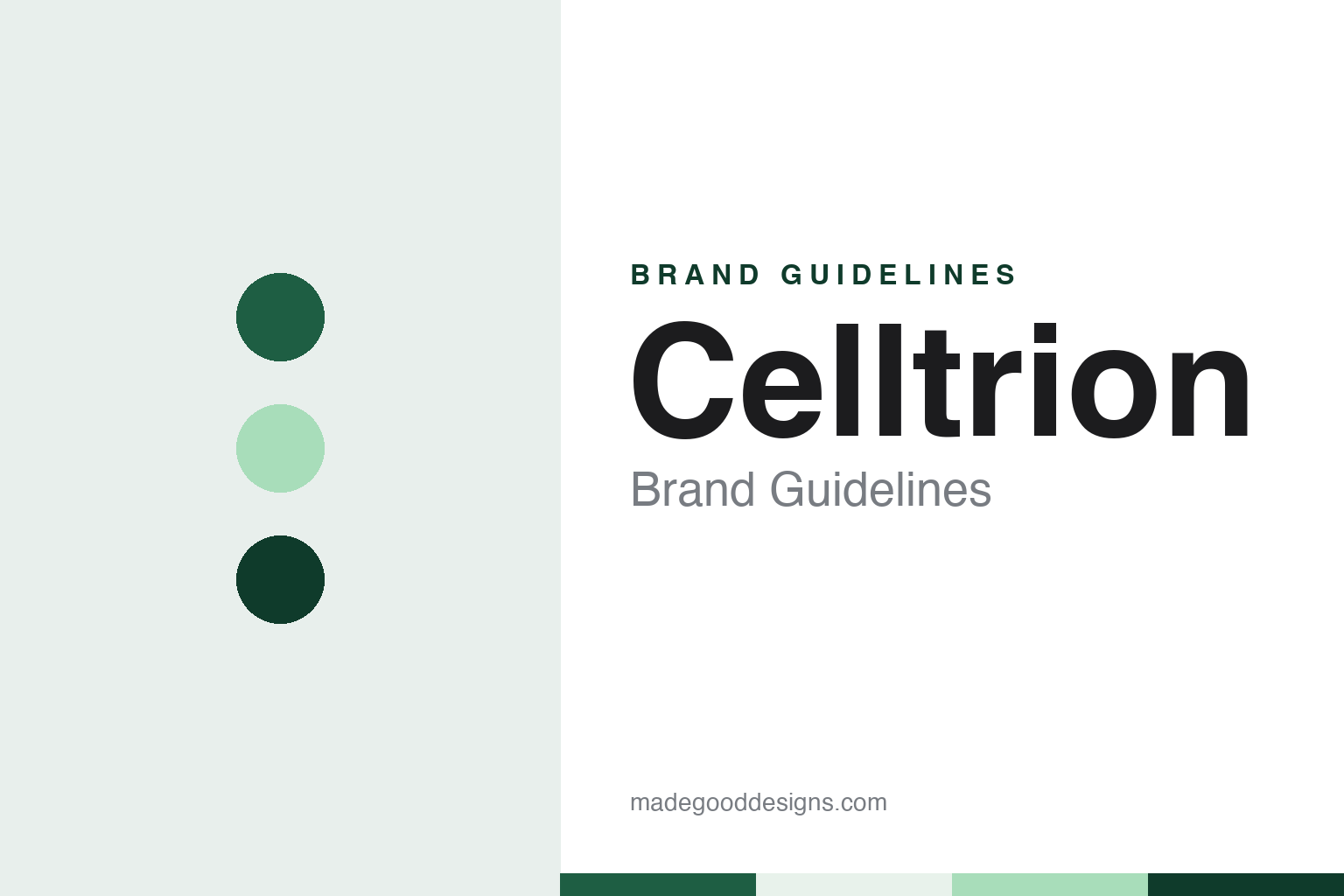
Two constants: a Celltrion green and mint palette and a Clean sans register. Abstract homage — not a Celltrion product or mark; no medicine, logo or pack is reproduced.
A 2002 start
A contract manufacturer in Incheon.
Celltrion is a biopharmaceutical company based in Incheon, South Korea. Its own history dates its founding to February 2002, and English Wikipedia names Seo Jung-jin as its founder; the Korea JoongAng Daily described him in December 2023 as Celltrion’s founder and chairman. Korean Wikipedia says the company began in 2002 in contract manufacturing, making medicines for other companies, and from 2009 pushed the development, clinical trials and approval of a number of its own biosimilars.
Its early milestones, as the company lists them, were a supply agreement with Bristol-Myers Squibb in June 2005; the completion of its first plant, with 50,000 litres of capacity, in July 2005; and a cGMP facility approval for that plant from the United States Food and Drug Administration in December 2007. A second plant, of 90,000 litres, was completed in October 2011.
Its route to the stock market was unusual. The company’s history records an initial public offering in August 2008; Korean Wikipedia says the listing came through a merger with Oalchem, a listed chemicals company first set up in 1991, which then took the Celltrion name. In February 2018, Korean Wikipedia says, the shares moved to the main KOSPI market.
Celltrion also had a sister company from early on. English Wikipedia says Nexol, founded in 1999 as a business consulting firm, signed a global distribution agreement with Celltrion in 2008 and was renamed Celltrion Healthcare in 2009. It went on to sign distribution partners region by region, among them Hospira in Europe in 2009 and Nippon Kayaku in Japan in 2010, according to the same article.
Colour
Remsima and what followed.
The product that made the company’s name is Remsima, a biosimilar of infliximab, an antibody medicine. Korea’s Ministry of Food and Drug Safety approved it in July 2012, the company says, and the European Medicines Agency’s record gives 10 September 2013 as the date its European marketing authorisation was issued, held today by a Celltrion Healthcare company in Hungary. English Wikipedia calls it the world’s first biosimilar monoclonal antibody approved by the EMA, and Celltrion itself calls Remsima “the world’s first mAb biosimilar.” The company records an FDA approval in April 2016; English Wikipedia describes the American approval as one for Inflectra, the product of Celltrion, Hospira and Pfizer.
More biosimilars followed, with dates as the company lists them. Truxima, which English Wikipedia describes as a biosimilar of rituximab, was approved in Europe in February 2017 and in the United States in November 2018. Herzuma, based on trastuzumab, was approved in Europe in February 2018 and in the US in December 2018. Yuflyma was approved in Europe in February 2021 and in the US in May 2023, and Vegzelma in Europe and the US in 2022.
Celltrion has also reworked its first product. A version of Remsima given as an injection under the skin was approved in Europe in November 2019, the company says, and in October 2023 the FDA approved it as a novel medicine, sold in the US as Zymfentra.
Its manufacturing story is told mainly at home. The company says it has an annual production capacity of 250,000 litres and calls itself the largest manufacturer and exporter of biosimilars in Korea. In January 2026 it began operating a plant in Branchburg, New Jersey, which it bought from Eli Lilly in 2025, according to English Wikipedia; the company gives its capacity as 66,000 litres. It completed a Global R&D Center in 2023, its history says, and describes its mission as “a healthier tomorrow where no patients are left untreated.”
Typography
Design and documentation.
Biosimilar makers sell medicines that most people only ever meet as a pack in a pharmacy or a hospital ward, so their public image is built from the places where those medicines are made. Their websites and reports favour gleaming steel bioreactors, vials moving along blue-lit filling lines, scientists in gowns and hoods, and close-ups of prefilled syringes and autoinjector pens. The pictures signal scale and control rather than any single product.
The category is young. The European Medicines Agency’s record shows that the marketing authorisation for Celltrion’s Remsima, a biosimilar of the antibody infliximab, was issued on 10 September 2013, and English Wikipedia describes it as the first biosimilar monoclonal antibody approved by the EMA. Since then a group of companies in Asia, Europe and North America has built ranges of biosimilars, each sold under a brand name of its own, alongside the corporate names covered in this guide.
Their messaging leans on access. Celltrion states a mission of “a healthier tomorrow where no patients are left untreated”; Samsung Bioepis says it makes “quality-assured biologic medicines more accessible, more quickly.” Celltrion’s brand page ties its green to trust. Trade meetings such as the GRx+Biosims conference and the BIO International Convention are where the sector’s companies present their pipelines and meet partners.
This guide sets out what can be checked about each maker — who founded it, who owns it, and which approvals and deals dated sources record — and marks clearly what rests only on the company’s own word.
Aa
A clean sans — a mark built from dividing cells. (Specimen set in Manrope, a sans STAND-IN; NOT the Celltrion logo.)
Celltrion
Six shades of green.
For most of its life Celltrion worked as a pair: Celltrion made the medicines and Celltrion Healthcare sold them abroad, while a third listed company, Celltrion Pharm, handled sales in Korea, Korean Wikipedia says. About three years before the merger, the group’s chairman had set out a plan to bring the three listed companies together, the Korea Times reported. Shareholders approved the first step in October 2023, and on 28 December 2023 Celltrion said it had completed its merger with Celltrion Healthcare, which was absorbed into it, according to the Korea Times and Yonhap. The Korea JoongAng Daily reported that Celltrion was the surviving company and that a further merger with Celltrion Pharm was then planned; on 16 August 2024 Celltrion said its board had decided not to go ahead with it, and Celltrion Pharm still appears as a separate family site on Celltrion’s website.
The company has kept buying abroad since. English Wikipedia records the purchase of iQone Healthcare Switzerland in November 2024 and of the French company Gifrer in May 2026.
Its identity is unusually well documented. Celltrion’s brand page says its logomark was “inspired by differentiating cells,” with circles that stand for the company’s diversity and dynamism, and that its green symbolises trust in what the company offers. The page sets out a scale of six “Celltrion Green” tones, running from a pale mint to a deep forest green, backed by supplementary colours that include a bright blue, a deep blue, a neon green and an orange.
For a design guide, Celltrion shows how a single colour family can carry a science company from one medicine to a whole range. Compare Samsung Bioepis, another Incheon biosimilar maker, and Pfizer, named with Hospira on the American approval of Inflectra. For this guide we use a deep green, a forest ink and a pale mint with a sans, an unofficial interpretation; no product or logo is reproduced.
Explore & save
Keep Celltrion’s identity on hand — save it to a board in the Made Good inspiration library.
Celltrion identity set
Pin the Celltrion green and mint palette and the Clean sans register to your own board.