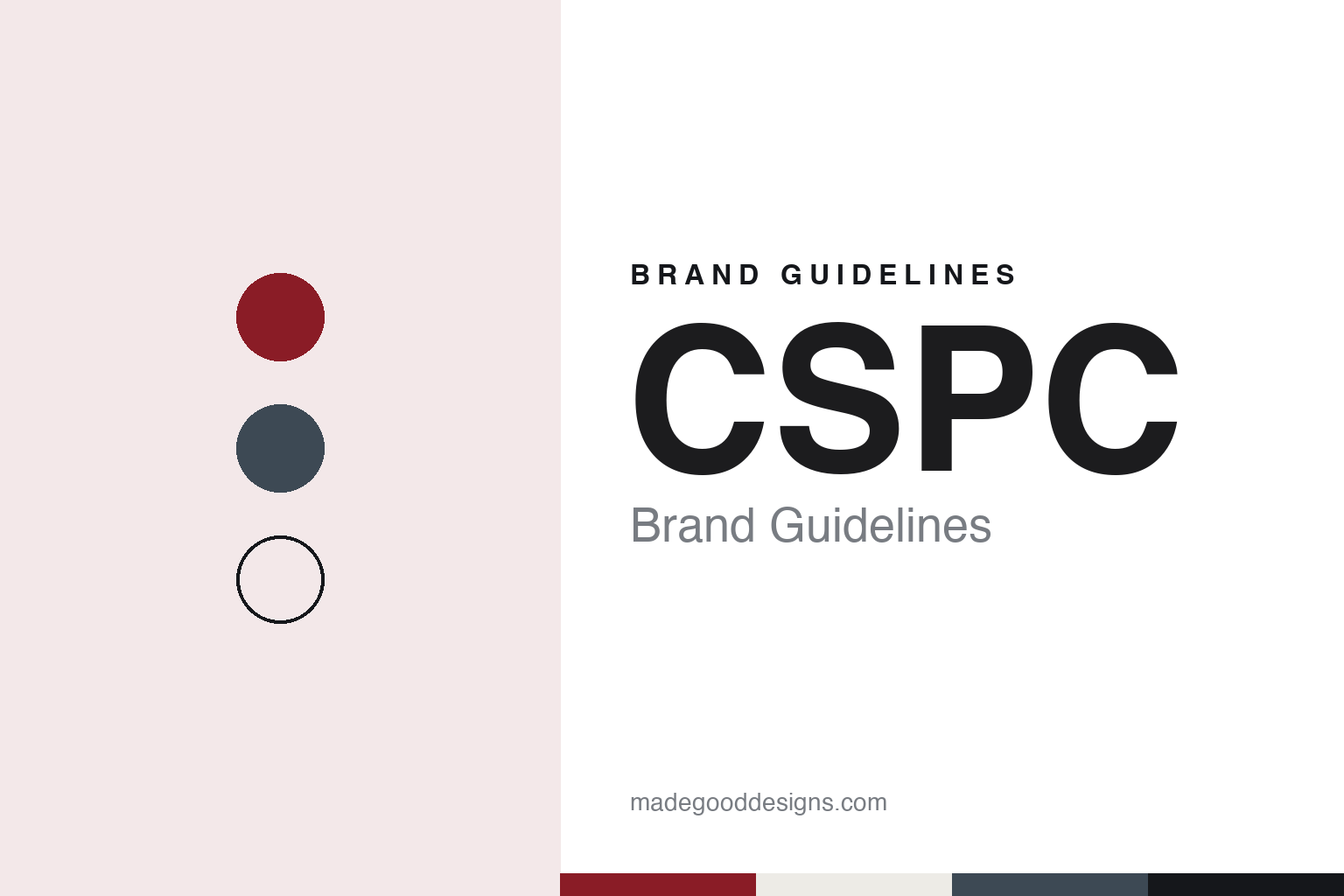
CSPC Brand Guidelines
The Shijiazhuang drug group that grew from vitamin C and antibiotics into new medicines.
Aa
Two constants: a crimson, slate and white palette and a plain technical sans register. Abstract homage — not a CSPC product or mark; no pack, logo or nameplate is reproduced.
From Hebei works to a Hong Kong listing
A listed company in 1994, a merged group in 1997.
CSPC is the shortened name of CSPC Pharmaceutical Group Limited, a drug maker whose factories sit in Shijiazhuang, the capital of Hebei province in northern China. Its Chinese name is 石药集团. The company describes its manufacturing as mainly located in Shijiazhuang, while its listed holding company keeps its registered office in Hong Kong.
The listed company came first. The company’s own corporate information page gives its listing date on the Main Board of the Hong Kong Stock Exchange as 21 June 1994, under the stock code 1093, and Chinese Wikipedia agrees. Chinese Wikipedia says the company first listed as China Pharmaceutical Enterprise and Investment, was later known as China Pharmaceutical Group, and took the CSPC name afterwards. It traces the business to the Hebei Pharmaceutical Group, set up in Shijiazhuang in 1984, whose bulk-drug lines — vitamin C, penicillin G and 7-ACA, a starting material for cephalosporin antibiotics — were the part that went to the Hong Kong market in 1994.
The group itself was formed on 21 August 1997, Chinese Wikipedia says, when the Hebei Pharmaceutical Group was combined with three other Shijiazhuang drug makers, the city’s No. 1, No. 2 and No. 4 pharmaceutical groups, under the new name. The Chinese business site Jiemian gave the same outline in December 2025: a Hong Kong listing in 1994 and a parent, CSPC Holdings, formed in 1997.
Ownership changed in the 2010s. Chinese Wikipedia records that in 2012 the listed company bought its parent’s finished-drug manufacturing and sales business, and that in October 2013 Hony Capital, the private-equity arm of Legend Holdings, sold a block of shares. It names Cai Dongchen, the chairman, as the largest individual shareholder. The company says it became a constituent of the Hang Seng Index in 2018, which it describes as the first from the pharmaceutical sector.
Colour
Bulk drugs, finished drugs and a caffeine business.
CSPC works in two segments, the company says: finished drugs and bulk drugs, the active ingredients other manufacturers buy. On the bulk side it names vitamin C, antibiotics and caffeine. English Wikipedia lists its active ingredients as including penicillin, cephalosporins, synthetic vitamins and caffeine.
On the finished side the company names nervous-system disease, oncology, anti-infectives and cardiovascular disease as its main therapeutic areas, and lists products including NBP, a butylphthalide drug, Domeisu, Jinyouli and Keaili as its most widely used innovative medicines in China. It says its research bases are in Shijiazhuang, Shanghai, Beijing and the United States, working on small-molecule targeted drugs, nano-formulations, monoclonal and bispecific antibodies, antibody-drug conjugates and biologics.
One of its newer products came out of the pandemic years. Chinese Wikipedia says that in April 2022 the company announced that its mRNA vaccine candidate, SYS6006, had been cleared by China’s National Medical Products Administration to begin clinical studies, and that it was approved for emergency use in mainland China in March 2023 under the trade name Duentai. Jiemian also reported the 2023 emergency-use listing.
Some of the group’s businesses have their own listings. Jiemian reported in December 2025 that CSPC holds a controlling stake in CSPC Innovation, which is listed on the mainland A-share market and filed an application to list in Hong Kong as well on 10 December 2025; that application had not been completed when Jiemian wrote. The same report said the subsidiary’s listing documents describe it as the world’s largest caffeine producer, with North America and Europe as its main markets.
The company also says the “CSPC” brand has been ranked in World Brand Lab’s list of China’s 500 most valuable brands every year since 2004.
Typography
How the category presents itself.
Korean and Chinese drug makers tend to introduce themselves through places as much as products. Their annual reports and websites lead with research campuses: new buildings in Shanghai and Suzhou, and the technology district of Pangyo, south of Seoul. Chia Tai Tianqing, for example, says it moved its global research headquarters to Shanghai in 2023, and Hengrui says it opened research offices in Princeton and Basel in 2020.
The pictures inside those reports follow a familiar pattern. White-coated scientists work at screens and fume hoods; long packaging lines carry tablets and vials; and the older companies keep a place for their beginnings, with founders and first factories shown in archive photographs. Several of the businesses in this group began as municipal or state factories decades before they became listed research companies.
Trade fairs are the other stage. The companies take booths at the BIO International Convention in the United States and at the large pharmaceutical fairs in China, where licensing talks with international partners are now a regular part of the business. Hengrui’s July 2025 licensing agreement with GSK is one recent example. In this guide, such deals are named without sums, and any deal not confirmed as completed is described as pending.
The visual identities themselves are mostly corporate and restrained: usually a wordmark in red, blue or green, with photography doing most of the work. Few of these companies publish brand guidelines or official colour values, so the palettes in this guide are our own unofficial interpretations, chosen to sit alongside the companies’ public materials without copying them.
Aa
A plain technical sans for a company of factories and laboratories. (Specimen set in IBM Plex Sans, a sans STAND-IN; NOT the CSPC logo.)
CSPC
Research deals and a new generation of management.
CSPC has also worked with international drug companies. On 13 June 2025 AstraZeneca announced a strategic research collaboration with CSPC, reported that day by Alliance News and by the Swedish magazine Nordic Life Science. The work is to be carried out by CSPC in Shijiazhuang using what the companies call an AI-driven, dual-engine drug-discovery platform, aimed at oral candidates including a preclinical small-molecule treatment for immunological diseases; AstraZeneca gains options on exclusive worldwide licences for the candidates. Nordic Life Science noted that the deal strengthened an existing collaboration between the two companies, and the trade publication DCAT Value Chain Insights listed it in its partnering round-up of 19 June 2025.
The company has also explained its recent direction. Jiemian reported in December 2025 that CSPC attributed weaker results to China’s national volume-based procurement of medicines, and that it was putting more weight on innovative drugs and outside licensing. On 19 December 2025, the same report said, Zhang Cuilong stepped down as chief executive while staying on the board, and Cai Lei, who had been a vice-president of the group’s US research unit, was appointed vice-chairman and chief executive. Three days later a CSPC subsidiary agreed to set up a joint venture with a related company to take over the group’s GLP-1 programmes for diabetes and weight management.
For a design guide, CSPC shows how an industrial bulk-drug business, built on vitamin C and antibiotics in one northern city, presents itself as a research company with a Hong Kong share listing. Compare Sino Biopharmaceutical, another Hong Kong-listed Chinese drug group, and Fosun Pharma. For this guide we use a deep crimson, slate and warm white with a sans, an unofficial interpretation; no product or logo is reproduced.
Explore & save
Keep CSPC’s identity on hand — save it to a board in the Made Good inspiration library.
CSPC identity set
Pin the CSPC crimson, slate and white palette and the plain technical sans register to your own board.