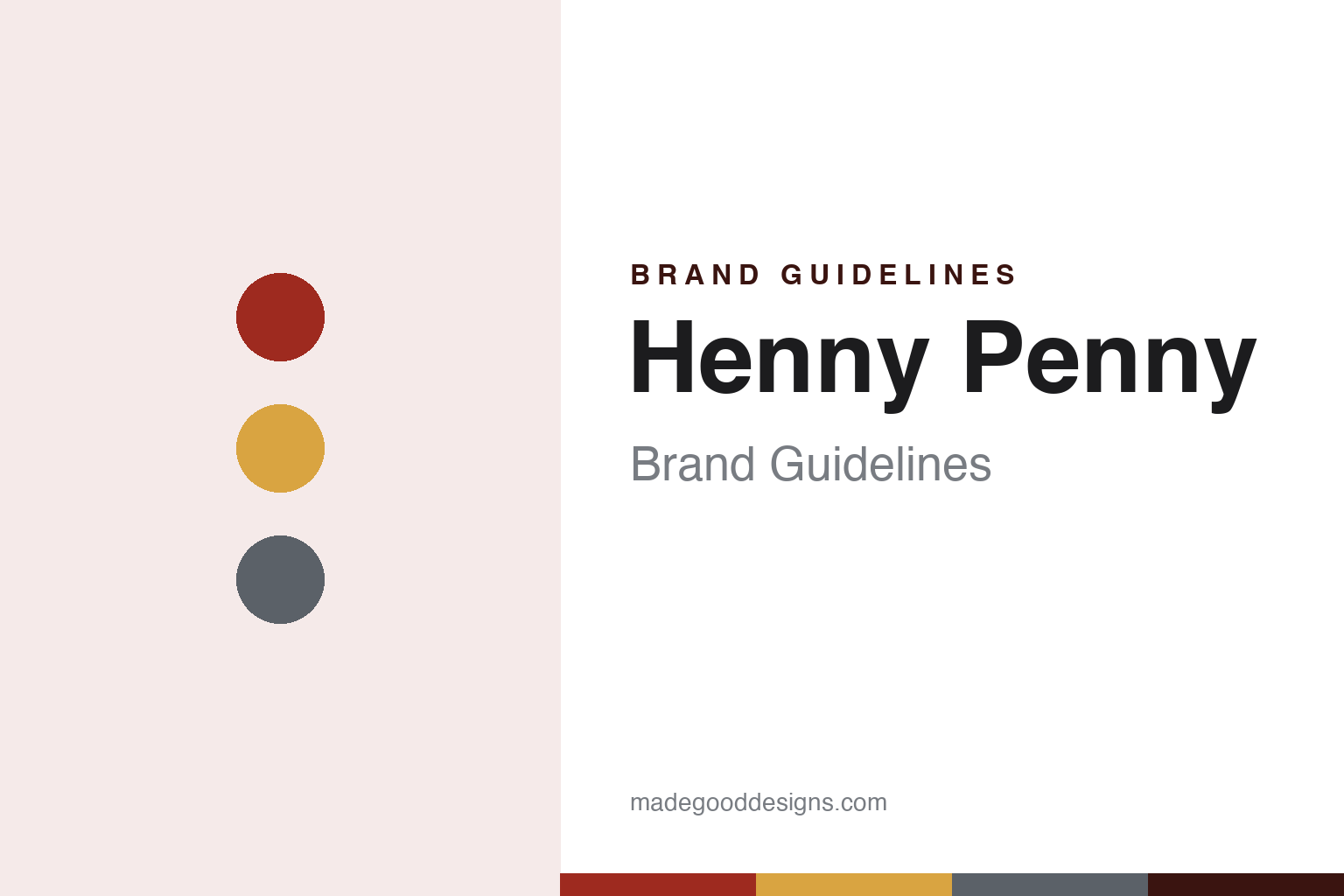
Henny Penny Brand Guidelines
The Eaton, Ohio pressure-fryer maker owned by its employees.
Aa
Two constants: a red, gold and steel palette and a workshop grotesque register. Abstract homage — not a Henny Penny product or mark; no fryer, logo or nameplate is reproduced.
Whispering Oak
A restaurant owner who built his own fryer.
Henny Penny began in a restaurant kitchen. The company says that in 1954 Chester Wagner, who ran the Whispering Oak restaurant in Eaton, Ohio, wanted to serve more chicken, faster, so he designed and built a fryer of his own and began cooking with it there. In 1957, by its account, he launched Henny Penny to sell the machine to other commercial kitchens. Foodservice Equipment Reports also gives 1957 as the year the company was established.
The product that defined the business came a few years later. The company dates its pressure fryers, which it calls its flagship line, to 1963, and says they changed the way high-volume cooking was done. After a decade of growth, it says, Henny Penny expanded its production buildings in Eaton in 1973.
Ownership changed in 1975. According to the company’s history, Jack Cobb, who had joined in 1959 as its fourth employee, bought Henny Penny from Wagner together with a partner and became its main owner. The company credits him with shaping the culture it still talks about today. The Cobb family ran the business for the next four decades: his son Steve Cobb became president and chief executive in 1997, after working across the company’s departments, and later served as chairman.
Under the Cobbs the range widened step by step. The company lists holding cabinets in 1980, rotisserie ovens and bun warmers in 1990, an open fryer line in 1992, heated merchandisers in 1993 and combi steamer ovens in 1995. It opened its first office outside the United States, in Paris, in 1986, and built a campus in Eaton in 1998.
Colour
Fryers for high-volume kitchens.
Fryers come first on Henny Penny’s website, which opens its product menu with open fryers and pressure fryers, followed by combi ovens and holding equipment. Its newer lines carry series names. In 2014, the company says, it introduced the Velocity Series pressure fryers, with automatic oil top-off and filtration, and the FlexFusion combi ovens; in 2023 it added the F5 Series fryers, with touchscreen controls.
Its customers are mostly restaurant chains, and its own history reads in part as a list of supplier awards from them. The company says McDonald’s gave it an Innovation Award in 2008 and named it Global Equipment Supplier of the Year in 2009 and 2010, that KFC named it U.S. Equipment Supplier of the Year in 2010, and that it has received supplier awards from Wendy’s, Arby’s, Del Taco and Brinker International. It lists Kitchen Innovations awards from the National Restaurant Association, including one in 2019 for a compact combi oven, and says its F5 open fryer was chosen for the NAFEM “What’s Hot! What’s Cool!” product gallery in 2025.
Henny Penny sells through distributors rather than directly. The company says each of its roughly 90 distributors around the world acts as a single point of contact for a customer, from menu development to service after the sale, and that its equipment is used in more than 100 countries. It describes the arrangement as one of the things that sets it apart.
Manufacturing has also spread beyond Ohio. The company says it opened a manufacturing plant in Suzhou, China, in 2005, to serve demand in Asia, and that in 2025 it marked twenty years there. It gives its workforce as more than 1,000 people across Eaton and Dayton in Ohio, Paris and Suzhou.
Typography
Fry stations and cooking suites.
Commercial fryer and range makers sell to people who rarely see their products in a showroom. Their buyers are chain operators, dealers and kitchen consultants, and the brands present themselves in the language of the cooking line: the fry station of a quick-service restaurant, a bank of vats with baskets hung above them, and the oil filtration tucked into the cabinet below.
Range and modular-suite makers work at a different scale. Their pictures show hotel and restaurant kitchens laid out as one continuous run of cooking blocks, with burners, solid tops, griddles and fryers set into a single stainless line, and close-ups of the working parts: a flame ring under a pan, the plate of a griddle, a row of control knobs. Much of the trade’s visual record is technical rather than glamorous: specification sheets, catalogue line drawings, cut-away diagrams of heating tubes, and drawing files that kitchen designers drop into their plans.
The industry also meets at its own fairs. HostMilano in Italy and, in the United States, the NAFEM Show and the National Restaurant Association Show are among the events that trade titles such as Foodservice Equipment Reports cover each year in their show reports. Many of the brands in this guide now belong to a few large groups, among them Middleby and Ali Group, which completed its purchase of Welbilt in 2022.
This guide sets out what can be checked about each brand — who founded it, who owns it, and what it says about where its products are made — and marks clearly what rests only on the company’s own word.
Aa
A sturdy workshop grotesque for a fryer maker’s catalogue. (Specimen set in Archivo, a sans STAND-IN; NOT the Henny Penny logo.)
Employee-owned
From a family company to a trust.
The largest change in Henny Penny’s recent history was its ownership. Foodservice Equipment Reports reported on 13 January 2015 that the company’s more than 600 employees had become its owners through the sale of its stock to a newly formed employee stock ownership plan (ESOP), as of 30 December. The trade magazine said the move kept Henny Penny, and the Wood Stone oven business it had bought in January 2014, privately held; both had previously been owned by the Cobb family. Steve Cobb stayed on as chairman, and Rob Connelly, named president and chief executive the previous October, stayed in his post. The company’s own timeline dates the change to 2015 and in 2025 marked ten years as an ESOP company.
The company now builds much of its message around that structure. Its website calls its staff “employee-owners” and says each has a personal stake in customers’ satisfaction. Leadership has passed on since the family years: the company says Connelly was succeeded as chief executive in 2024 by Kevin Buchler, its fifth CEO, and that Connelly became executive chairman.
Henny Penny has kept growing around its home town. The company says it finished its largest expansion in Eaton in 2020, adding about a third more space for production and development, opened a downtown office in Dayton in 2022, and in 2024 opened a global services centre in Eaton and a distribution centre in nearby Englewood. Its headquarters remains in Eaton, where the first fryer was built.
For a design guide, Henny Penny shows how a single machine built in a restaurant kitchen can become a company’s whole identity. Compare Frymaster and Pitco, two other American fryer makers. For this guide we use a fry-station red, a golden crumb and a kettle steel with a sans, an unofficial interpretation; no product or logo is reproduced.
Explore & save
Keep Henny Penny’s identity on hand — save it to a board in the Made Good inspiration library.
Henny Penny identity set
Pin the Henny Penny red, gold and steel palette and the workshop grotesque register to your own board.


