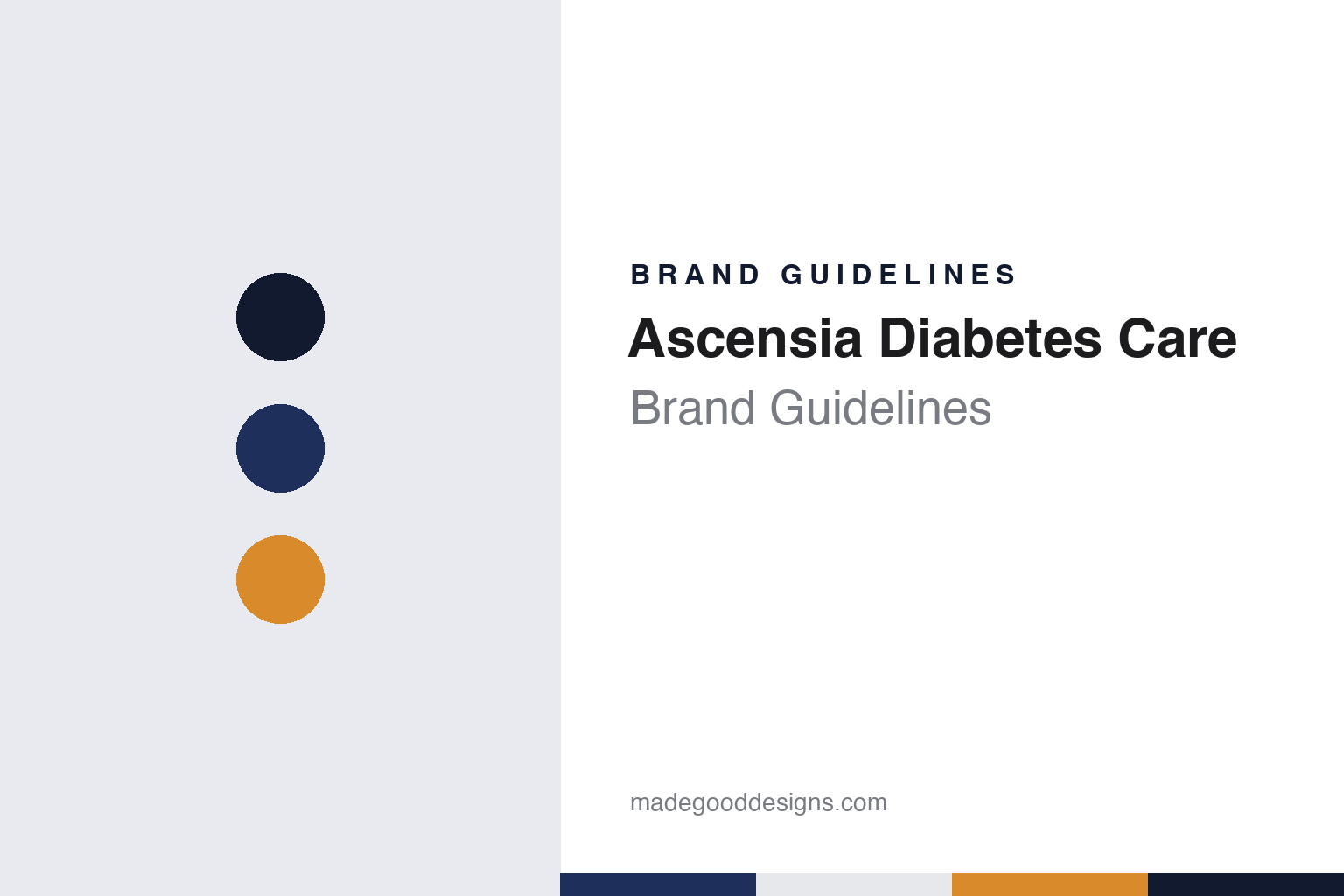
Ascensia Diabetes Care Brand Guidelines
Bayer’s meter business, reborn in Basel as a PHC Group company.
Aa
Two constants: a navy, amber and grey palette and an engineered sans register. Abstract homage — not an Ascensia or CONTOUR product or mark; no meter, logo or pack is reproduced.
From Bayer to Basel
A Bayer business unit, sold to a long-time supplier.
Ascensia Diabetes Care is a young company with an old business. It was created out of Bayer Diabetes Care, which its future owner described in 2015 as a business unit formed within Bayer and present in more than 125 countries. On 10 June 2015 Panasonic Healthcare Holdings of Tokyo announced an agreement to buy it from Bayer AG. Panasonic Healthcare Holdings had been set up in 2014 and was backed by funds sponsored by the investment firm KKR, which held 80 percent, with the Panasonic Corporation holding the remaining 20 percent.
The buyer was not a stranger. In the 2015 announcement Panasonic Healthcare said its subsidiary developed and manufactured blood-glucose meters and strips, that Bayer Diabetes Care had marketed and sold its products around the world for more than two decades, and that Bayer had been its exclusive sales and distribution partner for the Contour Next products and some Contour products. The deal was framed as joining Bayer’s global sales network with Panasonic Healthcare’s production.
The sale closed on 5 January 2016. The trade magazine CHEManager reported two days later that the business had been renamed Ascensia Diabetes Care Holdings, with its headquarters in Basel, Switzerland, and that the sale included the Contour range of blood-glucose monitoring systems and other products such as Breeze 2, Elite and Microlet lancing devices. The owners’ completion release named Michael Kloss, formerly global head of Bayer Diabetes Care, as Ascensia’s chief executive, and said the two companies would together develop, manufacture, market and sell meters and strips in more than 125 countries. Ascensia’s own history page now calls its parent PHC Holdings, “formerly known as Panasonic Healthcare Holdings.”
Colour
A heritage timeline, told by the company.
Ascensia presents itself as the continuation of a long line of products. At its launch in 2016 the completion release spoke of “over 70 years” of diabetes products, most recently as Bayer Diabetes Care; its website in 2026 says “more than 80 years.” The company’s history page gives the milestones as it sees them. It says it developed Clinitest in 1941, which it describes as the first convenient tablet test for reducing substances such as glucose in urine, and that through “the former Ames division” it introduced the Ames Reflectance Meter in 1969, which it calls the first portable blood-glucose meter.
The timeline continues with the Glucometer Elite of 1993, which the company says was the first meter to use “sip-in” sampling and the first low-volume system, using three microlitres of blood; a suite of meters with No Coding technology in 2003, including Breeze and CONTOUR; and the first meter in the CONTOUR NEXT line in 2012. These are the company’s own claims, and we give them as such.
Since becoming independent of Bayer, Ascensia has widened the CONTOUR name. The company says it launched a smarter version of its CONTOUR DIABETES app in 2018 and, in 2021, the GlucoContro.online data platform for clinicians and people with diabetes, which its website says is made and developed by a partner, SdNcenter. In 2026 it added CONTOUR COMFORT pen needles, described on its products page as designed to fit leading insulin pen injectors. The brand name itself is written in capitals on the company’s pages, and Ascensia says the Ascensia name, its logo and CONTOUR are trademarks of Ascensia Diabetes Care Holdings AG.
Typography
Design and documentation.
Diabetes device makers sell small things that people wear, carry or use many times a day: continuous glucose monitors worn on the upper arm or the belly, insulin pumps and tubeless patch pumps, blood-glucose meters with their test strips, and the pen needles and syringes used for injections. Their brand worlds are built around those objects, and increasingly around the data the objects produce.
A typical presentation pairs a close-up of a sensor or pump on skin with a phone screen showing a glucose graph and trend arrows. Apps and watch faces have become as central as the hardware: sensor makers describe readings sent wirelessly to phones, shared with family members and passed to insulin pumps, and that connection between devices is often the story the brand tells.
Photography in the category tends to be bright and active, with runners, swimmers, parents and children, while meter-and-strip brands lean on clean packshots of the meter, the strip pot and the lancing device. Regulation shapes the words as much as the pictures: product names come with indications, approval dates and age ranges, and marketing copy stays within what regulators such as the U.S. Food and Drug Administration have cleared.
The industry meets at medical congresses such as the American Diabetes Association’s Scientific Sessions, the annual meeting of the European Association for the Study of Diabetes (EASD) and the ATTD conference on advanced technologies and treatments for diabetes, where new devices and study results are presented to clinicians. This guide sets out what can be checked about each maker — who founded it, who owns it, where it says its products are made and what regulators have said — and marks clearly what rests only on the company’s own word.
Aa
An engineered sans for a meter-and-strip brand. (Specimen set in IBM Plex Sans, a sans STAND-IN; NOT the Ascensia or CONTOUR logo.)
Ascensia Diabetes Care
Years of selling an implant, then a handover.
For a period Ascensia also sold a very different device. From 2020 it held the exclusive worldwide distribution rights to Eversense, the implantable continuous glucose monitor made by Senseonics of Germantown, Maryland, according to Senseonics and Medical Device Developments. In February 2022 MedCity News quoted Senseonics’ chief executive as saying the new six-month Eversense E3 would be launched in the US together with “our partner Ascensia,” and Medical Device Developments reported in 2025 that Ascensia had launched the one-year Eversense 365.
On 3 September 2025 the two companies announced a memorandum of understanding to move all Eversense commercialisation back to Senseonics. In the joint release Koichiro Sato, chief operating officer and chief strategy officer of PHC Group and chief executive of Ascensia, said the companies had worked together on Eversense and that Ascensia remained invested in Senseonics; PHC said Eversense had diverged from Ascensia’s core business, Medical Device Developments reported. Senseonics later said it took over US commercial operations from the start of 2026 and closed the transfer of the European business in June 2026.
That leaves Ascensia focused on blood-glucose monitoring and related products. The company says it is headquartered in Basel, that its products are sold in more than 90 countries, and that its employees work under the PHC Group code of conduct. It says its CONTOUR portfolio now spans meters, digital diabetes-management tools and pen needles.
For a design guide, Ascensia Diabetes Care shows how a product name can carry a business through a change of owner: the company name is new, but CONTOUR, written in capitals in the 2016 launch release and on today’s website, carries on. Compare Senseonics, the implant maker it represented from 2020, and Roche, which Senseonics named as a distribution partner in 2016. For this guide we use a deep navy, a warm amber and a cool grey with a sans, an unofficial interpretation; no product or logo is reproduced.
Explore & save
Keep Ascensia Diabetes Care’s identity on hand — save it to a board in the Made Good inspiration library.
Ascensia Diabetes Care identity set
Pin the Ascensia navy, amber and grey palette and the engineered sans register to your own board.