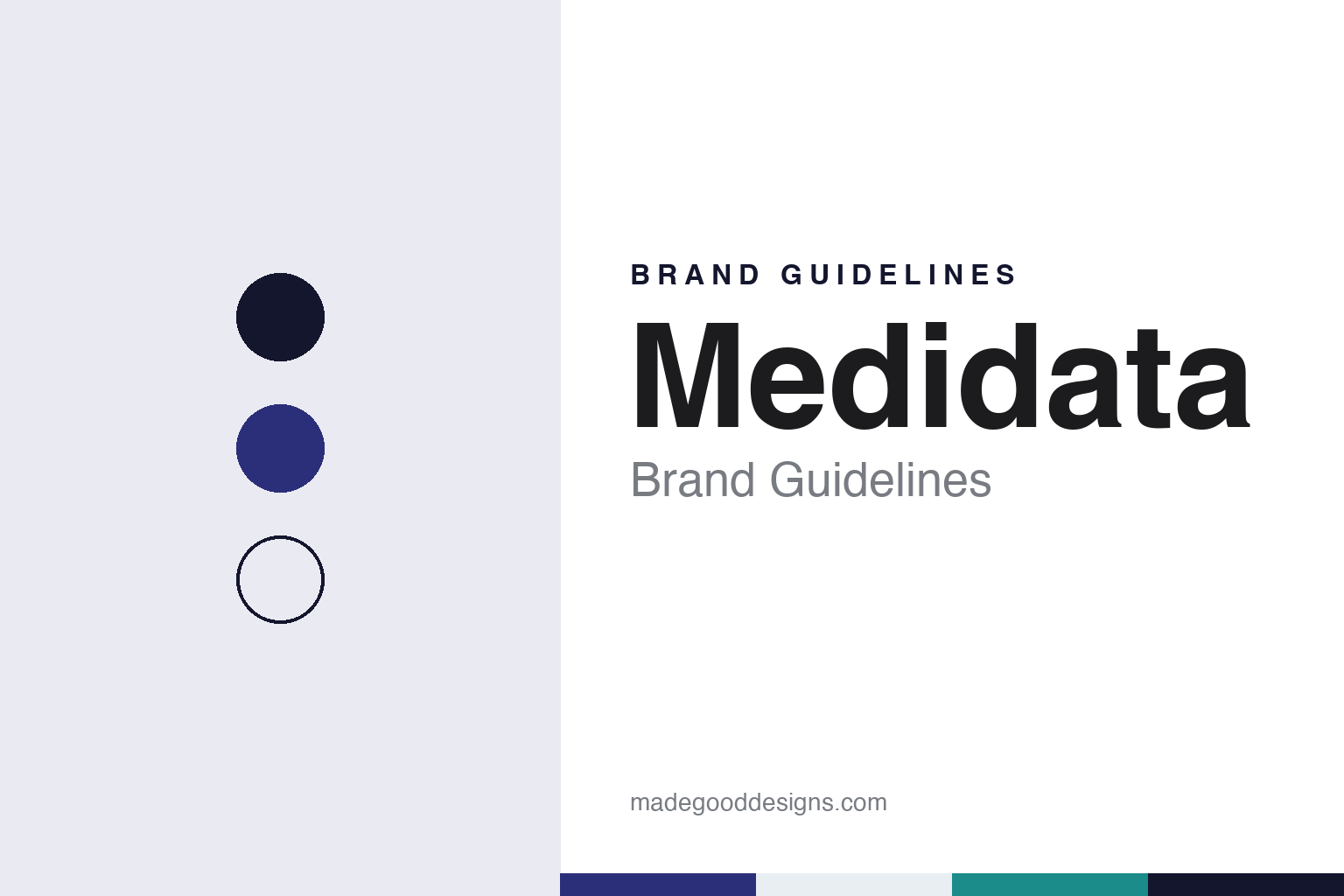
Medidata Brand Guidelines
Clinical-trial software from New York, a Dassault Systèmes brand.
Aa
Two constants: an indigo, teal and grey palette and a grotesque sans register. Abstract homage — not a Medidata product or mark; no screen, logo or interface is reproduced.
OceanTek to Medidata
Three founders and web software for trials.
Medidata traces its roots to OceanTek, a start-up that Glen de Vries and Ed Ikeguchi set up in 1994 to build web applications for conducting clinical trials, according to English Wikipedia. In 1999, with Tarek Sherif, they founded Medidata Solutions to provide online systems for designing and running clinical trials. The company is headquartered in New York City, and its own description in 2026 says it has supported clinical trials “for over 25 years.”
The company’s own timeline says that in June 1999 Sherif, then a fund manager, moved into a small office with de Vries, who wrote Medidata’s original software by hand, and that its first electronic data-capture software, later named Rave, launched that year. English Wikipedia dates Medidata Rave to 2001 and describes it as a system for electronic data capture and clinical data management that keeps a trial’s data in one place. In 2013 Medidata introduced the Rave Clinical Cloud, a platform for capturing and managing patient-related data in clinical operations, and in February 2018 it announced plans for virtual trials in which patients could take part remotely, English Wikipedia says.
Medidata took venture funding from investors including Insight Venture Partners in 2004 and listed on the Nasdaq stock market on 25 June 2009. Ikeguchi left in 2008, the same year Medidata bought Fast Track Systems, a maker of clinical-trial planning software, according to English Wikipedia. Medidata’s timeline records offices opening in London in 2004 and Tokyo in 2005, and English Wikipedia lists locations in China, Japan, Singapore, South Korea and the United Kingdom.
Colour
Rave, acquisitions and AI.
Through the 2010s Medidata widened its platform by buying smaller companies. English Wikipedia lists Clinical Force, a maker of clinical-trial management software, in 2011; Patient Profiles, for trial data quality, in 2014; Intelemage, a medical-image sharing technology, in 2016; Chita, a cloud content-management system, and Mytrus, a clinical-trial technology company, in 2017; and SHYFT Analytics, a cloud data-analytics firm, in 2018. In April 2019 it launched Acorn AI, built on its own data, and in 2020, after its change of ownership, it bought MC10, a digital-biomarker technology company.
Its customers include drug and device companies, contract research organisations, biotechnology firms and government institutions. English Wikipedia names customers as of 2017 including Johnson & Johnson, AstraZeneca, Amgen and Cancer Research UK, and records that Medidata was placed eleventh on Fortune’s Future 50 list that year.
Today Medidata groups its software as the Study, Patient and Data Experiences, the company says, and describes itself as having roughly 2,300 customers and about a million users; those are the company’s own figures. Rave remains at the centre of the data offer, with a lighter version, Rave Lite, which the company describes as data capture for Phase I, Phase IV and medtech studies. In April 2020 it launched myMedidata, a portal through which trial participants can learn about, enrol in and take part in studies, and in November 2023 Anthony Costello was named chief executive, according to the company’s timeline.
Medidata also runs its own customer conference, Medidata NEXT. The company says it began as a forum for Rave users, the Medidata User Group, became Medidata Symposium in 2015 and took the NEXT name in 2017; in 2026 it included an edition in Shanghai, according to its press releases.
Typography
Screens, summits and the science.
Life-sciences software is sold to scientists, clinicians, regulators and procurement teams at once, and the way these companies present themselves reflects that mixed audience. Their websites and brochures tend to show clean dashboards on laptops and tablets, molecule renderings and data charts, and people in lab coats or at clinic desks looking at screens. The product, in other words, is usually shown as an interface rather than an object.
The colour schemes follow the same logic. Many of these brands set one or two bright product colours against a lot of white space, so that charts, buttons and status labels stand out, and they use plain sans-serif type that stays legible in dense tables. Product families are often split into named “clouds,” “suites” or “platforms,” each with its own sub-brand, so a single company can carry dozens of product names under one mark.
Much of the selling happens in person. The sector gathers at trade conferences such as the DIA Global Annual Meeting, which brings together people working on drug development and regulation; Bio-IT World, which focuses on data and computing in life-sciences research; and SLAS, the laboratory-automation and screening society’s conference. Larger vendors also run their own customer summits, with keynote stages, product launches and user sessions; Medidata, for example, says its NEXT conference grew out of a user group for its Rave software.
Ownership matters too: several of the companies in this round have changed hands, and some have been bought by larger groups while keeping their own names. The guides in this round set out who founded each company, who owns it now and what it makes, and they mark clearly which statements rest only on the company’s own word.
Aa
A sturdy grotesque sans for a data-heavy register. (Specimen set in Libre Franklin, a sans STAND-IN; NOT the Medidata logo.)
Medidata
A Dassault Systèmes brand since 2019.
On 12 June 2019 Dassault Systèmes, the French 3D-design and simulation software group, agreed to buy Medidata, and on 29 October 2019 it announced that the acquisition was complete, in a release also published by Medidata; Medidata’s shares stopped trading on Nasdaq at the close on 28 October. Bernard Charlès, Dassault Systèmes’ vice chairman and chief executive, said then that Medidata would be “a core brand” in the group’s information-intelligence domain, adding: “We made virtual twins of cars and airplanes possible. We will do the same for the human body.” The release said Medidata would operate as a Dassault Systèmes brand powered by the 3DEXPERIENCE platform.
Medidata kept its name. Its press releases in 2026 describe it as “a Dassault Systèmes brand,” and in August 2026 it announced changes to its executive leadership, including a chief commercial officer working across Medidata and Dassault Systèmes’ life sciences organisation. Clinical Trials Arena, reporting in July 2022, referred to it as a Dassault Systèmes company.
Medidata has also been through a long court case with Veeva Systems. It sued Veeva and five former Medidata employees in federal court in New York in January 2017, alleging that confidential information had been used for Veeva’s benefit. In July 2022, partway through a jury trial, the judge granted Veeva’s request to end the case before it reached the jury, Reuters reported, and Clinical Trials Arena reported that the court had concluded Medidata failed to substantiate its allegations.
For a design guide, Medidata shows how a software brand can keep its own name and product lines inside a much larger group. Compare Dassault Systèmes, its owner since 2019, and Veeva, a rival in clinical-trial software. For this guide we use a deep indigo, a clear teal and cool grey with a sans, an unofficial interpretation; no product or logo is reproduced.
Explore & save
Keep Medidata’s identity on hand — save it to a board in the Made Good inspiration library.
Medidata identity set
Pin the Medidata indigo, teal and grey palette and the grotesque sans register to your own board.