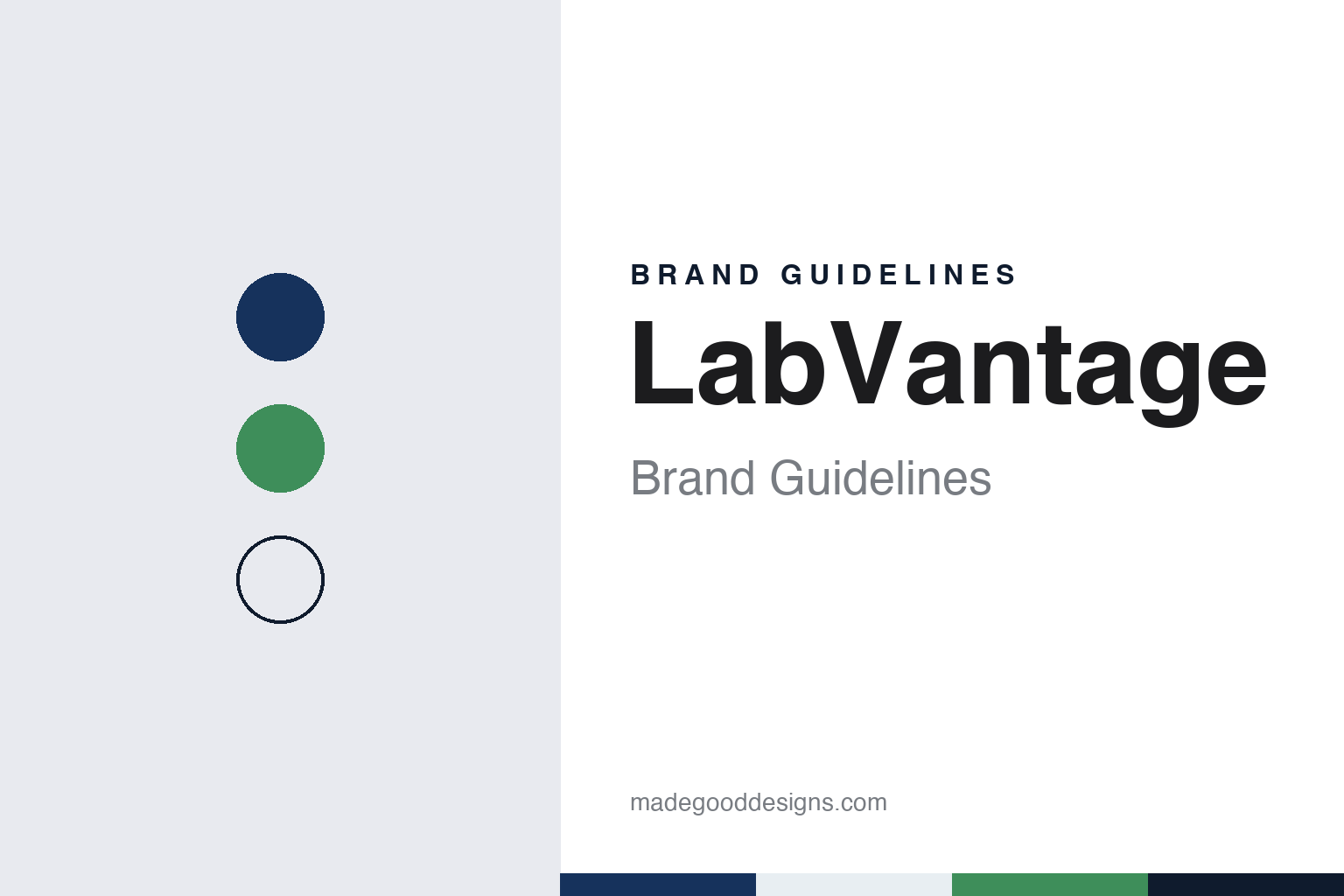
LabVantage Brand Guidelines
A 1981 Troy start-up that gave its software its own name.
Aa
Two constants: a navy, green and grey palette and a technical sans register. Abstract homage — not a LabVantage product or mark; no screen or logo is reproduced.
Laboratory MicroSystems
A graduate student’s company in Troy.
LabVantage began as Laboratory MicroSystems, founded in 1981 by Mark Chudzicki and Michael Boskin. English Wikipedia says Chudzicki started it while he was a graduate student at Rensselaer Polytechnic Institute in Troy, New York, and that the young company needed a loan from New York State’s Corporation for Innovation Development before it began to make money. It raised funds from about 100 local shareholders in 1985, and by 1986 it was based in a former downtown Troy hotel, the Hendrik Hudson, which had been converted into offices.
The company made laboratory information management software, or LIMS — systems that track samples, tests and results as they move through a laboratory. Wikipedia says it was named to the Inc. 500 list of fast-growing private companies in 1987, and that by 1988 its customers were mainly large corporations, among them General Electric, Dow Corning, DuPont and Exxon.
In 1990 the founders sold Laboratory MicroSystems to Instron, the materials-testing equipment maker. Seven years later, in April 1997, Instron sold it to Axiom Systems, a subsidiary of The Chatterjee Group, and the business was renamed LabVantage Solutions, according to Wikipedia and LIMSWiki, the laboratory-informatics reference wiki. LIMSWiki adds that later in 1997 LabVantage absorbed another company, Automated Compliance Systems, into its portfolio.
Colour
Sapphire, SQL*LIMS and one name.
The late 1990s were not easy. Wikipedia quotes a 2000 report by the market-research firm Strategic Directions International saying that “by the late 1990s, the company appeared to have lost its way,” weighed down by the number of products it had to maintain, and that sales had not grown meaningfully for several years. LIMSWiki says that by 1999 the company had decided to replace or rebrand most of its products under a single Sapphire line, built on a configurable client-server design.
A second consolidation came in the summer of 2011, when, LIMSWiki says, the company renamed its Sapphire and SQL*LIMS products after itself, so that the software and the company carried the same name. The platform has since been sold in numbered versions. LIMSWiki describes LabVantage 8 as a combination of LIMS, electronic lab notebook (ELN) and lab execution system (LES), and records that in February 2020 the company folded a scientific data management system (SDMS) into the platform and in March 2020 began offering the whole platform as software-as-a-service on subscription.
The company’s older stand-alone notebook, eNotebook, disappeared from its website in 2019, and LIMSWiki suggests its functions were folded into LabVantage 8 rather than dropped. The wiki lists the platform’s base features as tracking samples, reagents, experiments and studies; connecting with laboratory instruments and other systems; graphical workflow design; and support for regulatory compliance. It can run on a customer’s own servers or be hosted by LabVantage. A change of leadership came in June 2013, when Peter Bailey became chief executive, LIMSWiki records.
The same core is sold in editions for different kinds of laboratory. LIMSWiki lists editions for pharmaceutical work, food and beverage testing, oil and gas, biobanking, diagnostics and general quality control. That breadth is part of how the company presents itself: in 2022 it said it supported more than 1,500 customer sites across life sciences, food, consumer goods, oil and gas and healthcare.
Its workforce spread early. Wikipedia says that in 2005 about half of the company’s employees worked in India, with about 60 in North America and 20 in Europe, and that its customers in India then included GAIL, Indian Oil Corporation and Reliance Industries; in the United States it names Aventis and Pfizer among them.
Typography
Software for science.
Life-sciences software is sold to scientists, clinicians, regulators and procurement teams at once, and the way these companies present themselves reflects that mixed audience. Their websites and brochures tend to show clean dashboards on laptops and tablets, molecule renderings and data charts, and people in lab coats or at clinic desks looking at screens. The product, in other words, is usually shown as an interface rather than an object.
The colour schemes follow the same logic. Many of these brands set one or two bright product colours against a lot of white space, so that charts, buttons and status labels stand out, and they use plain sans-serif type that stays legible in dense tables. Product families are often split into named “clouds,” “suites” or “platforms,” each with its own sub-brand, so a single company can carry dozens of product names under one mark.
Much of the selling happens in person. The sector gathers at trade conferences such as the DIA Global Annual Meeting, which brings together people working on drug development and regulation; Bio-IT World, which focuses on data and computing in life-sciences research; and SLAS, the laboratory-automation and screening society’s conference. Larger vendors also run their own customer summits, with keynote stages, product launches and user sessions; Medidata, for example, says its NEXT conference grew out of a user group for its Rave software.
Ownership matters too: several of the companies in this round have changed hands, and some have been bought by larger groups while keeping their own names. The guides in this round set out who founded each company, who owns it now and what it makes, and they mark clearly which statements rest only on the company’s own word.
Aa
A technical sans for laboratory software. (Specimen set in IBM Plex Sans, a sans STAND-IN; NOT the LabVantage logo.)
From LIMS to CORTEX
A German merger and an AI layer.
In October 2022 LabVantage closed a merger with Biomax Informatics, a knowledge-management software company founded in 1997 and based in Planegg near Munich, according to the companies’ joint announcement. The same announcement gave LabVantage’s headquarters as Somerset, New Jersey, and said it had offered its products and services to laboratories “for four decades.”
Its most recent product move is LabVantage CORTEX, announced in March 2026 and shown at the Pittcon trade show in San Antonio. The company describes it as a cloud-native, multi-tenant artificial-intelligence, analytics and automation platform that sits alongside the validated LIMS core, so that AI features can change without a full system upgrade; its chief executive, Mikael Hagstroem, called it a proof point for an “autonomous lab ecosystem.” Those are the company’s own descriptions.
Outside recognition has come from industry analysts. In September 2026 LabVantage announced that Frost & Sullivan had named it a Visionary Leader in two 2026 Frost Radar reports, one on life-sciences LIMS and one on LIMS in industrial applications; the company says this was its fourth consecutive year of Frost Radar leadership. The announcement was made at its own customer conference, CTEC Europe 2026, in Paris.
For a design guide, LabVantage shows a software company that, in 2011, renamed its products after itself so that company and software share one name. Compare Benchling and Dotmatics, two other laboratory-software companies. For this guide we use a deep navy, a leaf green and pale greys with a sans, an unofficial interpretation; no product or logo is reproduced.
Explore & save
Keep LabVantage’s identity on hand — save it to a board in the Made Good inspiration library.
LabVantage identity set
Pin the LabVantage navy, green and grey palette and the technical sans register to your own board.