NephroPlus Brand Guidelines
A Hyderabad dialysis chain that calls its patients guests.
Aa
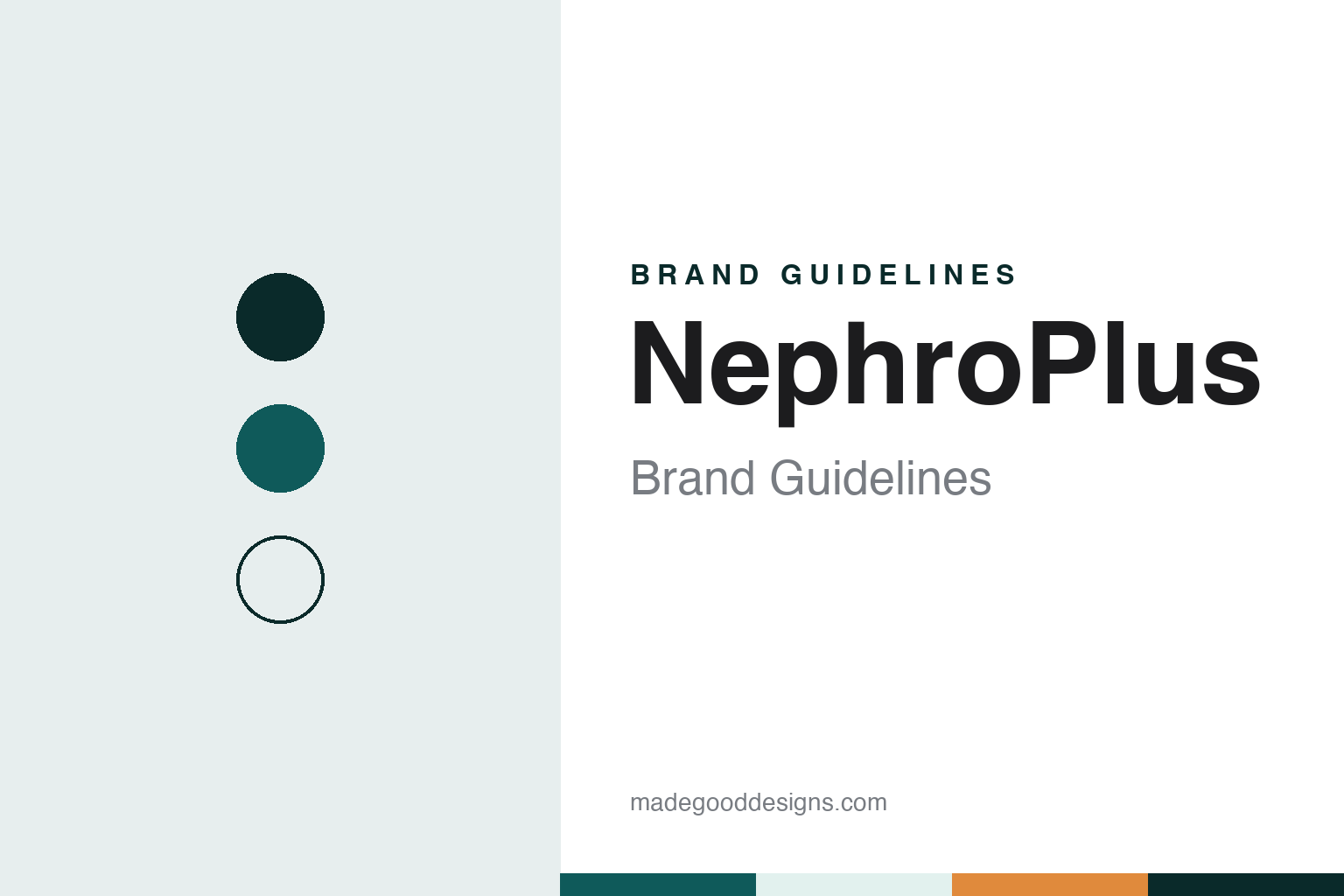
Two constants: a NephroPlus teal and marigold palette and a Friendly rounded sans register. Abstract homage — not a NephroPlus asset or mark; no logo or signage is reproduced.
Hyderabad, 2010
Three founders and one clinic.
NephroPlus started in Hyderabad in 2010. The Week reported in October 2015 that it was founded that year by Vikram Vuppala, an IIT Kharagpur graduate who had returned to Hyderabad after business school in Chicago, Kamal Shah, a chemical engineering graduate of Osmania University, and Sandeep Gudibanda, a graduate of the Indian School of Business. The magazine gave their roles as founder and chief executive, co-founder and director of business development, and co-founder and director of patient services. The company’s own history says its journey began in 2010 with the launch of its first dialysis clinic in Hyderabad.
The start was not easy, by the founders’ account. “People scoffed at us when we opened our first centre, saying many others had come before us and closed shop,” Shah told The Week in 2015, adding that the company was still around and thinking of expanding further. The magazine wrote that the three founders wanted to open a dialysis centre in every district of India.
The brand belongs to Nephrocare Health Services Limited, formerly a private limited company, which says it operates under the registered brand name “NephroPlus.” Its website adds that it is independent and not affiliated with any similarly named entities.
The founders set out to build what The Week called a chain of premium dialysis centres. The company’s mission is “to provide quality dialysis at affordable prices by using standardised protocols, continuous training and focused innovation,” and its stated vision is to help people on dialysis around the world lead “long, happy and productive lives.” Its values are three short sentences: “Guest care comes first,” “We deeply respect our Partners” and “Every Teammate is equally important.”
Colour
Guests, not patients.
The word that defines NephroPlus is “guests.” The company calls the people it treats guests rather than patients, a practice The Week noted in 2015, and the word runs through its website, its values and its events. Its values and website speak of “teammates” and “partners” in the same way.
The brand is built around services as much as clinics. Alongside in-clinic dialysis, its website lists dialysis on call, home haemodialysis, holiday dialysis for people who travel, and dialysis on wheels. In June 2023 Telangana Today reported that NephroPlus had launched a container dialysis unit with Shri Vamshi Hospital in Jadcherla, Telangana, a set-up designed for sites with little space and able to take four patients at a time; Vuppala, described as founder and chief executive, said the company planned ten more such units.
Much of its brand work happens at events. Aashayein is an annual gathering of people on dialysis, nephrologists, nutritionists and industry speakers, and the Dialysis Olympiad is modelled on the Olympic Games, with sports, diet and fitness sessions and talks; The Week described the Olympiad, with running, cycling and basketball, in 2015. The website also publishes dialysis-friendly recipes, such as a version of kanda pohe, the Maharashtrian breakfast, and a blog called Nephro Reads.
NephroPlus also trains staff. The NephroPlus Dialysis Academy trains dialysis technicians and nurses, and the company says it has trained and placed more than 1,000 students over nine years. Many of its centres sit inside hospitals: listing documents summarised by the IPO tracker Chittorgarh name partners including Max Super Speciality Hospital, Fortis Escorts, Care Hospitals and Wockhardt Hospitals.
Its early growth was backed by venture investors. The Week reported in 2015 that NephroPlus had raised two rounds of funding from Bessemer Venture Partners and the International Finance Corporation, and that it then had about 800 employees.
Typography
Design and documentation.
Dialysis and kidney-care companies sell to two audiences at once. One is clinical: nephrologists, nurses, technicians and hospital buyers who choose machines, dialyzers and solutions. The other is the patient, who may spend several sessions a week in a treatment chair or carry out dialysis at home. Their imagery tends to answer both: a calm patient in a reclining chair beside a machine, a nurse in a bright, orderly clinic, and close-ups of dialyzers, tubing and the screens of haemodialysis machines.
Home treatment has added a second setting. Peritoneal dialysis and home haemodialysis bring the equipment into kitchens, bedrooms and living rooms, and the companies that make or support it often show machines beside sofas and tables rather than in clinical rooms. Symbols tend to stay simple: kidney shapes, drops, waves and circles that print clearly on a label, a machine housing or a clinic sign.
The trade meets at a few large congresses. The American Society of Nephrology’s Kidney Week, held in Denver in 2026, drew nearly 12,000 participants from close to 100 countries, the society says, and makers such as Fresenius Medical Care list it among their events. In Europe, the European Renal Association holds an annual congress, scheduled for Rotterdam in 2027 and Berlin in 2028, according to the association.
This guide sets out what can be checked about each company: who founded it, who owns it, where it works and what it makes. Where a fact rests only on a company’s own word, we say so, and the colours and typefaces shown are our own interpretation rather than any official brand standard.
Aa
A friendly rounded sans — “Enabling A Normal Life.” (Specimen set in Inter Tight, a sans STAND-IN; NOT the NephroPlus logo.)
NephroPlus
From a Hyderabad clinic to a listed company.
In December 2025 the company went public. Bidding for the initial public offering of Nephrocare Health Services ran from 10 to 12 December 2025, and its shares were listed on the National Stock Exchange and BSE on 17 December 2025, according to Chittorgarh; India TV News reported the debut that day, describing the company as “known for its brand NephroPlus.” The listing documents named the promoters as Vikram Vuppala, Bessemer Venture Partners Trust, Edoras Investment Holdings, Healthcare Parent Ltd and two Investcorp funds.
The network now reaches beyond India. According to the offer summary published by Chittorgarh, NephroPlus operated 519 clinics as of 30 September 2025, of which 51 were in the Philippines, Uzbekistan and Nepal, and in India it was present in 288 cities across 21 states and four union territories. The company’s own about page gives a slightly earlier figure, 490 clinics as of 31 March 2025, and calls NephroPlus “Asia’s largest dialysis network”; that description is the company’s. Its home page, undated, now shows more than 540 clinics in more than 340 cities and more than 5,200 teammates.
Its tone is warm and plain. The home page leads with “Enabling A Normal Life,” and adds “because life can be normal even if kidneys aren’t,” while its customer-care line is signed off with the phrase “Dialysis Toh Nephroplus.” The guest language, the events and the recipes carry the same tone across the brand.
For a design guide, NephroPlus shows how a clinic chain can build an identity from words: guests, teammates and partners, carried through services, events and training. Compare Diaverum, another dialysis network that operates across several countries, and DaVita, the American dialysis provider. For this guide we use a deep teal and a marigold with a sans, an unofficial interpretation; no product or logo is reproduced.
Explore & save
Keep NephroPlus’s identity on hand — save it to a board in the Made Good inspiration library.
NephroPlus identity set
Pin the NephroPlus teal and marigold palette and the Friendly rounded sans register to your own board.