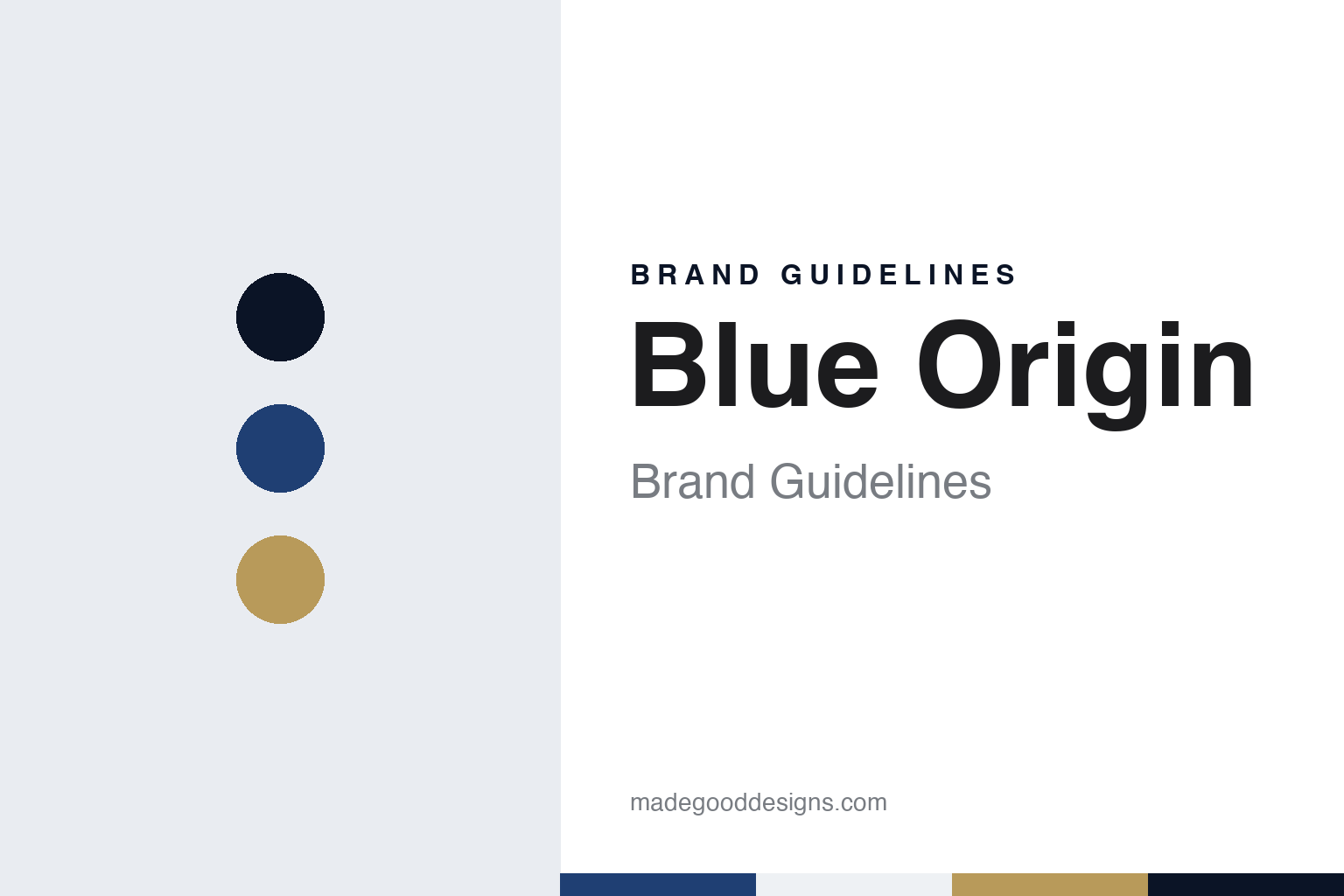
Blue Origin Brand Guidelines
Step by step, ferociously: a Kent space company with a tortoise coat of arms.
Aa
Two constants: a blue, white and gold palette and a heraldic serif register. Abstract homage — not a Blue Origin product or mark; no rocket, crest or logo is reproduced.
Gradatim Ferociter
A quiet start in Kent.
Blue Origin was founded in 2000 by Jeff Bezos, the founder of Amazon, and started in Kent, Washington, south of Seattle, where it is still based, the Kent Reporter wrote in January 2026. English Wikipedia describes a company that worked with a very low profile for its first years, funded by Bezos; it bought land for a launch site north of Van Horn, in West Texas, in 2006 and flew a first test vehicle there that November.
Its symbols say a good deal about how it wanted to be seen. In April 2016 Inverse described the company’s coat of arms, spotted in the reception area at the Kent headquarters: two tortoises on the Earth stretching up towards a golden cosmos, a rocket over a map with old sailing ships, and a winged hourglass, a symbol of fleeting time, above a scroll with the Latin motto Gradatim Ferociter — roughly “step by step, ferociously.” Inverse quoted the company’s website linking the motto to an incremental development process that “builds upon each success,” and quoted Bezos saying that the tortoises painted on the crew capsule mark its successful missions. Asked for the story of the crest, the company told Inverse it had “nothing to contribute at this time.” In October 2016 Alan Boyle’s Cosmic Log reported that Bezos had given a guide to the company’s symbols at the Museum of Flight’s Pathfinder Awards in Seattle.
The rockets carry astronauts’ names. New Shepard is named after Alan Shepard, the first American in space, and New Glenn after John Glenn, the first American to orbit the Earth.
Colour
New Shepard, engines and New Glenn.
New Shepard is a reusable suborbital rocket: a booster with one BE-3PM engine that lands upright, and a capsule for up to six people that returns under parachutes. It first launched and landed without a crew in 2015 and carried its first crew, including Bezos, on 20 July 2021, Wikipedia records. In January 2026 the company announced it would pause New Shepard flights “for no less than two years” and move resources to its lunar work; by then it said New Shepard had flown 38 times and carried 98 people above the Kármán line, the Kent Reporter reported on 30 January 2026.
Engines became a business of their own. In 2014 Blue Origin agreed to develop the BE-4, burning liquid oxygen and liquefied natural gas, for United Launch Alliance’s Vulcan; Wikipedia says the first two flight engines were delivered in October 2022, and Vulcan first flew with them in January 2024. Engines are built at a plant in Huntsville, Alabama, that the company calls Blue Engine, and tested at the West Texas site, which Wikipedia says has test cells for the BE-3 and BE-4 as well as New Shepard’s launch and landing pads. In June 2020 the company opened a new headquarters and research building in Kent, the O’Neill Building.
New Glenn, a heavy rocket seven metres wide with seven BE-4 engines on a reusable first stage, was named in 2016. It first flew on 16 January 2025 from Launch Complex 36 at Cape Canaveral and reached orbit, but the booster was not recovered, SpacePolicyOnline reported that day. In November 2025 it launched NASA’s ESCAPADE mission to Mars and landed its booster on the ship Jacklyn, Wikipedia records. In April 2026 an upper-stage problem left a customer satellite, AST SpaceMobile’s BlueBird 7, in too low an orbit, Payload reported.
Typography
Design and documentation.
Launch companies sell something few customers ever see up close, so their public image is built almost entirely from pictures and broadcasts. The familiar set is a rocket standing on its pad at dawn or under floodlights, the long-exposure streak of an ascent across a night sky, and the plume photographed from miles down the coast. Engine test stands supply a second genre: a horizontal or downward jet of fire, usually shot from a safe distance, which stands in for years of engineering that is otherwise invisible.
Factories are shown the other way round. Clean white halls, rows of tank sections, workers in coveralls and cleanroom suits suggest order and repetition rather than drama. Many launches are also accompanied by a mission patch, a small embroidered emblem in the tradition of NASA crew patches, which turns a single flight into something that can be collected and worn.
The countdown livestream has become a format in its own right, with hosts, telemetry overlays and replays of the booster or upper stage. Not every company has worked this way: in April 2016 Inverse described one maker that gave a day’s notice of its flights and published an edited highlights video afterwards, with no live webcast. Coverage now often runs alongside posts from executives on social media, which journalists quote in their reports.
The industry also meets in person. The Space Symposium in Colorado Springs and the International Astronautical Congress, which moves to a different host city each year, are where companies unveil models, sign agreements and show their identities on stands and banners. This guide looks at what can be checked about each company: who founded it, who owns it, what it has flown, and what it says about itself.
Aa
A heraldic serif for a company with a Latin motto and a coat of arms. (Specimen set in Cormorant Garamond, a serif STAND-IN; NOT the Blue Origin logo.)
Blue Origin
A setback at the pad, and the Moon.
On the evening of 28 May 2026 a New Glenn rocket exploded during a static-fire test at Launch Complex 36, destroying the vehicle and much of the pad’s equipment, Payload reported the next day; Bezos wrote that all personnel were accounted for and safe. In June the company said it would modify the complex rather than rebuild it as before, and in August it said its investigation had traced the failure to a main oxygen valve on one of the BE-4 engines, Wikipedia records.
The Moon is the company’s main stated aim. NASA selected Blue Origin in May 2023 to develop the Blue Moon lander for a later Artemis mission, and SpacePolicyOnline wrote in January 2025 that the lander would be used for Artemis V. A first uncrewed version, Blue Moon Mark 1, had been planned to fly on New Glenn, Payload reported in May 2026. The company also works on the Blue Ring spacecraft and, with partners, on the Orbital Reef space station design.
Blue Origin is privately owned and run from Kent, with rocket development at the headquarters, the Texas launch and test site, engine production in Huntsville and New Glenn production near Cape Canaveral, Wikipedia says. Dave Limp has been chief executive since 2023, after Rob Meyerson and Bob Smith. Former ULA chief executive Tory Bruno joined the company after leaving ULA in December 2025, Washington Technology reported.
For a design guide, Blue Origin shows how a young company can borrow the look of old heraldry — a crest, a Latin motto, tortoises — to signal patience. Compare United Launch Alliance, which flies its engines, and Rocket Lab, another launch company that also builds spacecraft. For this guide we use blue, white and a muted gold with a serif, an unofficial interpretation; no product or logo is reproduced.
Explore & save
Keep Blue Origin’s identity on hand — save it to a board in the Made Good inspiration library.
Blue Origin identity set
Pin the Blue Origin blue, white and gold palette and the heraldic serif register to your own board.