ST Telemedia Global Data Centres Brand Guidelines
A Singapore data-centre platform that grew from a Temasek investor into a KKR and Singtel company.
Aa
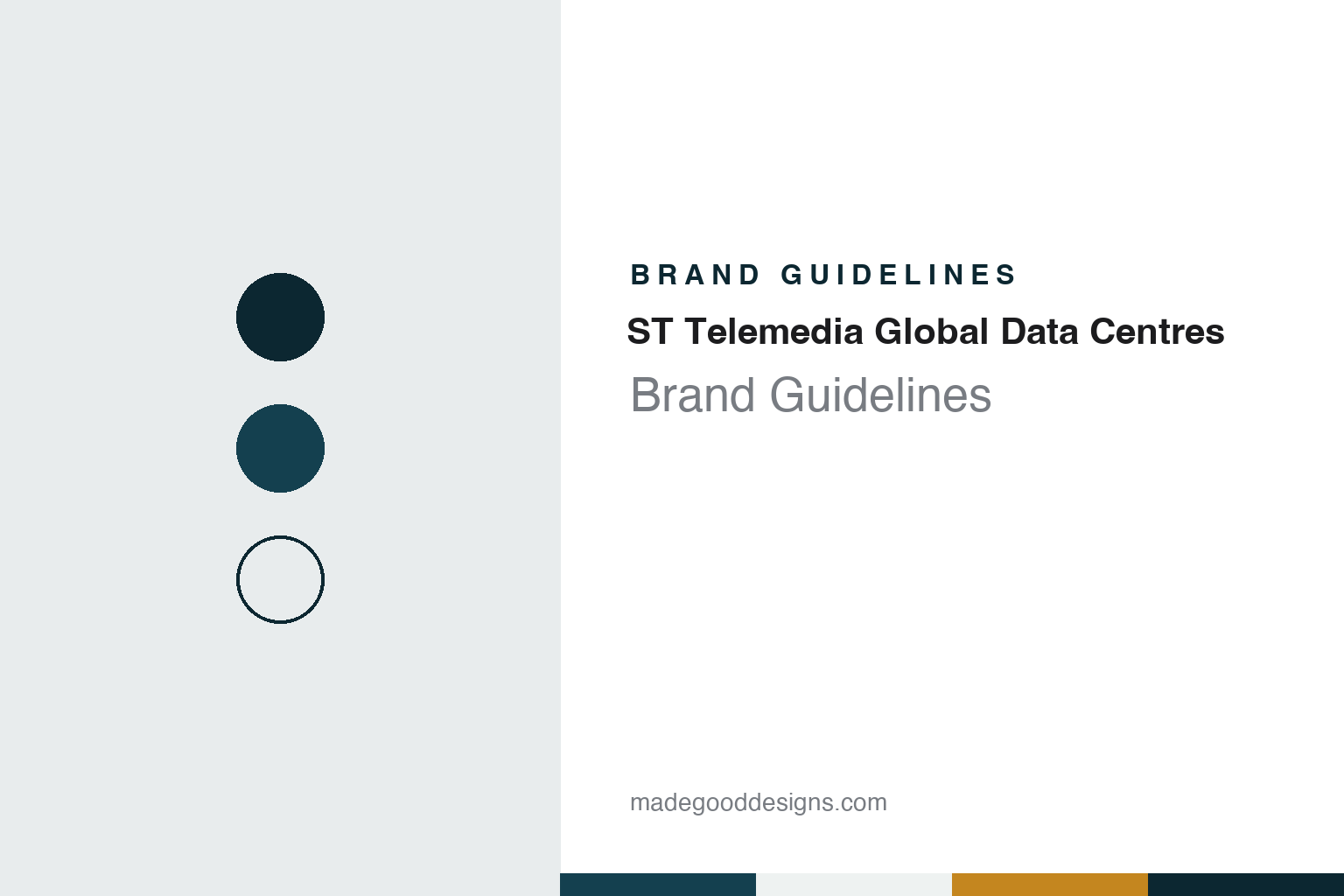
Two constants: a teal, mist and amber palette and a geometric sans register. Abstract homage — not an STTGDC facility or mark; no logo or building is reproduced.
A Temasek investor’s data centres
From an investment arm to an operator.
ST Telemedia Global Data Centres began in Singapore as the data-centre business of ST Telemedia (STT), the Singapore investor in communications, media and data centres that English Wikipedia describes as wholly owned by Temasek Holdings. Reuters, reporting in February 2026, gave the operator’s founding year as 2014 and its headquarters as Singapore. Wikipedia’s history of STT records that the group re-entered the data-centre market in August 2014 with an investment in GDS, a provider of data-centre services in China.
The first years were built through investments and partnerships. Wikipedia says that in March 2015 STT announced plans for its flagship Singapore data centre, STT Defu; that in June 2015 it invested, through STT GDC, in VIRTUS Data Centres in the UK; and that in July 2015 STT GDC and StarHub, another STT portfolio company, agreed to build MediaHub, a facility combining telecommunications, media and data-centre space.
India came next. In May 2016 STT announced a partnership with Tata Communications under which STT GDC took a 74% stake in Tata Communications’ data-centre business in India and Singapore, with Tata keeping the remaining 26%. Wikipedia says the Indian part of the deal was completed in October 2016 and the Singapore part in February 2017. In September 2026 the company said it had 34 data centres across 10 Indian cities, with more than 613MW of IT capacity.
Colour
Outside capital, then new owners.
For its first decade the operator sat inside ST Telemedia, which Wikipedia describes as its sole owner at the time of the Tata deal. Outside investors arrived in June 2024, when the global investment firm KKR and the Singapore telecoms group Singtel first invested in the company, Reuters reported. Before 2026, Reuters said, KKR owned about 14% and Singtel more than 4%.
On 4 February 2026 the two agreed to take full control, after Reuters had reported in November 2025 that they were in advanced talks to buy more than 80% of the company. Reuters reported that the KKR-led consortium would buy the remaining 82% from the founding shareholder, ST Telemedia, held through STT Communications, an indirect wholly owned subsidiary of Temasek, and that on completion KKR and Singtel would hold 75% and 25% respectively, after the conversion of preference shares they already held; Singtel’s exchange announcement said the cash would be paid in two equal tranches, half at closing and the rest about a year later. The trade publication w.media reported on 2 September 2026 that the purchase had been completed, and Submarine Networks gave the same 75–25 split two days later.
At the February announcement the companies described a platform of about 2.3 gigawatts of design capacity across 12 major markets in the Asia Pacific, the UK and Europe, offering colocation, connectivity and round-the-clock support, Reuters reported. Submarine Networks lists those markets as including Singapore, India, China, Thailand, Indonesia, the Philippines, Malaysia, Japan, Germany and the UK. In September 2026 the company said its operational capacity had risen by a quarter since the end of 2025, to 780MW, with close to 2GW of powered land secured for projects under construction and in its pipeline.
Recent projects sit across the region. The company says its Jakarta campus has a development pipeline of more than 360MW, and w.media reported that it had been selected under Singapore’s DC-CFA2 allocation round to develop 50MW of new data-centre capacity in the city-state.
Typography
How the category presents itself.
Data-centre operators sell something most of their customers will rarely see in person. The product is space, power, cooling and connections inside buildings that are secure by design, so the industry has built a recognisable visual language to stand in for the real thing. Long white halls lined with rows of server racks, often lit in a cool blue, are the most common image on websites, in reports and on trade-show stands.
The second stock image is the campus from the air. Aerial photographs show low, windowless buildings set out in a grid, with car parks, substations and fenced yards around them. Close-ups fill in the detail: banks of cooling towers or chillers on a roof, rows of backup generators, cable trays crowded with fibre and power cords, and engineers in hi-vis vests checking a tablet between the racks. The pictures are meant to suggest scale, order and control rather than any single product.
Names and marks tend to follow the same logic. Many operators use short coined names, initials or plain descriptive words, set in clean sans-serif type, and organise their sites with city or airport codes and numbers. Colour schemes lean on blues, greys and one sharper accent, and campaigns talk about capacity, connectivity and growth in measured, technical language. Because the buildings look alike, the difference is often carried by naming, maps of locations and the way a company describes its customers.
Much of this identity is presented in person at industry gatherings such as Datacloud Global Congress and PTC, where operators, investors and network companies meet. Stands, keynote slides and printed site maps there tend to repeat the same visual cues as the websites: hall photography, campus renders and lists of markets. The guides in this group look at how individual operators use those shared conventions.
Aa
A clean geometric sans for a one-word name. (Specimen set in Manrope, a sans STAND-IN; NOT the STTGDC logo.)
STTGDC
One word, a new logo and a brand line.
The identity changed with the ownership. Completion was announced alongside a refreshed global brand on 2 September 2026. The company now writes its name as a single run of capitals, STTGDC, and its announcement gave its website as sttgdc.com. w.media reported that the refresh introduced a new logo, keeping the STTGDC name while reflecting the company’s global focus across Asia, the United Kingdom and Europe, and that leadership, operations and strategy stayed the same.
The company says the refreshed brand is anchored in the line “Built Ready,” which it links to delivering reliable, resilient and AI-ready infrastructure for customers. Its president and group chief executive, Bruno Lopez, called the completion “the most important turning point in STTGDC’s evolution since we founded the company more than 12 years ago.” Its former parent has its own identity: Wikipedia says ST Telemedia adopted a sunburst logo in 2016, when it shortened its business name to “ST Telemedia.”
The full name, ST Telemedia Global Data Centres, still records the company’s origin in the Temasek group, and the STTGDC name was kept through the change of owner. The new owners bring other data-centre interests: Submarine Networks noted that Singtel also runs its own regional data-centre unit, Nxera, and KKR said the deal would deepen its partnership with Singtel, Reuters reported.
For a design guide, ST Telemedia Global Data Centres shows how an operator can keep a long descriptive name as its heritage while presenting a short, capitalised mark after a change of owner. Compare Keppel Data Centres, another Singapore operator with group roots, and Princeton Digital Group. For this guide we use a deep harbour teal, a pale mist and an amber accent with a geometric sans, an unofficial interpretation; no product or logo is reproduced.
Explore & save
Keep ST Telemedia Global Data Centres’s identity on hand — save it to a board in the Made Good inspiration library.
STTGDC identity set
Pin the harbour teal, mist and amber palette and the geometric sans register to your own board.