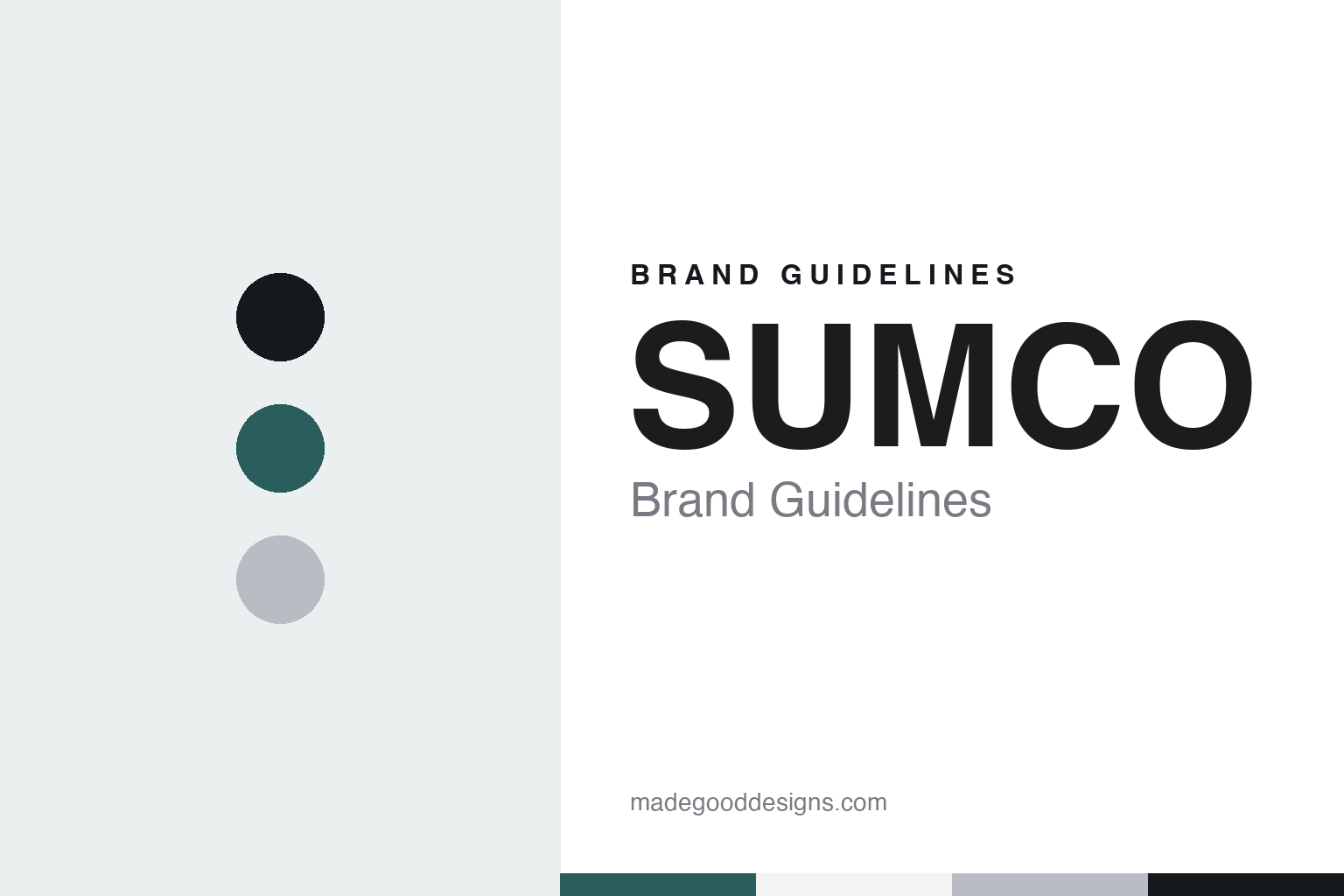
SUMCO Brand Guidelines
Silicon United Manufacturing: two silicon lineages merged under one acronym.
Aa
Two constants: a graphite, silver and teal palette and a geometric sans register. Abstract homage — not a SUMCO product or mark; no wafer, logo or nameplate is reproduced.
Silicon United Manufacturing
Two silicon lineages joined in 1999.
SUMCO was founded on 30 July 1999 as Silicon United Manufacturing Corporation, a company jointly owned by Sumitomo Metal Industries, Mitsubishi Materials and Mitsubishi Materials Silicon to develop and make 300mm silicon wafers, the company’s history says. Japanese Wikipedia says the name SUMCO comes from the first letters of that name: Silicon United Manufacturing COrporation.
Each side brought its own silicon history. On the Sumitomo side, Osaka Titanium, founded in 1952 with Sumitomo Metal Industries as a shareholder, began making polycrystalline silicon in 1960, according to Japanese Wikipedia; it was renamed Sumitomo Sitix in 1993 and merged into Sumitomo Metal Industries in October 1998, where the wafer business became the Sitix division. On the Mitsubishi side, a company founded in 1958 as a Chisso electronics-chemicals unit became Toyo Silicon in 1974 and Nippon Silicon in 1978, took over the silicon business of Japan Electronic Metals in 1979 and was renamed Mitsubishi Materials Silicon in 1991, Japanese Wikipedia says.
The merger came in stages. In February 2002, the company’s history says, Silicon United Manufacturing took over Sumitomo Metal’s Sitix division, merged with Mitsubishi Materials Silicon and was renamed Sumitomo Mitsubishi Silicon — in Japanese the order was Mitsubishi Sumitomo. In August 2005 it became SUMCO Corporation, and in November 2005 it was listed on the first section of the Tokyo Stock Exchange. In October 2006 a tender offer made Komatsu Electronic Metals a subsidiary; it is now SUMCO TECHXIV, based in Omura, Nagasaki. In 2016 the two founding groups sold most of their shares, Japanese Wikipedia says, and in March 2023 SUMCO acquired High-Purity Silicon Corporation of Yokkaichi, Mie, by buying its shares, the company says.
Colour
A name close to another company’s.
The new name led to a dispute. Samco, a Kyoto maker of semiconductor-production equipment founded in 1979, sued SUMCO in the Tokyo District Court in May 2006 for trademark infringement, saying customers had placed orders with the wrong company, Nikkei xTECH reported in August 2008. The two companies settled. SUMCO agreed not to write its name in Japanese katakana as “Samco,” to add a phrase such as “silicon wafer” beside its name on business cards and its website, to state on its website that it is unrelated to Samco, to cancel trademarks containing that katakana spelling and to pay a settlement, the report said.
SUMCO describes its business as making and selling silicon wafers for the semiconductor industry. Its product list covers polished wafers, sliced from single-crystal ingots to about 1mm and polished to a mirror finish; epitaxial wafers, which carry a layer of single-crystal silicon grown from vapour; annealed wafers, heated in hydrogen or argon to improve the surface layer; and silicon-on-insulator wafers, in which an insulating oxide layer is bonded between two polished wafers. It also offers junction isolated wafers and reclaims used wafers for customers. The company names single-crystal pulling, wafer processing and specialised processing as the key steps, calls 300mm wafers its mainstay and says it will reorganise production of 200mm and smaller wafers to suit the market.
Production is centred in Japan. SUMCO lists a Kyushu Factory with sites at Nagahama and Kubara in Imari and at Kohoku in Saga Prefecture and at Omura in Nagasaki, plus plants at Yonezawa in Yamagata and Chitose in Hokkaido and a JSQ division in Akita; SUMCO TECHXIV also runs a plant in Miyazaki. Abroad, the group lists SUMCO Phoenix in Arizona and PT SUMCO Indonesia in Bekasi, with offices in Taiwan, Korea, China, Singapore and Britain.
Typography
Wafers, resists and cleanrooms.
Silicon-wafer and chip-materials makers sell to a small number of very large customers, and their public image is built for engineers, investors and recruits rather than shoppers. Most of what they make never reaches a consumer’s hand: a polished wafer, a bottle of photoresist or a photomask is used up or hidden inside a chip long before anything is sold in a shop.
Their pictures tend to come from the factory floor. Corporate reports and websites in this field favour mirror-polished silicon wafers catching the light of a cleanroom, cylindrical crystal ingots drawn slowly out of a furnace, photolithography bays lit in amber to protect light-sensitive resists, and racks of high-purity chemical bottles. People appear mostly as technicians in full-body cleanroom suits, often called bunny suits, with only their eyes showing.
Names in this group often record a history. Shin-Etsu joins two old Japanese provinces, and SUMCO is an acronym of the company formed by a 1999 merger. The palettes in these guides are our own interpretations, not official colours.
The industry meets at its trade shows. SEMICON West in the United States, SEMICON Taiwan in Taipei and SEMICON Japan in Tokyo bring wafer, chemical and equipment suppliers onto the same floor as chipmakers, and booths there show the same vocabulary of wafers, ingots and cleanroom imagery. This guide sets out what can be checked about each company — who founded it, who owns it, where it makes its products — and marks clearly what rests only on the company’s own word.
Aa
A geometric sans for an acronym in capitals. (Specimen set in Inter Tight, a sans STAND-IN; NOT the SUMCO logo.)
SUMCO
An acronym in capitals.
Today SUMCO is headquartered in Shibaura, in Tokyo’s Minato ward, and listed on the Prime Market of the Tokyo Stock Exchange; Japanese Wikipedia says it joined the Nikkei 225 in October 2007. The company names Jiro Ryuta as president. Its mission statement sets the aim of being “the world’s No. 1 silicon wafer supplier,” and it lists IATF 16949, ISO 9001, ISO 14001 and ISO 45001 certifications. SUMCO says it received supplier awards in 2025 from TSMC, Samsung Electronics, Kioxia and Sony Semiconductor Solutions.
Plans changed in 2026. On 27 March 2026 SUMCO announced that Japan’s Ministry of Economy, Trade and Industry had approved an amended version of its plan for stable supply under the Economic Security Promotion Act, Evertiq reported on 7 April 2026. Instead of building a previously outlined new production facility, the company would upgrade equipment at existing plants, including its operations in Imari, while a possible new plant at Yoshinogari stayed under review. SUMCO cited rising demand from generative AI and stricter requirements for chips at 2nm and beyond, the report said.
SUMCO also addresses a general audience in Japan. The company says it sponsors the animated series Chibi Maruko-chan, broadcast on Sunday evenings on the Fuji TV network, and its website shows television spots with titles such as “Evolution of Semiconductors 2” and “Remote Moon Dance.”
For a design guide, SUMCO shows how an acronym born of a merger became a corporate name, and how a name close to another company’s was settled with a plain line of explanation. Compare Shin-Etsu Chemical, whose Shin-Etsu Handotai also makes silicon wafers in Japan, and GlobalWafers, a wafer maker based in Hsinchu. For this guide we use graphite, mirror silver and a deep teal with a sans, an unofficial interpretation; no product or logo is reproduced.
Explore & save
Keep SUMCO’s identity on hand — save it to a board in the Made Good inspiration library.
SUMCO identity set
Pin the graphite, silver and teal palette and the geometric sans register to your own board.