Silicon Labs Brand Guidelines
The Austin chip designer that bet on connected devices.
Aa
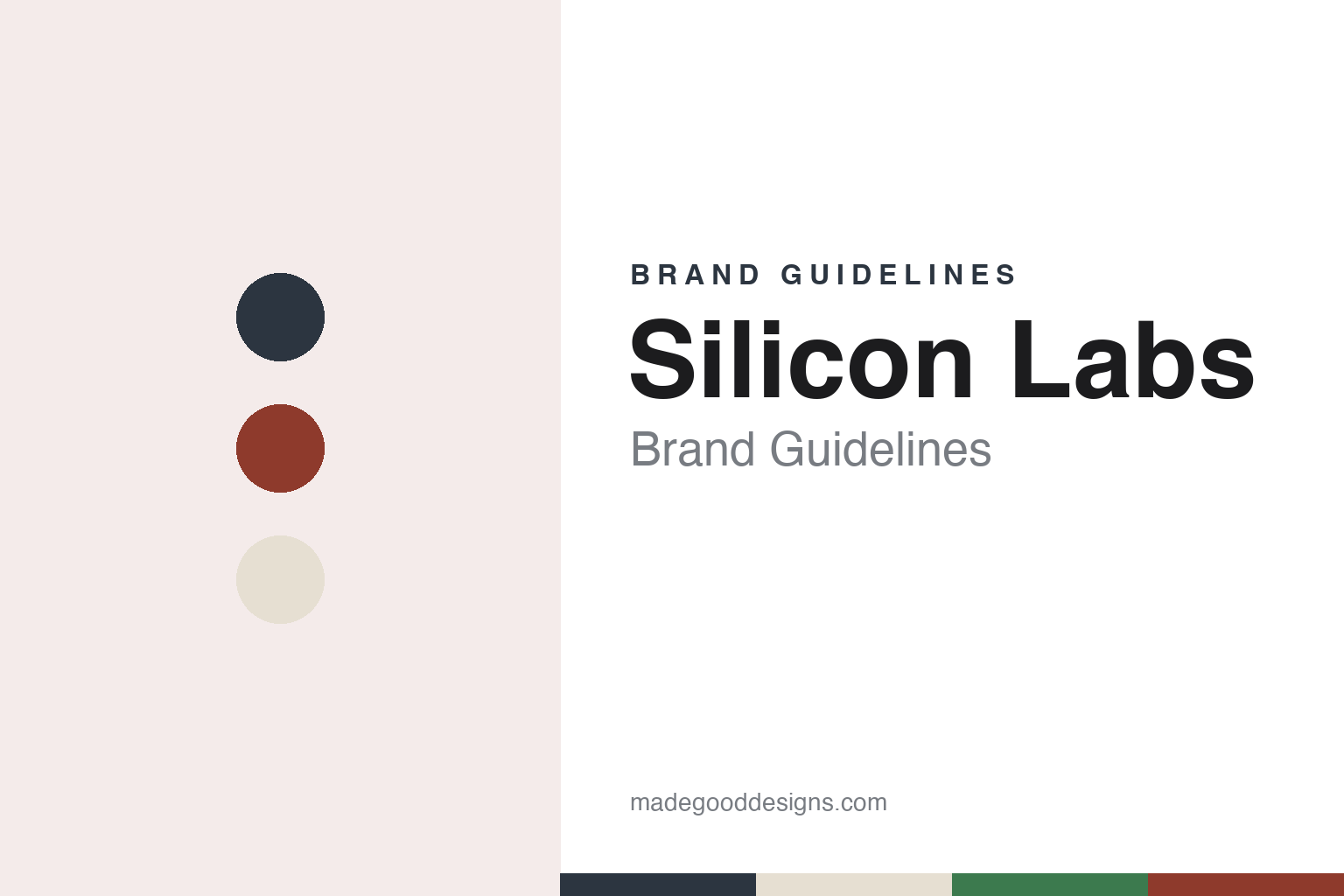
Two constants: a Silicon Labs brick, slate and green palette and a Rounded grotesque register. Abstract homage — not a Silicon Labs product or mark; no chip, board or logo is reproduced.
Out of Crystal
Three engineers, a modem chip and an Austin start.
Silicon Laboratories — known as Silicon Labs — was founded in Austin, Texas, in 1996 by Nav Sooch, Dave Welland and Jeff Scott, all alumni of Crystal Semiconductor, a company now owned by Cirrus Logic, according to English Wikipedia. It is fabless: it designs chips and has them made at outside foundries.
Its first product, released in 1998, was an updated design for a DAA, or direct access arrangement, the part of a modem that connects to the telephone line. English Wikipedia says it cost less and took less space than established designs and quickly became a commercial success. The company then turned to radio. In late 1999 it introduced its first RF chip, a CMOS RF synthesiser for mobile phones, which English Wikipedia calls the world’s first.
Silicon Labs became a publicly traded company in 2000. Over the next decade it added product families one after another: timing chips from 2001, 8-bit microcontrollers from 2003, crystal oscillators from 2004, a single-chip FM radio receiver in 2005, automotive microcontrollers in 2006, and television receiver and demodulator chips in 2010 and 2011, according to the timeline in English Wikipedia. In 2012 it entered the market for 32-bit microcontrollers built on Arm cores.
Colour
From modems to the connected home.
The company’s direction changed after Tyson Tuttle became chief executive in 2012. From then on, English Wikipedia says, Silicon Labs focused more and more on the Internet of Things: the small wireless chips inside smart-home devices, meters, lighting and industrial sensors. In 2015 it launched products for Thread, a networking standard for connected devices; in 2016 it released the Gecko family of multiprotocol wireless system-on-chips; in 2018 it launched the Z-Wave 700 platform; and in 2021 it added Wi-SUN technology and said its wireless devices would support Matter, the smart-home standard.
Wikipedia lists the protocols its chips support as Bluetooth, Zigbee, Thread, Z-Wave, Wi-Fi, Wi-SUN and proprietary sub-gigahertz and 2.4 GHz radio. Alongside the chips the company offers software stacks and a free development environment called Simplicity Studio, and a hardware and software security feature it calls Secure Vault, which Wikipedia says covers secure device identity, key storage and tamper detection.
Its microcontrollers are sold in two named families, according to English Wikipedia: EFM8, 8-bit chips compatible with the classic 8051 instruction set, and EFM32, 32-bit chips. The wireless range is offered both as bare system-on-chips and as certified modules, and Wikipedia also lists support for Amazon Sidewalk, Amazon’s shared low-bandwidth network for connected devices. By August 2019, the encyclopaedia says, the company held more than 1,770 patents worldwide, issued or pending.
To narrow its focus, Silicon Labs sold part of itself. On 22 April 2021 it said it would sell its infrastructure and automotive business to Skyworks Solutions, the Irvine, California, chipmaker, in an all-cash deal, Reuters reported; the agency said the company was doubling down on wireless chips for smart-home gear. English Wikipedia says the sale closed on 26 July 2021.
Leadership changed the same year. In July 2021 Silicon Labs announced that Tuttle would step down, and in January 2022 the former president Matt Johnson completed the move into the chief executive’s role, according to English Wikipedia.
Typography
How chip designers present themselves.
A fabless chip designer has an unusual problem for a brand: its product is a small, dark square that most buyers never see. The company designs the chip, an outside foundry makes the wafers, and the finished part disappears inside someone else’s phone, television, router or car. The visual language of the category grows out of that gap between what the company makes and what anyone can look at.
One answer is the rendering. Chips appear floating above circuit-board landscapes, lit from below, with traces running off toward the horizon like roads seen from the air. Another is the die photograph: a close view of the silicon itself, often tinted in false colour so that memory blocks, processor cores and interfaces read as separate districts on a map.
A third answer is to show the products the chip ends up in. Reference designs — earbuds, security cameras, smart speakers, displays, small smart-home gadgets — let a designer point to a finished object without claiming it as its own. Developer kits and evaluation boards, photographed on desks next to laptops and cables, speak to the engineers who choose components.
The calendar matters too. Much of the category’s public presentation happens at trade shows such as CES in Las Vegas, Computex in Taipei, Embedded World in Nuremberg and the Hot Chips conference, where booths, demo walls and technical papers carry the brand. Many press releases follow the same rhythm, dated from headquarters and timed to a show. The guides that follow look at how individual companies work within these conventions, and at what can be documented about each one.
Aa
A rounded, friendly grotesque for a connected-device register. (Specimen set in Manrope, a sans STAND-IN; NOT the Silicon Labs logo.)
A deal with TI
Agreed in 2026, not yet completed.
On 4 February 2026 Texas Instruments and Silicon Labs announced a definitive agreement under which Texas Instruments would acquire Silicon Labs in an all-cash transaction. In their joint release the companies said the deal would add about 1,200 wireless products to TI’s range and would move Silicon Labs’ manufacturing from external foundries into TI’s own wafer fabs. The companies said they expected the deal to close in the first half of 2027, subject to regulatory approvals; it had not closed at the time of writing. They said it was expected to close in the first half of 2027, subject to regulatory approvals, approval by Silicon Labs stockholders and other customary conditions. Financier Worldwide reported on 10 February 2026 that it would be TI’s biggest acquisition since it bought National Semiconductor in 2011. The sale was agreed in February 2026 and had not been completed at the time of writing; until it closes, Silicon Labs remains an independent company listed on Nasdaq.
In the same release Silicon Labs described itself as headquartered in Austin, with operations in more than 16 countries, serving the smart home, industrial Internet of Things and smart cities. Matt Johnson, its president and chief executive, said the two companies shared “a strong Texas heritage.”
The brand itself is quiet. Silicon Labs presents itself through developer tools, reference boards and product families such as Gecko rather than through a consumer face, and no public guidance on its logo, typeface or colours is documented, so the choices below are our own.
For a design guide, Silicon Labs shows how an engineering company can redraw itself around one market — from modems and phone radios to the connected home — while keeping a plain, technical voice. Compare Nordic Semiconductor, another designer of low-power wireless chips, and Cirrus Logic, which now owns Crystal Semiconductor, where the founders had worked. For this guide we use a brick red, a dark slate and a green with a sans, an unofficial interpretation; no product or logo is reproduced.
Explore & save
Keep Silicon Labs’s identity on hand — save it to a board in the Made Good inspiration library.
Silicon Labs identity set
Pin the Silicon Labs brick, slate and green palette and the Rounded grotesque register to your own board.