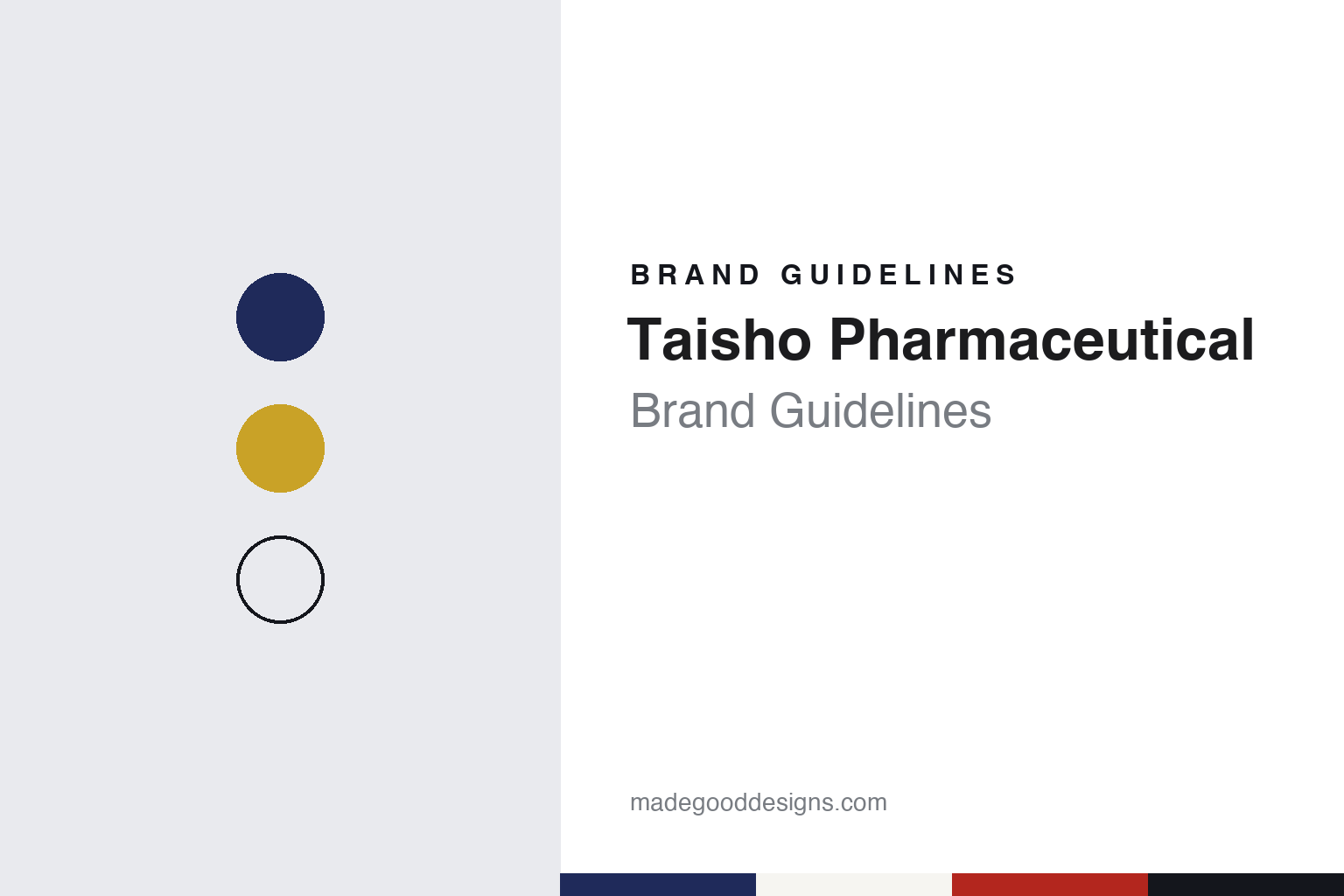
Taisho Pharmaceutical Brand Guidelines
The Tokyo pharmacy that became a household name in over-the-counter medicine.
Aa
Two constants: a deep indigo, gold and red palette and a plain Japanese gothic register. Abstract homage — not a Taisho product or mark; no bottle, logo or eagle is reproduced.
Taisho Seiyakusho
A pharmacist, a tonic and a name taken from a new era.
Taisho Pharmaceutical began in Tokyo in October 1912, the first year of the Taisho era that gave it its name. Japanese Wikipedia says the founder, Kinjiro Ishii, was running a pharmacy called Taizando when he set up Taisho Seiyakusho, the “Taisho pharmaceutical works.” The company’s eighty-year history, published by Taisho in 1993 and summarised on The Shashi, a Japanese company-history site, says Ishii was a trained pharmacist who saw that a haemoglobin tonic then imported could be made in Japan from cattle blood. Backed by an uncle and two others, he sold it as tablets and syrup under the name Taiso; when early stock absorbed moisture and came back, he redesigned the containers and had the tablets sold through Sankyo.
The man who shaped the company’s next half-century arrived in 1916. Shokichi Uehara joined as a bookkeeper through a public recruitment drive and soon moved into sales, the same history says. His idea, put into effect when the business became a joint-stock company in May 1928, was to make its retail pharmacies shareholders, so that they earned both dividends and rebates on what they sold. The retail chain built on that scheme, the Kyoseikai, grew to about 5,500 shops before the war. The first Pabron cough medicine came out in 1927, and Pabron is still the name of the company’s cough and cold range.
The war years are recorded in the same history and in a 1968 business history it cites. In April 1937 the head office moved to Chuo ward. In 1939, as controls on materials tightened with the war in China, the company closed the Korea branch it had opened in 1930, and added sulfa drugs to its range; from 1940 it also sold Riken cosmetics through its chain, which was suspended as the wartime economy deepened. In 1943 Teruji Ishii became president. In 1944 the company became a cooperating factory for the army and navy, making medicines for official use, and in June 1945, under wartime rules for consolidating drug makers, it absorbed a company called Meiji Seiyaku. The sources used for this guide do not say whether forced or conscripted labour was used.
Colour
An eagle for the television age.
Uehara became president in 1946, and in May 1948 the company took the name Taisho Seiyaku, Taisho Pharmaceutical, Japanese Wikipedia says. Its post-war chain ran into Japan’s new competition law, and the company turned to advertising instead, sponsoring radio dramas on Japan’s first commercial stations from 1952, according to the company history.
The eagle mark followed in July 1955. Japanese Wikipedia says the stylised eagle with spread wings was chosen from several candidates to present the company clearly on the then-new medium of television; the first version had twelve feathers and a realistic head and feet, used alongside a simpler version, and in April 1976 the two were merged into a single bolder mark with eight feathers. The company says it registered the eagle as a trademark and that its name became widely known through advertising that used it; Japanese Wikipedia records the line “Washi no māku no Taisho Seiyaku desu,” “Taisho Pharmaceutical, with the eagle mark,” as still in use.
The best-documented product is Lipovitan D, launched in March 1962. The company history, as summarised on The Shashi, says it turned a 20ml ampoule product into a 100ml bottled drink with a pineapple flavour, and credits the idea to Uehara himself; the company says the larger bottle diluted the medicinal taste and was meant to be drunk chilled. Exports began with Taiwan in 1963 and Thailand in 1965, the company says, and after deregulation in 1999 the drink could be sold in convenience stores and vending machines rather than only in pharmacies. pharmaphorum in December 2023 described Taisho as Japan’s largest consumer health and over-the-counter medicine maker, known for Lipovitan and Pabron.
Other names followed: the eye drop Iris in 1957, the pain reliever Naron in 1960, and Riup, a minoxidil hair-loss product of 1999 that the company calls Japan’s first direct over-the-counter medicine. Its first prescription drug, the psoriasis treatment Sorion, came in 1957, and the antibiotic Clarith in 1991. Japanese Wikipedia records that in February 1965, during Japan’s ampoule cold-medicine affair, sales of the company’s ampoule cold remedy Kyoryoku Pabron ended. The company has sponsored Japan’s national rugby team since 2001.
Typography
How Japanese drug makers present themselves.
Japanese drug makers tend to present themselves through places and archives as much as through products. Research campuses carry much of the weight: Chugai began full operation of its Chugai Life Science Park Yokohama, in Kanagawa, in 2023, and earlier ran a research laboratory at Tsukuba, in Ibaraki, from 2001 to 2005; Otsuka Pharmaceutical opened an Osaka Research Center for Drug Discovery in 2022, according to the companies’ own timelines. Photographs of laboratories, glass façades and scientists at screens recur across their websites and reports.
History is the other recurring theme. Several of these companies trace their roots to the Meiji and Taisho eras, and their anniversary pages lean on archive photographs of early shopfronts, factories and founders, including the old medicine-trading streets of Doshomachi in Osaka. Chugai marked its 100th anniversary in March 2025 and the Otsuka group its centenary in 2021, and both publish detailed chronologies of how their names and symbols changed.
The visual language is mostly cool and clean. Blue and white dominate packaging and corporate marks: Chugai moved its corporate colour from green to blue in 2002, and Otsuka describes the large O of its group symbol in “Otsuka BLUE.” Alongside prescription medicines, many of these firms sell consumer products, such as health drinks, eye drops and nutrition bars, that put their names on pharmacy and convenience-store shelves; Otsuka’s Pocari Sweat, launched in 1980, is one example.
Trade shows complete the picture: booths at international partnering events such as BIO and at CPHI Japan show the companies to licensing partners and suppliers rather than to shoppers. This guide sets out what can be checked about each company — its founding, its owners, its war years and its symbols — and marks clearly what rests only on the company’s own word.
Aa
A plain Japanese gothic — the register of a pharmacy shelf. (Specimen set in Zen Kaku Gothic New, a sans STAND-IN; NOT the Taisho logo.)
Taisho Pharmaceutical
From a stock-market listing to private ownership.
Taisho listed on the Tokyo Stock Exchange in September 1963. In September 2001 it agreed to combine with Tanabe Seiyaku, now part of Mitsubishi Tanabe, under a joint holding company, but the plan was dropped that December, Japanese Wikipedia says. In October 2011 the company created Taisho Pharmaceutical Holdings as its listed parent; English Wikipedia says the group acquired the French maker UPSA from Bristol Myers Squibb in 2019.
The company left the stock market in 2024. pharmaphorum reported in December 2023 that the Uehara family, Taisho’s largest shareholder, had offered to take it private in a management buyout. Japanese Wikipedia records that the bidding company, Otemon, held 73.12 per cent of the voting rights when the tender offer settled in January 2024; shareholders approved a squeeze-out in March, the shares were delisted on 9 April 2024, and in July 2024 Otemon merged with the old holding company and took the name Taisho Pharmaceutical Holdings. Japanese Wikipedia lists factories at Omiya, where the research centre also stands, and Hanyu in Saitama Prefecture, and at Okayama. The head office is in Toshima ward, Tokyo, and on 1 January 2026 the company adopted the slogan “Fly for Life.”
For a design guide, Taisho Pharmaceutical shows how a single mark, adopted for the television age, can carry a whole range of household medicines. Compare Takeda and Daiichi Sankyo, two other Japanese drug makers with pre-war roots. For this guide we use deep indigo, gold and red on paper with a sans, an unofficial interpretation; no product or logo is reproduced.
Explore & save
Keep Taisho Pharmaceutical’s identity on hand — save it to a board in the Made Good inspiration library.
Taisho Pharmaceutical identity set
Pin the Taisho Pharmaceutical indigo, gold and red palette and the plain Japanese gothic register to your own board.