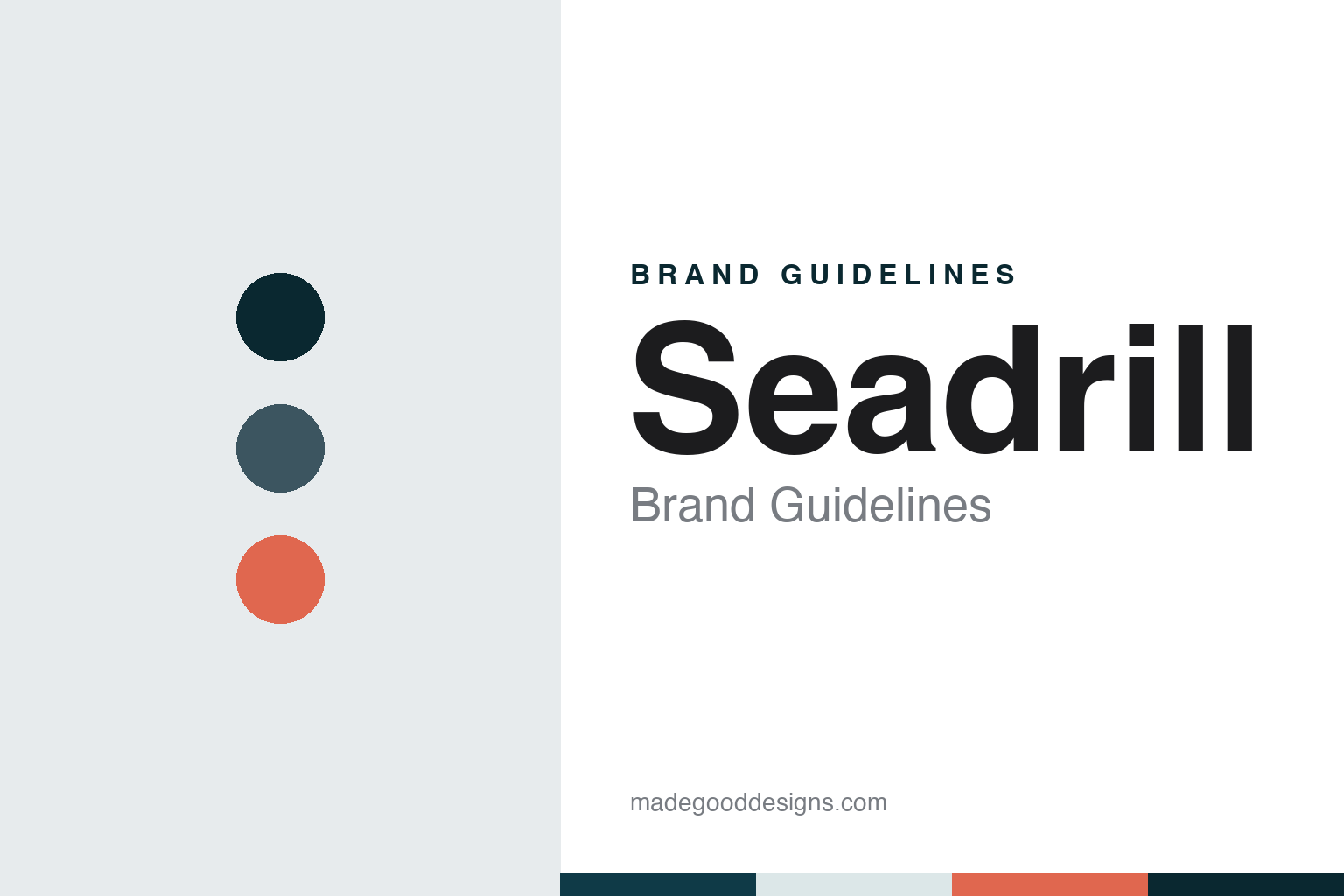
Seadrill Brand Guidelines
A Bermuda company of 2005 that built a deepwater fleet through acquisitions and two restructurings.
Aa
Two constants: a deep water and buoy coral palette and a Grotesque sans register. Abstract homage — not a Seadrill asset or mark; no rig, logo or nameplate is reproduced.
Built by buying
A Bermuda company assembled in its first decade.
English Wikipedia says Seadrill was incorporated as a Bermuda company on 10 May 2005 by John Fredriksen, and the company’s registered parent, Seadrill Limited, still lists Hamilton, Bermuda, as its home on its contact page.
It was assembled quickly through purchases. In July 2005, Wikipedia says, it bought jackup rigs from Odfjell Drilling. In September 2006 it took a controlling share of Smedvig, outbidding Noble Corporation; in 2007 it acquired Eastern Drilling; and in May 2010 it outbid Ensco, now part of Valaris, for Scorpion Offshore.
The early 2010s brought more deals in both directions. In April 2013, Wikipedia says, Seadrill sold most of its tender-rig and semi-tender operations to SapuraKencana, and in May 2013 it sold two tender rigs and the West Vencedor to Seadrill Partners, a separate entity. In June 2013 it bought a majority interest in Sevan Drilling, and in 2014 it floated its harsh-environment subsidiary, North Atlantic Drilling, while keeping a 70 percent stake. In November 2014, as the industry turned down, it suspended its dividend.
Colour
Two restructurings in five years.
The downturn led to court. In December 2017 Seadrill filed for bankruptcy, and it emerged in July 2018, English Wikipedia says. In 2019 it took 50 percent stakes in two joint ventures: Gulfdrill, which runs five jackups in Qatar with Qatargas, with Gulf Drilling International holding the other half; and Sonadrill, which runs three drillships aimed at Angolan waters, with Sonangol as its partner.
The second restructuring followed. Seadrill delisted its shares from the New York Stock Exchange in June 2020 and, on 10 February 2021, filed for Chapter 11 for the second time; it emerged in February 2022 with a new board, Wikipedia says. A financing subsidiary, Seadrill New Finance, went through its own short Chapter 11 case between 12 and 20 January 2022.
A return to the markets came that autumn. Seadrill received approval to relist on the New York Stock Exchange under the ticker SDRL, and its shares began trading there on 14 October 2022; its Oslo listing became secondary and moved to the main list of the Oslo exchange on 17 November 2022. In October 2022 it completed the sale of seven jackups to ADES Arabia Holding. In December 2022 it agreed to acquire Aquadrill, a London-based rig owner, in an all-stock deal that closed in April 2023, and in June 2023 it announced the sale of its three tender-assist units, according to Wikipedia.
Two older matters are part of the record. In 2015 Petrobras alleged bribery in rig contracts signed by Sevan Drilling between 2005 and 2008; in 2018, Wikipedia says, Økokrim, the Norwegian authority for economic and environmental crime, completed its investigation and the original charges were dismissed. In November 2009 the West Atlas, a jackup Wikipedia describes as Seadrill’s, caught fire on the Montara field off northern Australia after the well had been leaking for ten weeks; the field operator, PTTEP of Thailand, took responsibility for the spill and in 2011 pleaded guilty to four charges in the Darwin Magistrates Court, Wikipedia says.
Typography
Design and documentation.
Drilling contractors sell time on machines that most of their customers’ shareholders will never see, so their public image leans heavily on photographs of the machines themselves. Offshore companies favour the long view: a drillship or a semi-submersible standing alone on open water, its derrick the tallest thing for miles, or a jackup rig on its three legs with the sun going down behind it. Land drillers tend to show a single rig on flat, open ground, with a line of trucks and a wide sky.
People appear too, and usually in working clothes. Derrick crews in coveralls and hard hats, gloved hands on pipe, and teams on the rig floor are the standard human images of the trade. Many contractors also run named safety campaigns aimed at their own crews, with slogans, posters and stickers that become part of the visual language of a rig as much as of the company.
Much of a driller’s graphic output is financial and technical rather than promotional. Listed contractors publish fleet status reports, which list each rig with its type, location, customer and contract dates, and investor presentations full of rig diagrams, maps and backlog charts. These documents are read closely by analysts and customers, and their layout is often plainer and more consistent than the company’s marketing.
Names carry a lot of the weight. The industry has been shaped by mergers, so many contractors are the sum of older firms, and rigs often keep a predecessor’s name or a numbered series long after the company that built them has gone. A contractor’s identity can therefore be read in its rig names and its logo on a hull as much as in any brochure.
Aa
A grotesque sans for a fleet of West rigs. (Specimen set in Barlow, a sans STAND-IN; NOT the Seadrill logo.)
Seadrill
“Setting the standard in deepwater.”
Seadrill’s present line is short: the company says it is “setting the standard in deepwater oil and gas drilling,” with a “high-specification, floater-focused fleet” of drillships and semi-submersibles. It describes its work as technology-led and data-driven, and says it secured the industry’s first ABS notation for managed-pressure drilling in 2016, earned CBM notations from ABS in 2021 and 2024, and had drilled more than 100 managed-pressure wells by 2024. It names ISO 9001, ISO 14001, ISO 45001 and ISO 50001 certifications on its about page; we give all of these as its own statements.
Its rig names are the most consistent part of the identity. Most units on its fleet page carry a “West” prefix, among them the West Polaris, West Capella, West Saturn and West Vela, alongside the semi-submersible Sevan Louisiana and the drillships Sonangol Libongos and Sonangol Quenguela, which the page lists as owned by Sonadrill. In November 2026 the page listed a single jackup, the West Elara, among its floaters.
The company is spread across several offices. Its contact page lists Seadrill Limited in Hamilton, Bermuda; management companies in Liverpool and in Stavanger, Norway; Seadrill Americas in Houston; offices in Rio de Janeiro, Singapore and Luanda; and a training centre, the Seadrill Development Academy, in Dubai. It publishes a fleet status report, the latest dated November 2026, and a magazine called World of Seadrill. Its shares trade in New York as SDRL, with a secondary listing in Oslo.
For a design guide, Seadrill shows how a company remade twice in court can keep continuity through a naming system, giving rigs bought from different owners a shared “West” family. Compare Odfjell Drilling, which sold Seadrill its first jackups in 2005, and Noble Corporation, the bidder Seadrill beat for Smedvig. For this guide we use a deep water blue and a buoy coral on sea spray with a sans, an unofficial interpretation; no product or logo is reproduced.
Explore & save
Keep Seadrill’s identity on hand — save it to a board in the Made Good inspiration library.
Seadrill identity set
Pin the Seadrill deep water and buoy coral palette and the Grotesque sans register to your own board.