Borr Drilling Brand Guidelines
A 2016 jackup start-up built from other drillers’ rigs.
Aa
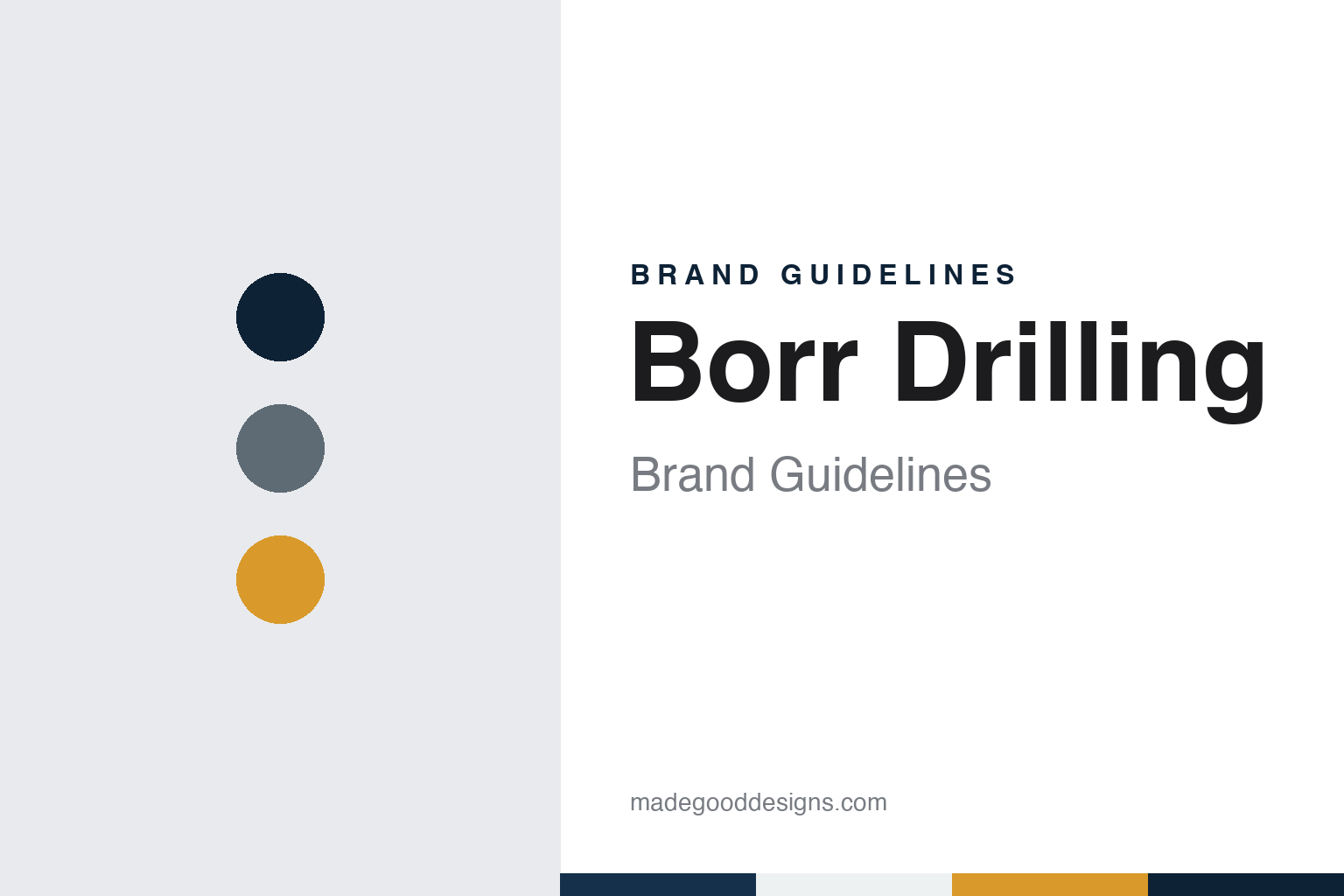
Two constants: a navy, steel and amber palette and an engineered sans register. Abstract homage — not a Borr Drilling asset; no rig, logo or nameplate is reproduced.
Magni Drilling
A drilling company that began with no rigs.
Borr Drilling is a young company in an old trade. It was set up in 2016 by the Norwegian investor Tor Olav Trøim and other executives who had left the rig owner Seadrill, the Reuters report carried by MarineLink said in March 2017. Its first name was Magni Drilling, OE Digital reported in January 2017, and it raised its first money through a listing in Oslo, where it traded on the over-the-counter board.
The timing was deliberate. The price of crude had fallen by more than half since 2014, and oil companies had cut back on rig hire, leaving many rigs idle, the same Reuters report noted. The company described its own plan at the time as uniting “record low asset prices with a capable operating organization,” OE Digital reported, and its first chief executive, the economist and former Seadrill finance chief Rune Magnus Lundetræ, spoke of an entry into drilling “at close to historical low valuations.”
The first purchase was small: two stacked KFELS Super A jackups from the US driller Hercules Offshore, built at Keppel in Singapore in 2013. Borr took delivery in January 2017 and renamed them Frigg and Ran, formerly Hercules Resilience and Hercules Triumph, OE Digital reported on 30 January 2017.
Two months later came the deal that made its name. In March 2017 Borr agreed to buy the shallow-water fleet of the Swiss-based offshore driller Transocean: 15 jackups, ten working rigs and five still under construction, the Reuters report said, funded with a large issue of new shares. At that point Borr owned just two rigs.
Colour
Jackups only, for water up to about 400 feet.
Borr has kept to one kind of rig. A jackup is a drilling unit that stands on legs lowered to the seabed, used in shallow water; the company says its rigs are designed to work in water depths of up to about 400 feet, and calls itself a “pure-play” jackup company. It lists the work it takes on as exploration, production, workover, plug and abandonment, and carbon capture and storage.
Its own timeline sets out how the fleet was gathered. After the Hercules and Transocean deals, it lists nine rigs from the PPL Shipyard in October 2017, two from Paragon Offshore in March 2018, five from Keppel FELS in May 2018 and one more, the Hakuryu 15, in March 2019. The designs it names include the Pacific Class 400, the F&G JU2000E, the KFELS B, Super B and Super A classes, and the Gusto MSC CJ50. The company says it has the youngest jackup fleet in the industry; that is its own description.
The fleet grew again in 2026. In January Borr completed the purchase of five jackups from Noble Corporation, taking its fleet to 29 rigs, according to the company’s announcement republished by Cyprus Shipping News on 2 February 2026. The rigs were to be renamed Sif, Freyja, Forseti, Bestla and Joro, in place of Noble names such as Noble Resolute and Noble Resilient.
In July 2026 a second group followed. BC Ventures, a 50/50 joint venture between Borr and its long-term well construction partner in Mexico, completed the purchase of five jackups from Fontis Finance, OE Digital reported on 29 July 2026: two Friede & Goldman JU-2000E rigs, Oberon and Titania FE, and three LeTourneau Super 116-C rigs, Courageous, Defender and Intrepid, all already in Mexico. That took Borr’s owned and jointly owned fleet to 34 rigs, the report said, and the company described Mexico as a well-established shallow-water drilling market.
Typography
How drilling contractors present themselves.
Drilling contractors sell time on machines that most of their customers’ shareholders will never see, so their public image leans heavily on photographs of the machines themselves. Offshore companies favour the long view: a drillship or a semi-submersible standing alone on open water, its derrick the tallest thing for miles, or a jackup rig on its three legs with the sun going down behind it. Land drillers tend to show a single rig on flat, open ground, with a line of trucks and a wide sky.
People appear too, and usually in working clothes. Derrick crews in coveralls and hard hats, gloved hands on pipe, and teams on the rig floor are the standard human images of the trade. Many contractors also run named safety campaigns aimed at their own crews, with slogans, posters and stickers that become part of the visual language of a rig as much as of the company.
Much of a driller’s graphic output is financial and technical rather than promotional. Listed contractors publish fleet status reports, which list each rig with its type, location, customer and contract dates, and investor presentations full of rig diagrams, maps and backlog charts. These documents are read closely by analysts and customers, and their layout is often plainer and more consistent than the company’s marketing.
Names carry a lot of the weight. The industry has been shaped by mergers, so many contractors are the sum of older firms, and rigs often keep a predecessor’s name or a numbered series long after the company that built them has gone. A contractor’s identity can therefore be read in its rig names and its logo on a hull as much as in any brochure.
Aa
An engineered sans for a fleet of identical machines. (Specimen set in Archivo, a sans STAND-IN; NOT the Borr Drilling logo.)
Borr Drilling
A Bermuda company with Norwegian roots.
Borr Drilling Limited is a Bermuda company; its website says it is subject to Bermuda law, which is based on English law, and to the rules of the exchanges where it is listed. Its shares trade on the New York Stock Exchange and on Euronext Growth Oslo under the ticker BORR, according to its February 2026 announcement.
Leadership has passed through people with long careers elsewhere in oilfield services. The website says Tor Olav Trøim chaired the board from August 2017 to September 2019 and again from February 2022 to September 2025. Patrick Schorn, a former executive vice president at Schlumberger, now SLB, joined the board in January 2018, became chief executive in September 2020 and executive chairman in September 2025, the company says. By January 2026 the chief executive was Bruno Morand, who spoke for the company on the Noble deal.
The brand’s language is plain and practical. The website opens with the line “Built To Make a Difference,” and lists four values: adaptability, teamwork, integrity and commitment. It says it aims to recruit local staff in the regions where it works and to reduce its carbon footprint; those are the company’s own aims, stated on its website.
Its rig names give the brand a quieter signature. Rigs bought from other owners have been given new short names, such as Frigg and Ran for the former Hercules units and Sif and Freyja for two of the former Noble rigs, as the reports and the company announcement record.
For a design guide, Borr Drilling shows how a company assembled from other firms’ equipment can build one identity through a single rig type, what it calls a uniform fleet design, and new names for the rigs it buys. Compare Transocean, which sold Borr its shallow-water fleet, and Noble Corporation, which sold it five more rigs in 2026. For this guide we use a navy, a steel grey and an amber with a sans, an unofficial interpretation; no product or logo is reproduced.
Explore & save
Keep Borr Drilling’s identity on hand — save it to a board in the Made Good inspiration library.
Borr Drilling identity set
Pin the Borr Drilling navy, steel and amber palette and the engineered sans register to your own board.