Diamondback Energy Brand Guidelines
A Midland producer named for a snake and built on Permian acreage.
Aa
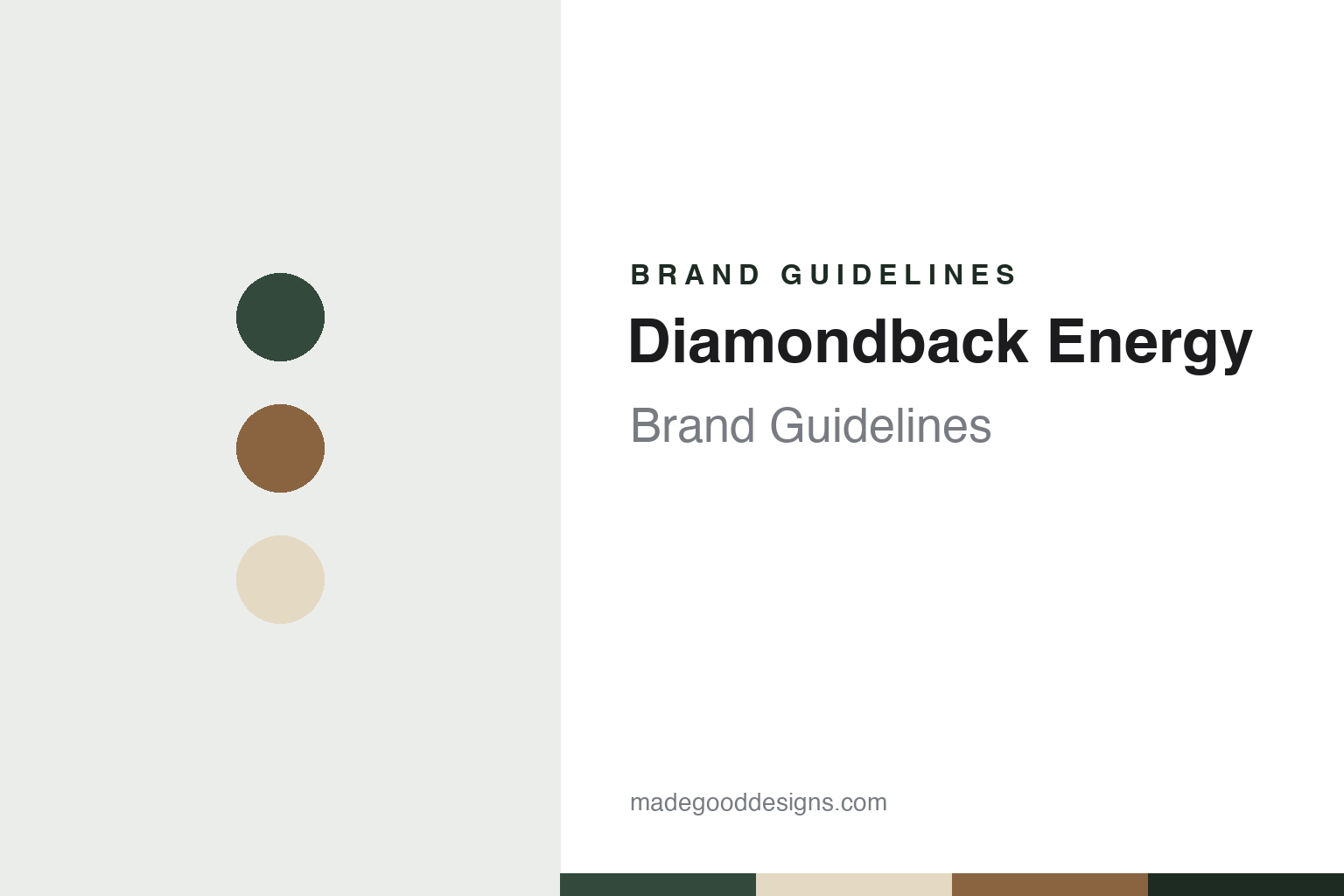
Two constants: a mesquite green, caliche and saddle brown palette and a sturdy grotesque register. Abstract homage — not a Diamondback Energy asset or mark; no logo, snake or photograph is reproduced.
Midland, 2007
A Permian start and a snake’s tooth on the ticker.
Diamondback Energy is an oil and gas producer based in Midland, Texas, and English Wikipedia describes it as a company engaged in exploration in the Permian Basin, the large sedimentary basin of west Texas and southeastern New Mexico. It began operations in December 2007 with the acquisition of 4,174 net acres in the Permian, according to the same article, which cites the company’s annual report filed with the US Securities and Exchange Commission.
The Permian is the setting for the whole story. English Wikipedia’s article on the basin names Midland, Odessa and San Angelo as Texas cities that serve as headquarters for oil production in the region, and divides the Permian into component basins, the Midland Basin being the largest and the Delaware Basin the second-largest. Diamondback’s acquisitions have kept it inside that map.
The company went public in October 2012 through an initial public offering on the Nasdaq. Its ticker, FANG, refers to a snake’s tooth, and the company’s logo at the time showed a Western diamondback rattlesnake, English Wikipedia says, citing the company’s own announcement of the completed offering. English Wikipedia lists the shares on the Nasdaq under FANG today.
Colour
Buying the neighbours’ acreage.
Diamondback grew through a string of Permian purchases. In March 2017 it bought assets from Brigham Resources, English Wikipedia says. In August 2018 it agreed to buy the privately held Ajax Resources of Houston, the Oil & Gas Journal reported on 10 August 2018. The deal added 25,493 net acres, about 21,000 of them in northwest Martin and northeast Andrews counties, and brought Diamondback’s total leasehold to 230,000 net surface acres in the basin, the journal said. The company told the journal that the Ajax acreage allowed pads of a dozen or more wells drilled into several layers, among them the Middle Spraberry, the Lower Spraberry and the Wolfcamp A. The acreage came with about 12,100 barrels of oil equivalent a day of production, 88% of it oil, and Diamondback counted 362 net potential horizontal drilling locations on it, according to the same report. The journal noted that the deal was announced alongside the company’s second-quarter results.
Larger deals followed. Diamondback completed its acquisition of Energen in November 2018; English Wikipedia says that at the end of 2017 Energen held 444 million barrels of oil equivalent of proved reserves, all of them in the Permian Basin. In 2021 Diamondback bought leasehold interests and assets from Guidon Resources in February and acquired QEP Resources in March, the same encyclopedia says.
The largest was Endeavor Energy Resources, a company founded in 1979 that English Wikipedia describes as one of the largest private oil producers in the contiguous United States; its first well was drilled in the Spraberry Trend, the article says. The merger was first announced in February 2024 and completed in September 2024, after two comprehensive reviews by the US Federal Trade Commission, Offshore Technology reported on 11 September 2024. Endeavor, with a workforce of more than 1,200, brought about 470,000 net acres, including 344,000 net acres in core counties of the Midland Basin, the publication said.
After the deal, Diamondback’s existing shareholders owned about 60.5% of the combined company and Endeavor’s equity holders about 39.5%. The company projected production of about 816,000 barrels of oil and gas a day from a footprint of about 838,000 net acres, Offshore Technology reported. In April 2025 Diamondback added Double Eagle IV, English Wikipedia says.
Typography
How producers present themselves.
Oil and gas producers sell crude, gas and liquids to refiners, traders and utilities rather than to shoppers, so most of their visual identity lives in places investors, partners, regulators and job seekers look. The pictures are familiar across the sector: drilling pads on open plains photographed from the air, with straight gravel roads running between them; offshore platforms and floating production, storage and offloading vessels, the FPSOs, standing in grey water; and geologists holding core samples cut from the rock they hope to produce.
The second register is the investor presentation. Producers set out their story in investor-day slides and quarterly decks built around acreage maps, with basins shaded in company colours, wells marked as dots and figures for inventory and reserves given in the units the industry uses. Names of basins and plays, such as the Permian, the Eagle Ford or the North Sea, often carry as much weight on these pages as the company’s own mark.
The third is reporting. Annual reports and sustainability reports sit beside each other on company websites, and the sustainability documents return to the same subjects year after year: methane, flaring, water and land use. Community-investment pages show schools, clinics and local programmes in the areas where a company drills, usually with photographs of the people involved rather than of the equipment.
Behind those formats, upstream companies often carry long histories of mergers, spin-offs and renamings, and their names can outlast the businesses that first used them. The guides in this group follow that record company by company, from the origins of each name to its current owner, and treat the colours and type shown here as our own interpretation rather than any company’s official system.
Aa
A sturdy grotesque for a company named after a West Texas snake. (Specimen set in Archivo, a sans STAND-IN; NOT the Diamondback Energy logo.)
Diamondback Energy
A Permian producer that stayed in Midland.
Those deals changed the company’s scale. English Wikipedia, citing Diamondback’s annual report for 2024, gives its estimated proved reserves at the end of that year as 3,557 million barrels of oil equivalent, of which 49% was oil, 27% natural gas liquids and 24% natural gas. The same article places the company 383rd on the Fortune 500 and 471st on the Forbes Global 2000.
The headquarters has not moved with that growth. Diamondback was a Midland company when it went public in 2012, it was described as Midland-based by the Oil & Gas Journal in 2018, and English Wikipedia gives Midland as its headquarters. Ajax, by contrast, was a Houston company, according to the Oil & Gas Journal.
The documented visual facts are the ones tied to its listing: the FANG ticker, chosen as a reference to a snake’s tooth, and the Western diamondback rattlesnake that appeared in the company’s logo at the time of the offering, according to English Wikipedia. The name, the ticker and the early logo all draw on the same rattlesnake.
For a design guide, Diamondback Energy shows how a name, a ticker and an animal can carry a single idea for a company whose real assets are acreage and wells in one basin. Compare EOG Resources and Occidental, two more US oil and gas producers in this series. For this guide we use a mesquite green, a pale caliche and a saddle brown with a sans, an unofficial interpretation; no product or logo is reproduced.
Explore & save
Keep Diamondback Energy’s identity on hand — save it to a board in the Made Good inspiration library.
Diamondback Energy identity set
Pin the Diamondback Energy mesquite green, caliche and saddle brown palette and the sturdy grotesque register to your own board.