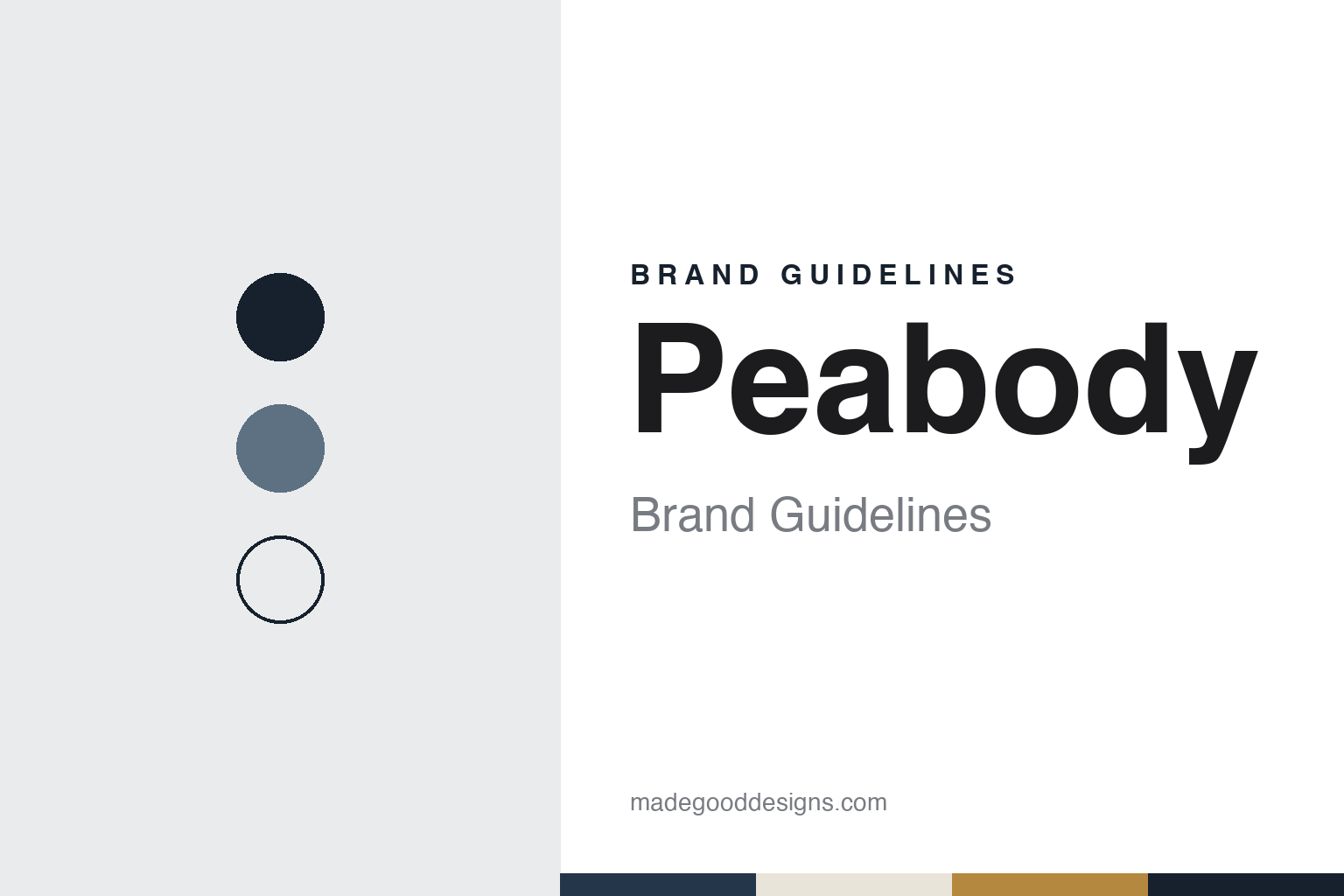
Peabody Brand Guidelines
A Chicago coal dealer of 1883 that became a St. Louis miner on two continents.
Aa
Two constants: a slate, sand and brass palette and an industrial sans register. Abstract homage — not a Peabody product or mark; no logo, mine photograph or nameplate is reproduced.
Peabody, Daniels & Company
A coal merchant in Chicago before it was a miner.
Peabody began as a seller of coal, not a digger of it. English Wikipedia says the business was founded in Chicago in 1883 as Peabody, Daniels & Company by Francis Peabody and a partner, and that it bought coal from established mines and sold it to homes and businesses around the city. In the late 1880s Peabody bought out his partner, and in 1890 the firm was incorporated in Illinois as the Peabody Coal Company.
Mining came next. Wikipedia dates the company’s first mine to 1895, in Williamson County in southern Illinois, followed by further Illinois operations. In 1913 it won its first long-term contract to supply the Chicago Edison Company, the forerunner of the utility Commonwealth Edison, and that link between a coal company and a power company set the pattern for much of what followed. The company first went public in 1929, on the Midwest Stock Exchange, and joined the New York Stock Exchange in 1949.
The move that gave Peabody its present home came in the 1950s. Wikipedia says that by the middle of the decade the company was losing ground to producers with cheaper surface mines, and that in 1955 it merged with the Sinclair Coal Company. The combined business kept the Peabody name but moved its headquarters to St. Louis, Missouri, where it remains. Under chairman Russell Kelce it expanded production and sales.
The same decade produced one of the company’s longest-running programmes. Wikipedia dates Peabody’s first land reclamation programme, Operation Green Earth, to 1954, and says the company has since been recognised by the United States Department of the Interior for reclamation work. In 1962 Peabody opened mining operations in Queensland, Australia, and formed an equity partnership with the Japanese trading house Mitsui & Co. and the Australian builder Thiess.
Colour
Kennecott, Hanson, Lehman Brothers, then the market.
For three decades Peabody was owned by other companies. Wikipedia says the Kennecott Copper Corporation bought it in 1968; the Federal Trade Commission challenged the purchase on antitrust grounds and in 1976 ordered Kennecott to sell. A newly created Peabody Holding Company, controlled by a consortium of companies, bought the coal business. In 1990 the British conglomerate Hanson, one of those owners, bought out the others.
Hanson let it go again in 1996, demerging Peabody and the Eastern Group as The Energy Group. When the utility TXU acquired The Energy Group, Peabody was sold to Lehman Brothers Merchant Banking Partners. The company returned to the stock market with an initial public offering in May 2001, and has been publicly traded since, apart from its time in bankruptcy.
The mine map changed through these years. Peabody opened the North Antelope and Rochelle mines in Wyoming’s Powder River Basin in 1983 and 1984, Wikipedia says, and North Antelope Rochelle is now its largest operation. It bought West Virginia mines from Armco in 1984, added Australian mines in 1993, and in 2006 completed the purchase of Excel Coal, an independent Australian producer. In October 2007 it spun off its West Virginia and Kentucky mines as Patriot Coal, and in October 2011 it took majority control of Queensland’s Macarthur Coal.
Some chapters are disputed. In 1964 and 1966 a Peabody subsidiary signed leases with the Navajo Nation and the Hopi Tribe for coal and water on Black Mesa in Arizona; Wikipedia records long-running objections over the leases and the use of the Navajo Aquifer, and Peabody’s position that its operations used a small share of the aquifer’s water. The Black Mesa Mine suspended operations in 2006 and was fully decommissioned in January 2010. In 2015 an investigation by the New York Attorney General concluded that Peabody had misled investors about climate-related financial risk; the settlement required revised disclosures, with no financial penalty and no admission of wrongdoing.
Typography
How coal companies present themselves.
Coal companies rarely sell to the public, so their identity work is aimed at investors, governments, customers in power and steel, and the communities around their mines. The visual language that follows is one of scale: draglines working an open pit, haul trucks on benched slopes, trains on loading loops and ships at export terminals. Peabody’s own description of itself as a supplier of “essential products for the production of affordable, reliable energy and steel” names both of the markets those pictures serve.
Alongside the pit photography sits a second register: the land after mining. Producers publish reclamation and rehabilitation pages, biodiversity and water sections, and reports on safety and community relations. Peabody, for example, groups climate, land, water, safety, human rights and cultural heritage under one sustainability menu on its website, and says it plans progressive restoration of land disturbed by mining.
A third theme is the future of the product itself. Thermal coal for power and metallurgical coal for steelmaking are often reported as separate businesses; Peabody, for instance, lists its mines under “Seaborne Metallurgical,” “Seaborne Thermal,” “Powder River Basin” and “Other U.S.” headings. Some producers point to other energy projects; Coal India, for one, describes a solar project in Gujarat on its own website. How much weight a company gives each story varies, and the guides in this round report what each one says rather than judging it.
The most consistent document in the category is the annual report, with its maps of mines, its tables of operations and its photographs of crews and equipment. For a designer, that report is often the clearest record of how a coal company wants to be seen: the identity is less a logo than a set of repeated scenes, from the open cut to the rail line to the restored hillside.
Aa
An industrial sans — the register of mine maps and annual reports. (Specimen set in Archivo, a sans STAND-IN; NOT the Peabody logo.)
Peabody
From Peabody Energy to Peabody.
The most recent turn in the story is a bankruptcy. Wikipedia says Peabody filed for Chapter 11 protection on 13 April 2016, after several years of heavy losses, and emerged on 3 April 2017, when it began trading again on the New York Stock Exchange under the ticker BTU. At the same time it changed its logo from “Peabody Energy” to plain “Peabody,” the name the company now uses on its website; the legal name in the site’s footer is still Peabody Energy, Inc. In 2018 it bought the Shoal Creek metallurgical coal mine from the Drummond Company.
A larger purchase did not go ahead. In November 2024 Peabody agreed to buy Anglo American’s steelmaking coal mines in Queensland — Moranbah North, Capcoal, Aquila and Grosvenor, as SteelOrbis listed them. After a fire at Moranbah North on 31 March 2025, Peabody withdrew from the deal; SteelOrbis reported on 22 August 2025 that Anglo American said the fire was not a material adverse change and would pursue arbitration for damages over what it called wrongful termination. Wikipedia says Anglo American began arbitration in late 2025.
Today Peabody describes itself as “a leading coal producer, providing essential products for the production of affordable, reliable energy and steel.” Its website groups its mines under seaborne metallurgical operations — including Centurion, Metropolitan and Shoal Creek — seaborne thermal mines at Wambo and Wilpinjong in New South Wales, the Powder River Basin, and other mines in the United States. Its sustainability pages, the company says, cover reclamation, water, safety and cultural heritage, including work with Traditional Owners in Australia.
For a design guide, Peabody shows how a coal company can keep a founder’s surname through a century of owners while trimming the word around it. Compare Anglo American, the other side of the abandoned 2024 deal, and Glencore. For this guide we use slate, sand and a brass accent with a sans, an unofficial interpretation; no product or logo is reproduced.
Explore & save
Keep Peabody’s identity on hand — save it to a board in the Made Good inspiration library.
Peabody identity set
Pin the Peabody slate, sand and brass palette and the industrial sans register to your own board.