Bursa Malaysia Brand Guidelines
A 1930 brokers’ association, a shared market with Singapore, and a new name in 2004.
Aa
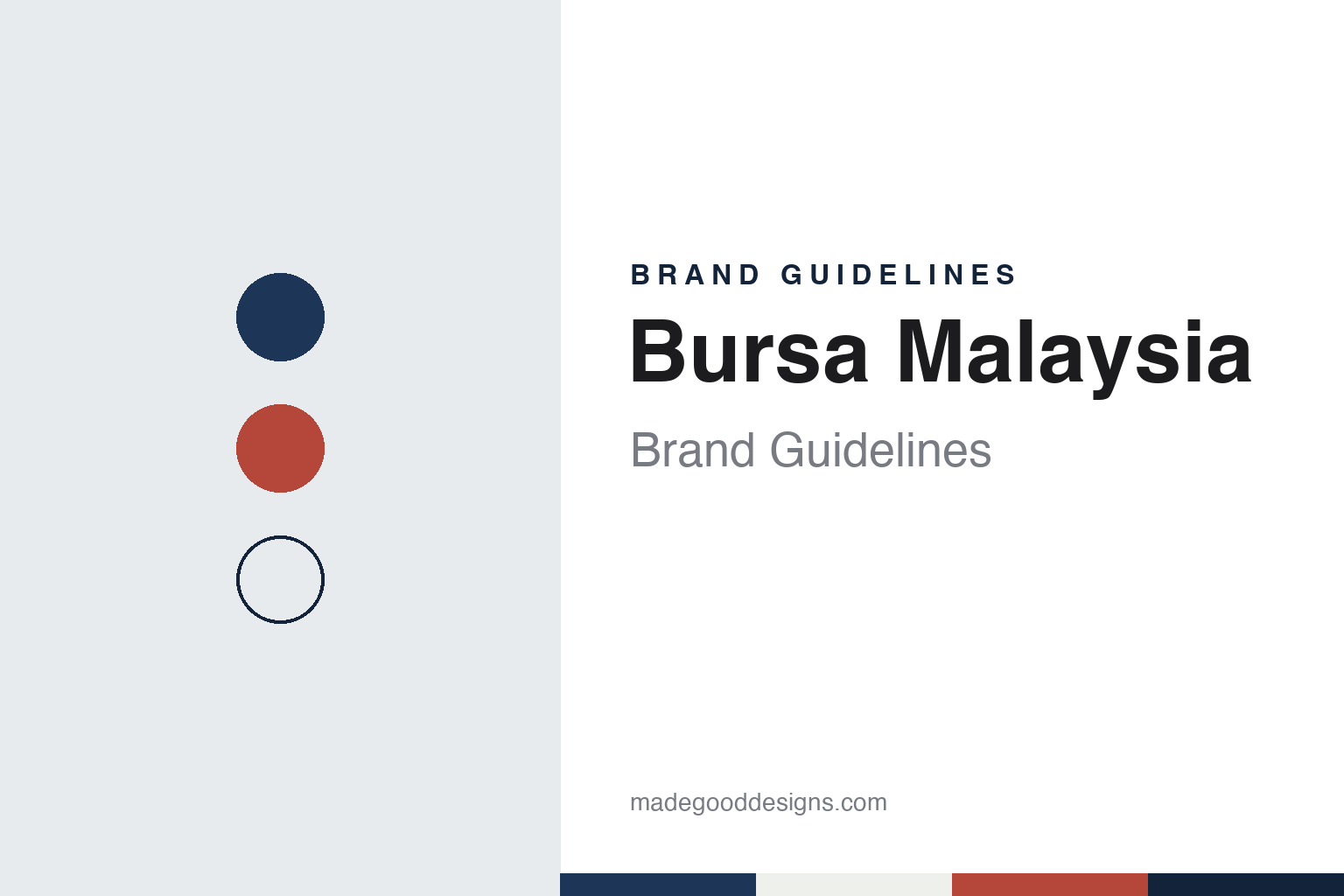
Two constants: a bourse blue, mist and laterite red palette and a rounded geometric sans register. Abstract homage — not a Bursa Malaysia asset; no logo, ticker or mark is reproduced.
From brokers’ club to KLSE
A market shared with Singapore, then split in 1973.
Bursa Malaysia’s story begins in 1930, when the Singapore Stockbrokers Association was set up as a formal securities organisation in Malaya, according to English and Malay Wikipedia. In 1937 it was re-registered as the Stockbrokers’ Association of Malaya, but it still did not trade shares to the public. The sources used for this guide do not say what became of the association during the Japanese occupation of Malaya and Singapore in 1942–45.
Public trading began with the Malayan Stock Exchange, which opened for business on 9 May 1960, both Wikipedia articles say. From 1961 a board system linked two trading rooms, one in Singapore and one in Kuala Lumpur, by direct telephone lines, so that the same shares traded at a single set of prices in both places. The Stock Exchange of Malaysia was formally formed in 1964; after Singapore separated from Malaysia in 1965, the exchange carried on as the Stock Exchange of Malaysia and Singapore.
The shared market ended in 1973, when Malaysia and Singapore stopped the interchangeability of their currencies. The exchange then divided into the Kuala Lumpur Stock Exchange Bhd and the Stock Exchange of Singapore, according to Wikipedia, though Malaysian companies remained listed in Singapore and Singaporean companies in Kuala Lumpur. A new company limited by guarantee, the Kuala Lumpur Stock Exchange, took over the operation of the market.
The exchange’s benchmark came later. English Wikipedia says the Kuala Lumpur Composite Index, or KLCI, was introduced on 4 April 1986, with a base value of 100 set at 1 January 1977.
Colour
Demutualisation, a new name and a listing.
By the early 2000s the exchange was preparing to become a shareholder-owned company. The market-infrastructure profile kept by the settlement house Clearstream says the KLSE was demutualised in January 2004, converting from a company limited by guarantee into a public company limited by shares.
The new name was announced first. On 14 February 2004 The Star reported that the Kuala Lumpur Stock Exchange would be called Bursa Malaysia once demutualisation was complete. The newspaper quoted the exchange’s executive chairman, Azlan Hashim, as saying the change was about “moving on with a new image” rather than abandoning the old name; that “Bursa” was a word used in many jurisdictions, including Italy and Spain; and that “Malaysia” reflected a consolidated group housing the securities market, the derivatives market, the offshore markets and the clearing houses. He acknowledged that there were contrary views about dropping the familiar KLSE name.
The switch took effect on 20 April 2004, according to the exchange’s announcement of that day, republished by Mondo Visione. Its chief executive, Yusli Mohamed Yusoff, said the launch completed the change of the exchange’s logo and name that followed demutualisation, and described it as the start of a wider transformation of its commercial and regulatory objectives.
A year later the exchange became a listed company itself. Malay Wikipedia dates Bursa Malaysia’s own listing to 18 March 2005, and Clearstream says its shares were listed on the Main Board in March 2005. In April 2005, Malay Wikipedia adds, it introduced a scheme giving all investors free access to research reports on companies listed on its market.
Typography
How exchanges present themselves.
Stock exchanges sell something that cannot be held: access to a market. Most of their public image is therefore built from rituals, rooms and numbers rather than products. One common ritual is the ceremony around the opening or closing of trading. Borsa İstanbul, for example, says it announces the start and end of each session by ringing a bell symbolically, offers bell-ringing ceremonies to listed companies and other organisations, and hands guests a crystal gong hammer as a keepsake.
Rooms come next. Older exchanges often began in borrowed spaces: the Shanghai Stock Exchange reopened in 1990 in the ballroom of a hotel on the Bund before moving to a purpose-built tower in Pudong. Exchanges also show off their trading floors and technology: Borsa İstanbul lists a renewed trading floor and a primary data centre among its milestones. Exchange buildings themselves, from façades to statues at the entrance, become part of the identity.
Numbers carry the rest. Index names such as the SSE Composite or the BIST 100 work as brands in their own right, quoted daily in news reports and printed on tickers and screens. Listing ceremonies supply the backdrops that newly listed companies use in their own announcements, and cross-border links such as Stock Connect give exchanges a story to tell about reach.
Exchanges also publish a great deal: annual and integrated reports, investor-education material and milestone timelines. This guide uses those documents alongside independent dated sources, and marks clearly where a fact rests only on the exchange’s own account. The palettes and typefaces shown are unofficial interpretations, not the exchanges’ own marks.
Aa
A rounded geometric sans for a short, two-word name. (Specimen set in Manrope, a sans STAND-IN; NOT the Bursa Malaysia logo.)
Bursa Malaysia
An exchange group with an index made with FTSE.
Today Bursa Malaysia is an exchange holding company. Clearstream describes three core businesses — exchange operations; clearing, settlement and depository operations; and information services — run by subsidiaries including Bursa Malaysia Securities, the exchange operator, a securities clearing house and the central depository. Its securities market has three boards: the Main Market, the ACE Market (the name stands for Access, Certainty, Efficiency) and the LEAP Market, for Leading Entrepreneur Accelerator Platform, according to Clearstream; English Wikipedia says the ACE Market grew out of the earlier MESDAQ board. Malay Wikipedia also lists derivatives, bonds and Islamic-markets subsidiaries and the Labuan International Financial Exchange, the offshore market.
The index changed its name too. In 2006 Bursa Malaysia began working with the index provider FTSE on a new series of indices for the Malaysian market, both Wikipedia articles say. On 24 June 2009 the exchange reminded the market that the KLCI would adopt FTSE’s global index methodology and be renamed the FTSE Bursa Malaysia KLCI from 6 July 2009. According to that announcement, the index would be made up of the 30 largest eligible Main Board companies, free-float adjusted and screened for liquidity, recalculated every 15 seconds instead of every 60, and opened at the old index’s closing value of 3 July 2009. Index futures and options and an exchange-traded fund that used the old benchmark moved to the new one on the same day, and an independent committee reviews its constituents every June and December.
English Wikipedia says that, together with the Securities Commission Malaysia, the exchange regulates the country’s capital market and maintains order in the trading of shares, bonds and derivatives. The name itself carries the history: bursa is the word for an exchange, and Malaysia replaced a city name that the market had used since 1973.
For a design guide, Bursa Malaysia shows how an exchange can trade a familiar acronym for a national name at the moment it changes ownership. Compare SGX, whose forerunner, the Stock Exchange of Singapore, was the other half of the 1973 split, and ASX. For this guide we use a deep bourse blue, a pale mist and a laterite red with a sans, an unofficial interpretation; no product or logo is reproduced.
Explore & save
Keep Bursa Malaysia’s identity on hand — save it to a board in the Made Good inspiration library.
Bursa Malaysia identity set
Pin the Bursa Malaysia bourse blue, mist and laterite red palette and the rounded geometric sans register to your own board.