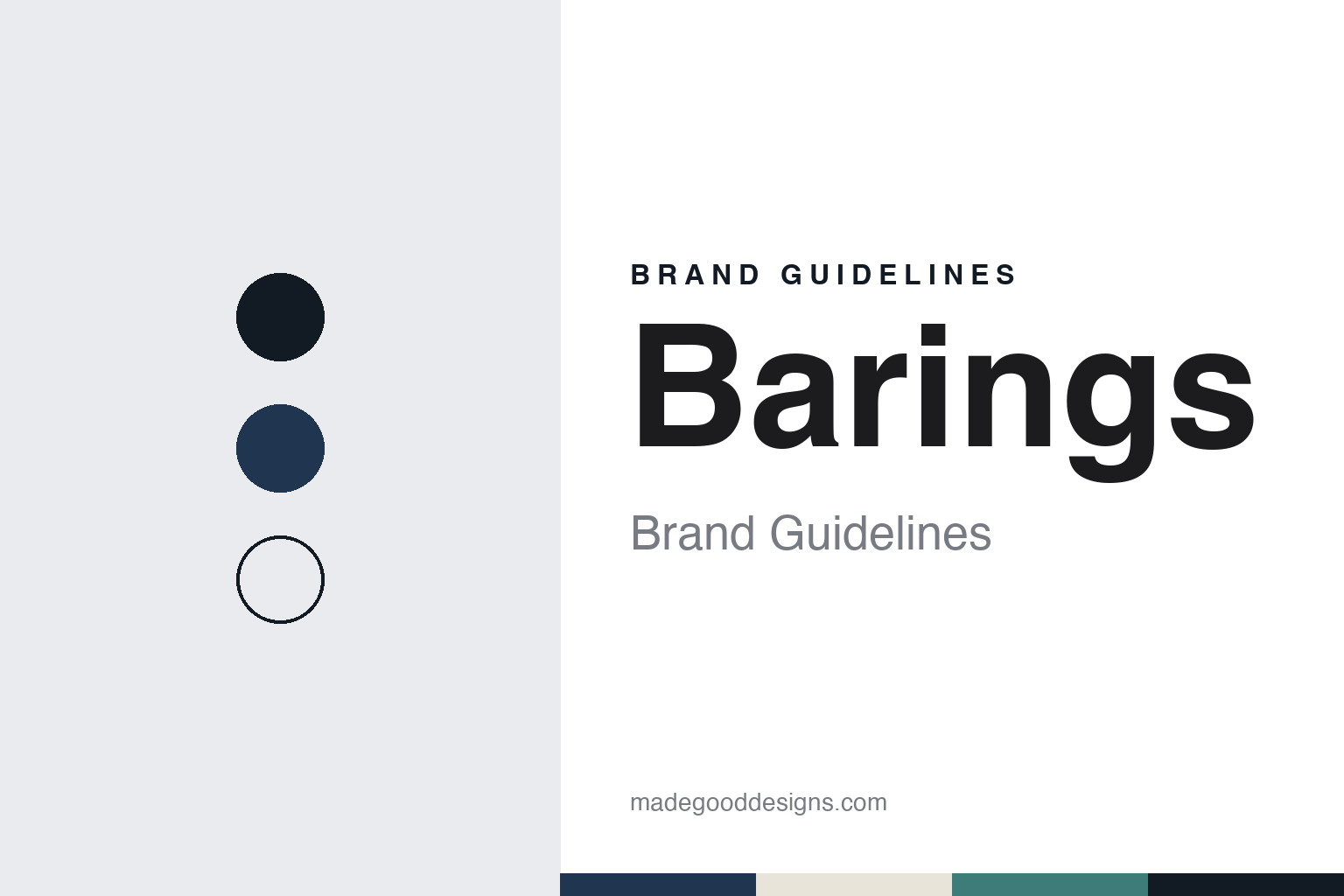
Barings Brand Guidelines
A 1762 London name carried by a MassMutual firm formed in 2016.
Aa
Two constants: a navy, teal and stone palette and a Ledger serif register. Abstract homage — not a Barings asset; no logo, document or mark is reproduced.
A 1762 Name
A London merchant house, a Boston firm and a Massachusetts insurer.
Barings, the investment manager, was formed in September 2016, when the Massachusetts insurer MassMutual brought four of its businesses together under one name: Babson Capital Management, Cornerstone Real Estate Advisers, Wood Creek Capital Management and Baring Asset Management, according to English Wikipedia and the company’s own history timeline. Wikipedia gives its headquarters as Charlotte, North Carolina. The name is far older than the firm: Barings dates its history to 1762, the year the London merchant house John & Francis Baring & Co was set up.
The American side came from Boston. Barings’ timeline says David L. Babson & Co. was established there in 1940 as a growth-equity firm, that MassMutual acquired it in 1995 and merged its own investment division into it in 2000, and that it was renamed Babson Capital Management in 2004, the year it bought the European leveraged-loan business Duke Street Capital Debt Management. Cornerstone, a real estate equity team, was spun off from MassMutual’s investment division in 1994, and Wood Creek was set up as a real assets joint venture in 2005, the company says.
The British side came through a collapse. Baring Asset Management, the fund-management arm of the old bank, passed to the Dutch group ING when the bank failed in 1995, and MassMutual later bought it from ING. The company’s timeline and Wikipedia date that purchase to 2005; the Baring Archive, the trust that keeps the bank’s papers, gives 2004. Wikipedia adds that MassMutual gained the right to use the Baring Asset Management name, while Northern Trust took the business’s financial services group.
Colour
The old merchant house.
The Baring Archive traces the family business to John Baring of Bremen, who settled in Exeter in 1717 as a merchant and manufacturer; in 1762 his sons founded the London house later known as Baring Brothers. It traded commodities, acted as London agent for overseas merchants and financed their trade, the archive says, and in the nineteenth century it issued securities for governments and railway companies, vying with Rothschilds for leadership of the London capital market. Barings’ own timeline lists its part in financing the Louisiana Purchase, which it dates to 1803, and the first external bond issue for Argentina in 1824; in 1886 the house floated Arthur Guinness Sons & Co, according to the archive.
That history includes slavery. English Wikipedia says the house traded in slave-grown cotton and slave-based mortgages, and that the slave trade enriched the family and the business. In a statement posted on 10 July 2020, the Trustees of the Baring Archive said that records in the archive relate to slavery, including the international trade in slave-grown commodities such as sugar and cotton and papers on mortgages over plantations where those crops were grown, and announced a working group to make those records more accessible to researchers.
In 1969 a majority stake passed to the newly founded Baring Foundation, and in 1985 a new top-level company, Barings plc, was set up, the archive says. Ten years later Barings became insolvent as a result of unauthorised trading by an employee in its Singapore office, and its business was acquired by ING. Wikipedia describes it as one of England’s oldest merchant banks. That bank no longer exists; today’s Barings is the MassMutual business that carries the name.
Typography
How private credit managers present themselves.
Private credit firms lend to companies directly rather than through banks or public bond markets, and they present themselves mainly to the investors whose money they manage rather than to consumers. Their websites tend to be restrained: a few corporate colours, plain sans or serif type, photographs of offices and people, and pages organised by investment strategy and by the kinds of client they serve. Blue Owl, for example, sorts its site by audience — asset managers, financial advisors, institutional investors and insurance companies — while Oaktree groups its work into credit, equity and real estate.
Writing carries much of the identity. Managers publish insight pieces, market outlooks and explanatory charts on how direct lending works, where loans sit in a company’s capital structure and how risk is shared. Oaktree’s co-founder Howard Marks has posted his memos publicly on the firm’s website for years, and its pages set out its investment philosophy as a short list of tenets. Team pages, dated timelines and accounts of past deals and portfolio companies do the work that advertising does for a consumer brand.
Listed vehicles add another layer. Many firms run business development companies, American funds that lend to private companies, some traded on a stock exchange and some not. Each needs its own investor-relations pages, with filings, results and shareholder letters; non-traded funds typically offer quarterly tender offers of up to 5% of shares, Reuters explained in July 2026, so their letters on withdrawal requests are public documents in their own right.
Ownership changes often. Many of the firms in this group were formed by merger, spun out of a bank or another manager, or bought by a larger asset manager, and their names, sites and visual identities are adjusted as they move. This guide sets out what can be checked about each firm — who founded it, who owns it and how it describes its business — and marks clearly what rests only on its own word.
Aa
A ledger serif for a 1762 name. (Specimen set in Source Serif 4, a serif STAND-IN; NOT the Barings logo.)
Barings
A MassMutual subsidiary with a Japanese partner.
Barings describes itself as a global alternative asset manager working across credit, real assets, capital solutions and emerging markets, for institutional, insurance and wealth clients. Its private credit pages cover global direct lending, capital solutions, infrastructure and corporate private placements, and it manages listed vehicles including Barings BDC, a business development company traded on the New York Stock Exchange that primarily makes debt investments in middle-market companies. Barings BDC began as Triangle Capital Corporation, which Barings acquired and renamed in 2018; it merged with MVC Capital in 2020 and with Sierra Income Corporation in 2021, the company says. Barings also lists purchases of Altis Property Partners in 2022, Gryphon Capital Investments in 2023 and Artemis Real Estate Partners, which it dates to 2025.
Ownership changed in 2026. On 14 May 2026, Insurance Business reported that MassMutual and Barings had completed the sale of an 18% stake in Barings to Japan’s MS&AD Insurance Group, through its core non-life subsidiary Mitsui Sumitomo Insurance. MassMutual keeps 82% and controlling governance rights, Barings continues to manage most of MassMutual’s general investment account, and Mitsui Sumitomo appoints one director to the Barings board, the magazine reported. The company now calls itself a subsidiary of MassMutual with a minority investment from MS&AD.
The firm also warns about misuse of its name. Its website says it has seen a rise in fraudulent websites, fake WhatsApp accounts and AI-generated voicemails impersonating its employees, that it does not do business on messaging apps, and that its web presence sits only on the barings.com domain.
For a design guide, Barings shows how a 1762 name can be carried by a firm formed in 2016, with the old house’s history kept in a separate archive. Compare Golub Capital, another manager of business development companies, and BlackRock. For this guide we use a deep navy, a muted teal and a warm stone with a serif, an unofficial interpretation; no product or logo is reproduced.
Explore & save
Keep Barings’s identity on hand — save it to a board in the Made Good inspiration library.
Barings identity set
Pin the Barings navy, teal and stone palette and the Ledger serif register to your own board.