DHT Brand Guidelines
Three letters from Double Hull Tankers, one ship type.
Aa
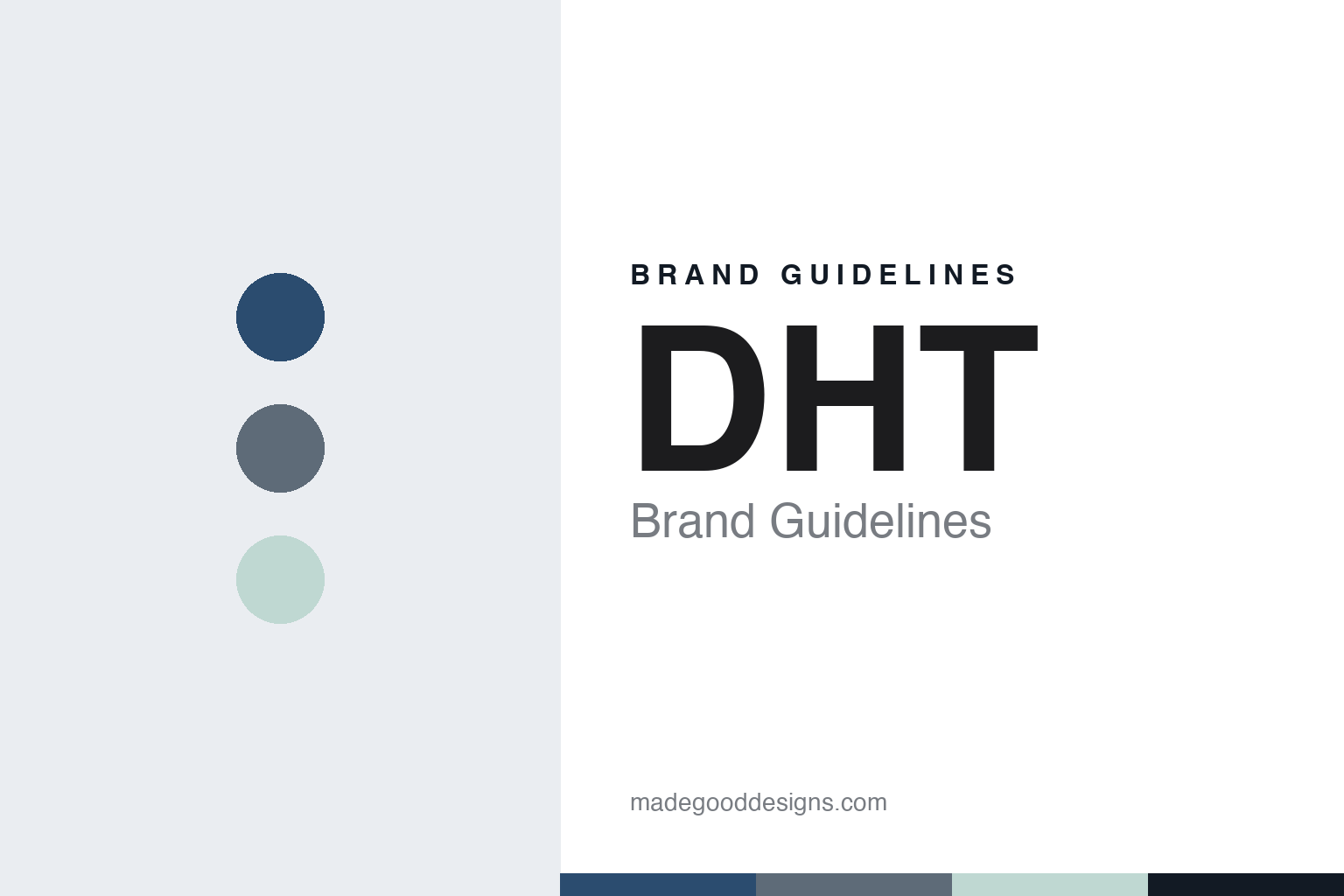
Two constants: a steel blue, slate and sea-foam palette of our own and a compact grotesque sans register. Abstract homage — not a DHT vessel, funnel or mark; no ship, logo or flag is reproduced.
Double Hull Tankers
A Marshall Islands company formed by OSG.
DHT began in 2005 as Double Hull Tankers, Inc., a newly formed Marshall Islands company wholly owned by Overseas Shipholding Group (OSG), the American tanker owner. In September 2005 MarineLink reported that it had filed for an initial public offering and planned to buy seven oil tankers — three very large crude carriers (VLCCs) and four Aframaxes — from OSG subsidiaries and to charter them back to other OSG companies. DHT says it was formed and listed on the New York Stock Exchange that year, with the seven ships carrying long-term time charters.
The early company was, in its own later words, more of a “leasing type” business, chartering its ships to OSG companies. At the end of 2007 and in early 2008 it added two Suezmax tankers on long-term bareboat charters. In March 2010 a series of transactions made DHT Holdings, Inc., a new Marshall Islands corporation, the publicly held parent of the original company, by then called DHT Maritime, Inc.; each shareholder received one share of the new company for each share held in the old.
The turn came in September 2010, when the Norwegian shipping partners Svein Moxnes Harfjeld and Trygve P. Munthe joined as senior management. DHT says it then set out to become an operational shipowner, building its own staff in wholly owned management companies; today it names those as being in Monaco, Norway, Singapore and India. The Royal Gazette of Bermuda, which describes DHT as Bermudian-based, still named Moxnes Harfjeld as chief executive in June 2026.
Colour
Samco, BW Group and a contest for control.
Growth came through two large purchases. In September 2014 DHT bought all the shares of Samco Shipholding, a privately owned shipowner in Singapore whose seven VLCCs averaged four and a half years old, along with Samco’s half share in Goodwood Ship Management, a Singapore ship manager. In March 2017 it acquired BW Group’s VLCC fleet: eleven ships, including two newbuilding contracts, which DHT says expanded its VLCC fleet by half and made BW Group, the maritime group owned by the Sohmen Pao family, a significant shareholder.
That deal came during a contest for control. In April 2017 MarineLink reported that the oil tanker firm Frontline, then holder of 14.5 percent of DHT, had spent the past year trying to buy the whole company and had made a fifth all-share offer. Frontline took its opposition to the BW transaction to the high court of the Marshall Islands, where DHT is incorporated, and the court agreed to hear the complaint on 17 May 2017. DHT remains a separately listed company today.
Since then DHT has narrowed to one ship type. The Royal Gazette described it in June 2026 as operating only VLCCs, ships able to carry about two million barrels of oil, and said its website listed 24 of them. Its newest ships include the DHT Antelope and DHT Addax, delivered by Hanwha Ocean in January and March 2026, and the DHT Gazelle, delivered from the Hyundai yard in March 2026, with the DHT Impala due from Hyundai later that summer. In June 2026 DHT ordered another VLCC from Hanwha Ocean for delivery in August 2028, adding it to what the company calls its “Antelope Class” series; a later report in the same paper named that ship the DHT Oryx.
Typography
Design and documentation.
A tanker or dry-bulk owner sells a service rather than a product, so its identity has to live on its ships and in its paperwork. The oldest signs are the funnel mark and the house flag, painted or flown on every vessel the company operates; today the same hull in company livery is more often seen in an aerial photograph taken from a drone, the ship shown loaded and under way, filling the first screen of a corporate website.
Behind that picture sits the fleet list. Owners publish their ships by class and by name, from the very large crude carriers and Suezmax tankers of the crude trade to Capesize and smaller bulk carriers. Frontline’s home page, for example, counts its VLCCs, Suezmaxes and LR2/Aframax tankers, while CMB.TECH groups its ships under division names such as Euronav for oil tankers and Bocimar for dry bulk. Vessel names can run in a family too: Bocimar’s ships usually carry the prefix Mineral, English Wikipedia says.
Most owners also give space to crew welfare and safety, to environmental reporting and to the next generation of ships. Newbuilding and fuel announcements carry much of the story: CMB.TECH, for one, uses the slogan “Decarbonise Today, Navigate Tomorrow” and in 2026 presented a dry-bulk ship it describes as ammonia-powered, while Frontline’s 2026 fleet-renewal deal was framed around scrubber-fitted “ECO” newbuildings.
Because so many of these companies are listed in New York, Oslo or Brussels, the investor-relations section often does the heaviest lifting: quarterly results, presentations, dividend histories and charts of freight rates. This guide sets out what can be checked about each company — where it was founded, who controls it and what became of its name — and marks clearly what rests only on the company’s own word.
Aa
A compact grotesque sans for a three-letter name. (Specimen set in Archivo, a sans STAND-IN; NOT the DHT logo.)
DHT
An investor-facing tanker company.
DHT describes itself as an independent crude oil tanker company whose fleet trades internationally, employed through a combination of market exposure and fixed-income contracts — spot voyages alongside multi-year time charters. The Royal Gazette reported in September 2026 on three-year charters for the 2016-built DHT Panther and the 2015-built DHT Jaguar, and on a five-year charter for the DHT Harrier agreed that January. The company sets out a capital-allocation policy of cash dividends, investment in vessels, debt prepayments and share buybacks. In June 2026 it also agreed a new seven-year revolving credit facility, arranged by Nordea Bank with a syndicate that included ING Bank, DNB Bank and ABN AMRO, The Royal Gazette reported.
Its self-presentation is plain and investor-facing. The website speaks of “first rate operations and customer service,” “quality ships” and a “transparent corporate structure,” and is organised around investor-relations pages — dividend policy, quarterly and annual reports, SEC filings and webcasts — with downloadable images of its vessels and people and a podcast. The name began as the initials of Double Hull Tankers, a description of the ships it was formed to own; the listed company today is DHT Holdings, Inc., known simply as DHT.
In June 2026 The Royal Gazette also reported design upgrades for the two Hyundai-built ships, intended, the company said, to ensure trading eligibility and commercial flexibility, with the DHT Gazelle to return to the yard after its cargo commitments and the DHT Addax taking its place on a long-term charter in the meantime.
For a design guide, DHT shows how a company can keep a technical founding name as three letters while its fleet, management and strategy change around it. Compare Teekay, another Bermuda-based tanker group, and Frontline, which bid for DHT in 2016–17. For this guide we use a steel blue, a slate grey and a pale sea-foam with a sans, an unofficial interpretation; no product or logo is reproduced.
Explore & save
Keep DHT’s identity on hand — save it to a board in the Made Good inspiration library.
DHT identity set
Pin the DHT steel blue, slate and sea-foam palette and the compact grotesque sans register to your own board.