Slaughter and May Brand Guidelines
Two founders’ surnames, kept unchanged since 1889.
Aa
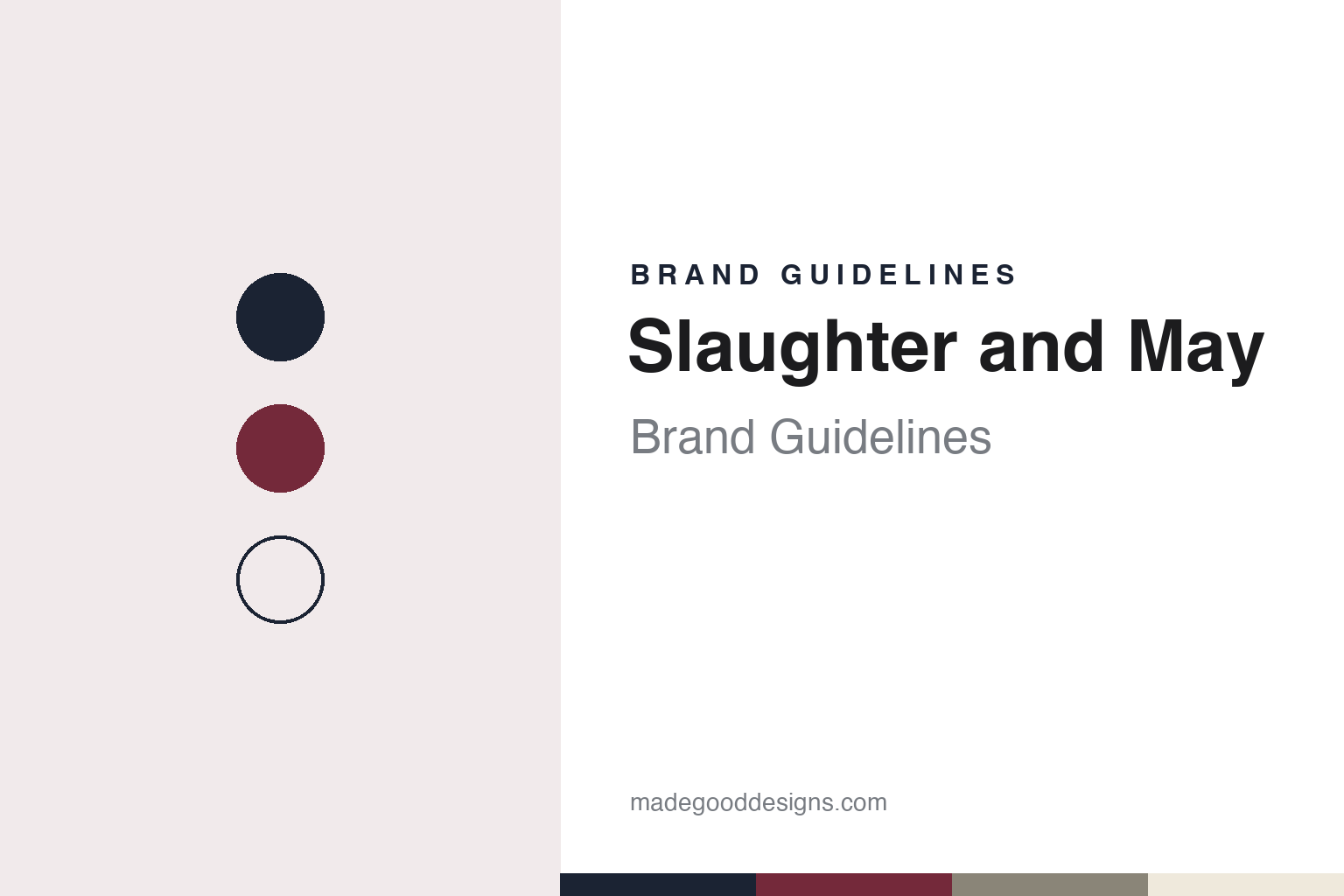
Two constants: an ink navy, oxblood and parchment palette and a classic serif register. Abstract homage — not a Slaughter and May asset; no logo or mark is reproduced.
1 January 1889
Two young solicitors in the City of London.
Slaughter and May was founded in the City of London on 1 January 1889 by two solicitors, William Capel Slaughter and William May. The firm says the two met while training together in the City; English Wikipedia adds that both had previously been at Ashurst Morris Crisp, the firm now known as Ashurst. The firm has kept the founders’ two surnames as its name ever since.
The firm’s own timeline sketches the decades that followed. It says that in the 1920s and 1930s it acted for more merchant banks than any other law firm, naming Schroders, Barings and Rothschilds among its clients. In the 1940s and 1950s, it says, it set up departments for specific areas of law while keeping what it calls a multi-specialist approach, in which lawyers work across several fields rather than one. In 1974 it opened an office in Hong Kong; both the firm and English Wikipedia describe it as the first London firm to do so. In the 1980s and 1990s, the firm and Wikipedia both say, it acted on UK privatisations including British Airways, British Gas and British Steel.
Slaughter and May is usually counted among London’s “Magic Circle” firms; English Wikipedia uses the term for a group of large London-based multinational firms. Unlike most large UK firms, which operate as limited liability partnerships, Wikipedia says Slaughter and May remains a traditional general partnership, and so is not required to publish public accounts.
Colour
Few offices of its own, many partner firms abroad.
What sets the firm apart among its peers is how little of its international work runs through its own offices. Besides London, it has offices in Hong Kong, Beijing (opened in 2009) and Brussels. English Wikipedia records that it closed its New York office in September 2004 and its Singapore office in October 2004, referring US work to Wall Street firms and South-East Asian work to the Australian firm then called Allens Arthur Robinson. In December 2005, Wikipedia adds, it agreed to hand its Paris office to the French firm Bredin Prat.
Instead the firm relies on a network of independent partner firms, which it describes as close working relationships with market-leading independent firms around the world. Wikipedia names some of them, among them Bredin Prat in France, Hengeler Mueller in Germany, BonelliErede in Italy and Uría Menéndez in Spain, along with firms in Australia, New Zealand, South Korea and Japan. Many of these have little overseas presence of their own, Wikipedia notes, so they do not compete with Slaughter and May. The firm says it works in more than 130 countries and with more than 270 law firms each year, and that in 2007 it moved its Brussels office into shared premises with several of these partner firms.
Other milestones the firm lists include a 2002 move to its current London office, becoming a founding member of the Race to Net Zero Lawyers Alliance in 2021, and a six-year Solicitor Apprenticeship Scheme for school leavers launched in 2024. In April 2026, Artificial Lawyer reported that the firm was adopting the full platform of the legal AI company Harvey across all of its practice areas. The firm has also appeared in less flattering public records: in May 2018, English Wikipedia notes, a joint report by two House of Commons committees on the collapse of the contractor Carillion criticised the fees taken by the company’s advisers, Slaughter and May among them.
Typography
How UK and global law firms present themselves.
Large UK and global law firms sell advice rather than objects, so their identities rest on names, words and a small number of visual constants. Many trade under founders’ surnames that have been shortened or combined through mergers, and the wordmark is usually set plainly, in one weight, with the colour doing quiet work: often a single accent, used sparingly against white, grey or a dark neutral.
The firm website carries most of the brand. A typical site is organised around expertise and sectors, with practice pages for areas such as finance, disputes or competition, and an office list or map that shows how many cities and countries the firm covers. Partner profiles, with photographs, practice areas and contact details, sit at the centre of the client-facing pages, because clients often choose a lawyer as much as a firm.
Firms also publish a steady stream of thought leadership: insights, briefings, blogs, webinars and seminars on regulation, markets and technology. Alongside these sit annual reports or results pages, statements on responsible business, inclusion and sustainability, and pro bono reports that describe unpaid work for charities and community groups. Graduate-recruitment pages, sometimes run as separate microsites, address law students with a different, warmer voice, while alumni networks keep former lawyers in touch.
The firms in this guide, many of them with long roots in London, share that vocabulary, but their histories differ: some go back to the eighteenth or nineteenth century, others are the products of mergers this century, and several now operate as international partnerships spanning dozens of countries. This guide sets out what can be checked about each one, from founding and mergers to how it presents itself today, and marks clearly what rests on the firm’s own word.
Aa
A classic serif for two founders’ surnames. (Specimen set in Source Serif 4, a serif STAND-IN; NOT the Slaughter and May logo.)
Slaughter and May
Two surnames, unchanged since 1889.
The firm’s name has not changed in more than 135 years, and that constancy is the clearest part of its identity. Where many large firms have lengthened their names through mergers or cut them to initials, Slaughter and May still carries the two founders’ surnames joined by a plain “and” rather than an ampersand. Some legal press shortens it to “Slaughters”, as Artificial Lawyer did in its April 2026 report.
The firm sets out four core values on its website: the highest standards, independence of thought, collective endeavour and respect for all. It says it has more than 1,400 partners and staff worldwide, and it says it acts for more FTSE 350 companies than any other law firm. Its offices are few, its international reach runs through partner firms, and its name has stayed as it was in 1889; those are the facts a designer has to work with.
For a designer, the name itself is the main asset: three words of very different lengths, with a short connective in the middle, which sit comfortably on one line in a classic serif. A single dark colour for text and one restrained accent for headings or rules are enough for a firm whose public material is mostly written: client briefings, guides, sustainability reports and recruitment pages. None of the sources used for this guide documents the firm’s colours or typefaces, so the tones below are our own.
For a design guide, Slaughter and May shows how a firm can let an unchanged founders’ name do the work of a brand. Compare it with Linklaters and Freshfields, two other London firms with long histories. For this guide we use ink navy, oxblood, stone grey and parchment with a serif, an unofficial interpretation; no product or logo is reproduced.
Explore & save
Keep Slaughter and May’s identity on hand — save it to a board in the Made Good inspiration library.
Slaughter and May identity set
Pin the ink navy, oxblood and parchment palette and the classic serif register to your own board.