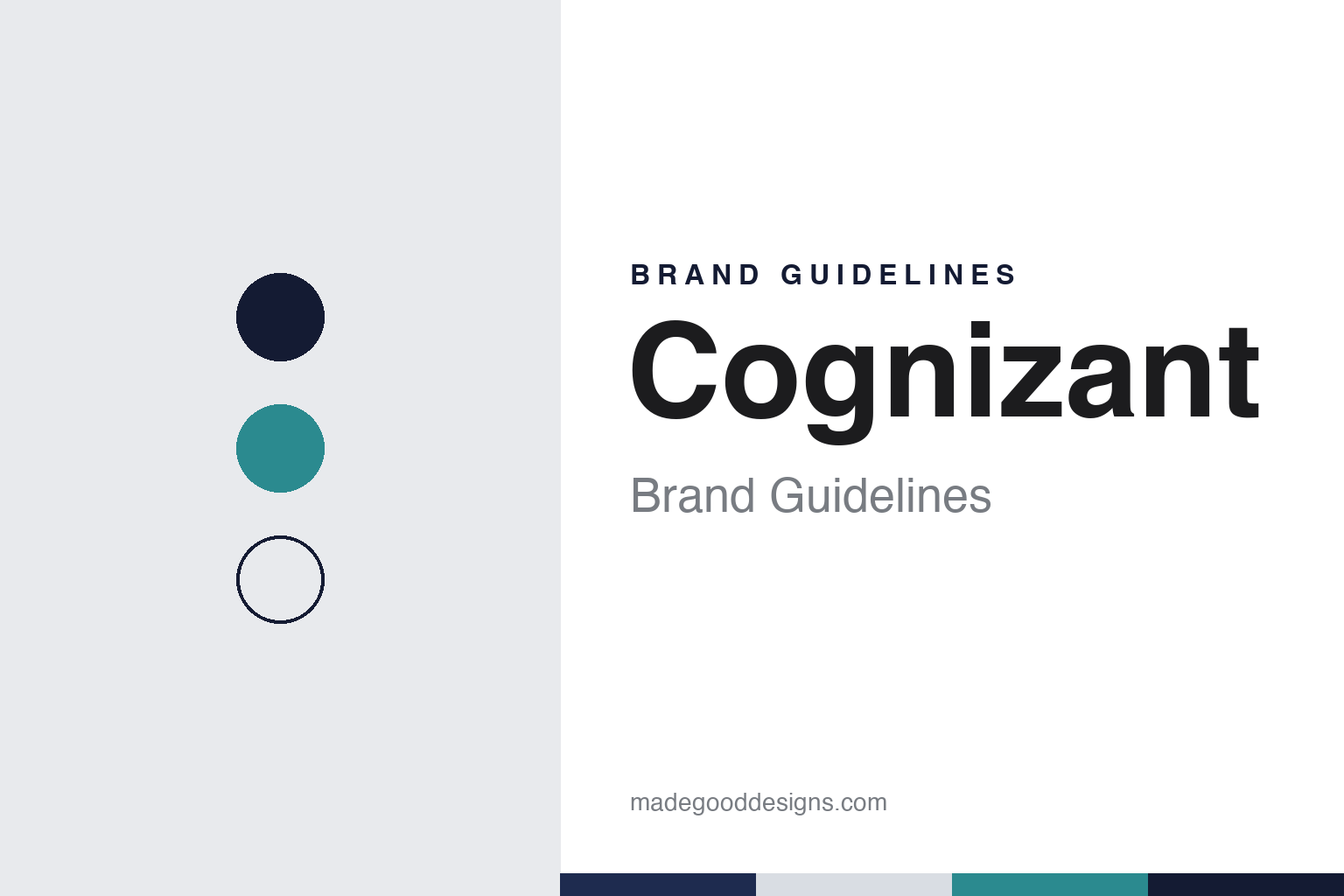
Cognizant Brand Guidelines
A Dun & Bradstreet technology unit in Chennai that became a Nasdaq-listed services company.
Aa
Two constants: a Cognizant navy, teal and grey palette and a geometric sans register. Abstract homage — not a Cognizant asset or mark; no logo or wordmark is reproduced.
Dun & Bradstreet Satyam Software
An in-house technology unit in Chennai.
Cognizant did not start as a company of its own. English Wikipedia says it was set up in 1994 in Chennai, India, as Dun & Bradstreet Satyam Software (DBSS), a joint venture in which Dun & Bradstreet held 76 per cent and Satyam Computers 24 per cent. It began with about 50 employees as Dun & Bradstreet’s in-house technology unit, carrying out large IT projects for the group’s own businesses, and in 1996 it started looking for customers outside the group.
The name came from a reshuffle at the parent. In 1996, English Wikipedia says, Dun & Bradstreet spun off several subsidiaries — among them IMS International, Nielsen Media Research and DBSS — into a new company called Cognizant Corporation. In 1997 DBSS renamed itself Cognizant Technology Solutions; in July that year Dun & Bradstreet bought Satyam’s 24 per cent stake, and the head office moved to the United States. Its early work centred on Y2K projects and web development.
In 1998 the parent split again, into IMS Health and Nielsen Media Research, and Cognizant Technology Solutions became a public subsidiary of IMS Health. In June 1998 IMS Health floated part of the business in an initial public offering, and the shares were listed on Nasdaq. IMS Health sold its remaining stake of about 56 per cent in 2003, English Wikipedia says, and from then on Cognizant stood alone.
Colour
From Y2K projects to a global services firm.
Independence brought rapid growth. English Wikipedia records Cognizant joining the Nasdaq-100 index in 2004, moving into the S&P 500 in November 2006 and entering the Fortune 500 in 2011. Over those years its work widened from software projects into business process outsourcing and consulting, organised into industry units such as banking, insurance, healthcare, manufacturing and retail, and into technology units such as analytics and testing. In September 2014 it bought TriZetto, a healthcare IT services company.
The head office is in Teaneck, New Jersey, but most of the people work in India. English Wikipedia says that at the end of 2023 about 254,000 of more than 347,700 employees were in India, across 13 cities, with Chennai and Hyderabad the largest bases by 2024, followed by Bengaluru. It also lists delivery centres in countries including the UK, Hungary, the Philippines, Canada, Brazil and Mexico. The company’s own website now gives a global headcount of about 356,700.
The name became more visible outside the IT trade through sport. In January 2021, English Wikipedia says, the newly renamed Aston Martin Formula One team announced Cognizant as its title sponsor. The same year the company became a partner of golf’s Presidents Cup, title partner of the LPGA Tour’s Founders Cup and a digital partner of the sailing league SailGP, and by 2024 it was also title sponsor of Major League Cricket in the United States.
Its community work runs largely through the Cognizant Foundation, registered in India in March 2005 as a charitable company to support education and healthcare programmes, and through an employee volunteering scheme called Outreach, English Wikipedia says.
Typography
How IT services firms present themselves.
IT services and consulting firms sell work that is hard to photograph: software, systems, advice and the people who deliver them. Their identities therefore lean on a small set of tools. Wordmarks are usually set in a confident sans-serif, often in capitals or as a short set of initials, and palettes tend to sit in blues and purples, from deep navy to bright violet, used across websites, reports and event stands.
Their websites follow a familiar structure. Industry pages address banks, insurers, retailers, manufacturers and public bodies one by one, while capability pages cover cloud, data, cybersecurity, AI and consulting. Client case studies carry much of the proof, usually naming the customer and describing a programme of work rather than a product, and many firms publish their own research reports, surveys and indices to show expertise and to be quoted in the business press.
Place matters too. Delivery centres and offices are often photographed as campuses, with landscaped grounds, glass buildings and training halls, and those images recur across annual reports, recruitment material and news coverage. Careers pages speak directly to graduates and early-career engineers, with training programmes, campus recruitment and employee stories, alongside pages for experienced hires and alumni.
The last layer is public commitment. Sustainability reports, community programmes, education initiatives and sponsorships of sport and culture give the brand a presence beyond the client meeting, and in the case of sponsorship can put a company name on a stadium, a team shirt or a city race. The guides that follow look at how each firm uses those tools, and where its own history shows through.
Aa
A geometric sans for a mark built around one letter. (Specimen set in Plus Jakarta Sans, a sans STAND-IN; NOT the Cognizant logo.)
Cognizant
A new logo, a tagline and a court case.
Cognizant’s present identity dates from 21 March 2022, when the company announced a new logo and the tagline “Intuition engineered”. Its press release described the change as the latest evolution of its brand identity, meant to reflect its focus on digital technologies such as artificial intelligence, cloud, the Internet of Things and software engineering, and quoted its chief marketing officer as saying that perceptions of the company had not shifted as fast as the company itself. The newsroom offered the logo for download with usage guidelines.
The new mark, a hexagonal “C”, soon met a legal challenge in India. In an order dated 19 March 2024, The Hindu BusinessLine reported, the Bombay High Court temporarily barred Cognizant from using the logo in India on a suit by Atyati Technologies, a Bengaluru company whose orange hexagonal honeycomb device had been in use since early 2019. The case then went back and forth. In September 2025, Moneycontrol reported, the Supreme Court of India set aside a Division Bench ruling that had again restricted the logo, restored an earlier High Court order declining an injunction, and asked the High Court to decide the application within six months; Cognizant said the hexagonal logo had already been rolled out across its platforms as part of its global brand identity. On 7 July 2026, The Hindu BusinessLine reported, the Bombay High Court rejected Atyati’s plea for interim relief, finding that Cognizant had shown it created the logo independently and that the two companies’ services and customers were distinct.
Today the company presents itself as a builder of artificial-intelligence systems for large enterprises, with “AI Builders” as the headline of its own About page, alongside pages on its values, its social purpose and its careers.
For a design guide, Cognizant shows how a corporate spin-off can carry its parent’s name into a global brand and then redraw its mark around a single letter. Compare Dun & Bradstreet, the company it grew out of, and Accenture, another consulting and technology services firm. For this guide we use a deep navy, a teal and a cool grey with a sans, an unofficial interpretation; no product or logo is reproduced.
Explore & save
Keep Cognizant’s identity on hand — save it to a board in the Made Good inspiration library.
Cognizant identity set
Pin the Cognizant navy, teal and grey palette and the geometric sans register to your own board.