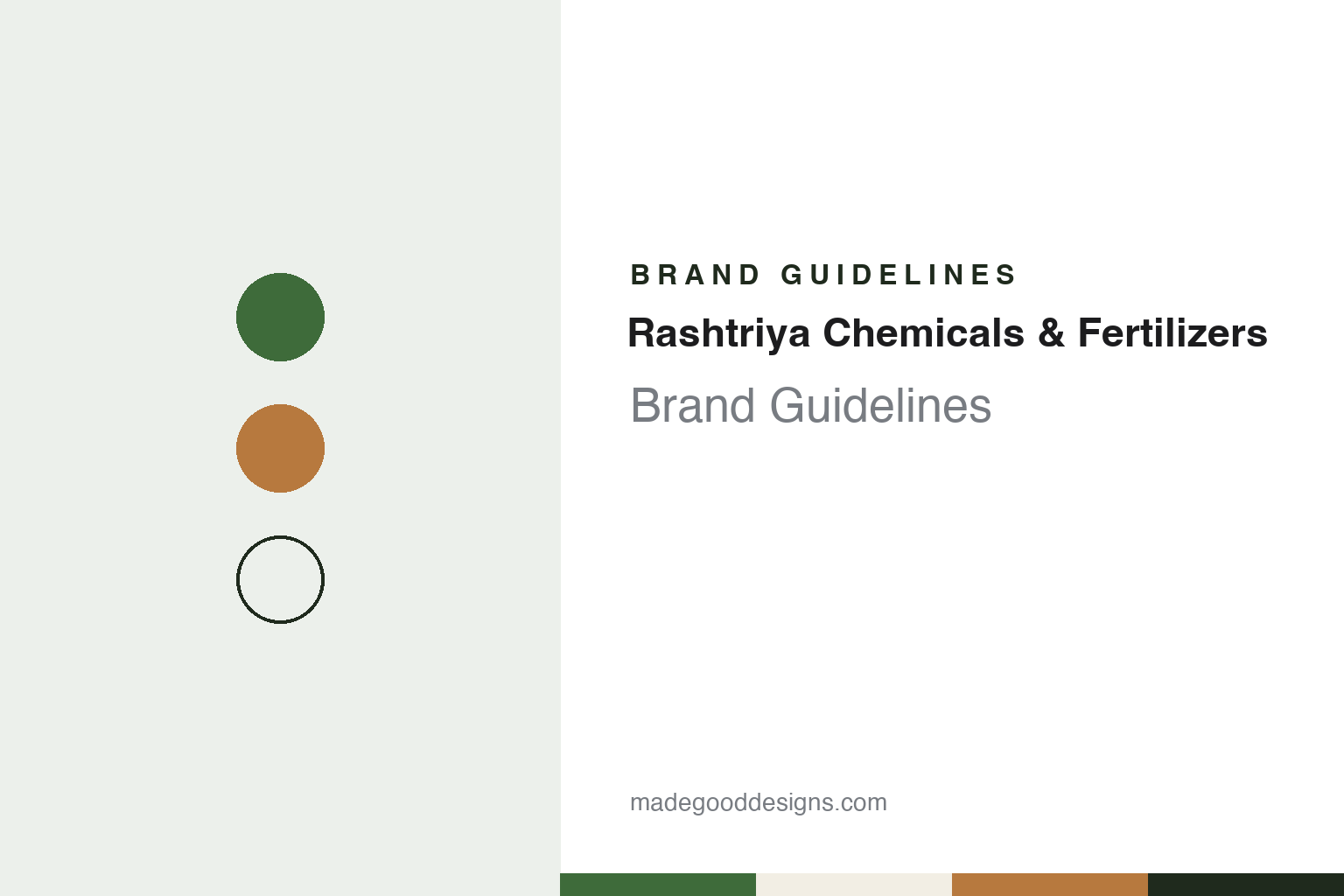
Rashtriya Chemicals & Fertilizers Brand Guidelines
The Mumbai fertiliser maker behind the Suphala name.
Aa
Two constants: a green, ochre and off-white palette and a public-works sans register. Abstract homage — not a Rashtriya Chemicals & Fertilizers product or mark; no logo, bag or wordmark is reproduced.
Trombay and Thal
A state fertiliser company in Maharashtra.
Rashtriya Chemicals and Fertilizers, usually shortened to RCF, is an Indian state-owned maker of fertilisers and industrial chemicals based in Mumbai. English Wikipedia describes it as a central public sector undertaking owned by the Government of India and under the administrative control of the Ministry of Chemicals and Fertilizers. The government holds about 75 percent of the shares: the financial news site IIFL gave that figure as of June 2024, and the company gives the same proportion on its “RCF at Glance” page.
The company is a product of reorganisation. The first state-owned fertiliser unit in India was set up at Sindri in 1951, followed by units at Nangal and Trombay, according to English Wikipedia’s history of the Fertilizer Corporation of India, which was incorporated in 1961 to bring such units together. In 1978 that corporation was split up: new entities including Hindustan Fertilizer Corporation, Projects and Development India and RCF were formed, and the Trombay plant passed to RCF. English Wikipedia’s own article on RCF also dates the company’s establishment to 1978.
RCF has two operating units. Trombay lies within Mumbai, and Thal is in Raigad district, about 100 kilometres from the city, the company says. Hindi Wikipedia says the Thal urea plant has operated since 1985 and puts its output at 17.07 lakh tonnes of urea a year; it also names two plants making the complex fertilisers Suphala 15:15:15 and Suphala 20:20:0, granular grades that combine nitrogen, phosphorus and potash.
The product list is broad. On its “RCF at Glance” page the company lists urea, complex fertilisers, a sulphur-coated urea sold as Urea Gold, and speciality products: bio-fertilisers, micronutrients, fully water-soluble fertilisers and soil conditioners. Alongside fertilisers it makes industrial chemicals which, it says, go into dyes, solvents, leather, pharmaceuticals and other industrial products, sold through its Industrial Products Division.
Colour
Suphala, Bharat Urea and a farm magazine.
RCF’s brands are aimed at farmers and dealers rather than at shoppers. In an interview that the Free Press Journal dates to June 2019, the company’s chairman named Ujjwala and Suphala as its well-recognised brands, and said that RCF also marketed imported fertilisers, among them di-ammonium phosphate, muriate of potash and NPK grades, alongside its own output. The same interview described a marketing network in 20 major states.
The current product pages use a further set of names. Urea appears as Bharat Urea, with its nitrogen content and granule size given as specifications, and the coated variant as Bharat Urea Gold. Other names include Sujala, which the company describes as a fully water-soluble fertiliser containing nitrogen, phosphorus and potash for greenhouse and field crops; Microla, a micronutrient product; and Bharat NPK 15:15:15. The same page says RCF is setting up a nano urea plant at its Trombay unit based on technology developed by IFFCO, and The Economic Times reported in August 2023 that the plant had received environmental clearance from the Ministry of Environment, Forest and Climate Change.
Communication with farmers runs through extension work. The company lists soil testing in fixed and mobile laboratories, Kisan Suvidha Kendras, or farmer service centres, dedicated farmer training centres at Thal and Nagpur, field demonstrations and exhibitions. It publishes RCF Sheti Patrika, which it calls a monthly magazine; its site carries monthly issues and quarterly Hindi editions through 2026. A toll-free Kisan Care line, a “Kisan Manch” mobile app and a dealer portal called RCF Dealer Parivar complete the set, and its social media accounts run under the handle @rcfkisanmanch. The website itself is offered in English and Hindi.
The company names its management-system certifications. It says both units are accredited to ISO 9001, ISO 14001 and ISO 50001, among other standards, and that RCF is certified for product stewardship under the International Fertilizer Association’s Protect & Sustain programme.
Typography
How fertiliser makers present themselves.
Fertiliser makers sell to two very different audiences at once: farmers and dealers on one side, and industrial buyers, investors and governments on the other. Their public material tends to reflect that split. Green fields, ripening crops and harvest scenes sit beside photographs of mines, process plants, storage domes and port terminals, so that the farm and the factory appear under the same name.
Much of what these companies publish is practical. Crop-nutrition guides, product-grade explainers and nutrient ratios printed as plain numbers, such as an NPK grade written out in full, do a good deal of the identity work. Many makers add agronomy tools, soil-testing services, call centres or field demonstrations for growers, and present them as part of the brand rather than as an extra.
The investor side has its own documents. Annual reports, quarterly statements, sustainability and emissions reports and filings to stock exchanges give these companies a steady, formal voice, often with maps of plants and shipping routes. Capacity figures, new plant projects and joint ventures appear there first, usually dated and attributed, and they are the most reliable record of how a maker has grown.
Distribution is the last layer. Fertiliser reaches farms through dealer networks, cooperatives, regional offices and state channels, and the bag, the dealer sign and the product name are often what a grower actually sees. The guides that follow look at each company through what can be checked: who founded it, who owns it, where it makes its products, how it presents itself and, where it matters, how its name and ownership have changed over the decades.
Aa
A plain, sturdy sans for a public-sector producer. (Specimen set in Hind, a sans STAND-IN; NOT the Rashtriya Chemicals & Fertilizers logo.)
RCF
Navratna status and new plants.
RCF’s standing within the state sector changed in August 2023, when the Government of India granted it Navratna status. The Economic Times reported the decision on 29 August 2023, citing the company’s filing to the stock exchanges. RCF says it was the first public sector company in the fertiliser sector to be elevated to the Navratna category.
Several projects are under way or proposed. In October 2024 the company’s board approved an order to Larsen & Toubro for a complex fertiliser plant of 1,200 tonnes a day at Thal, to be built on a lump-sum turnkey basis over about 27 months, IIFL reported. The company’s new-projects page also lists an ammonia plant revamp at Thal and a coal-gasification fertiliser plant at Talcher in Odisha. English Wikipedia describes Talcher Fertilisers as a joint venture of GAIL, Coal India and RCF, with the Fertilizer Corporation of India as a smaller partner, formed to revive a closed fertiliser unit with urea made from coal.
In July 2026 GAIL and RCF signed a memorandum of understanding for a proposed gas-based urea project in the Vidarbha region of Maharashtra, with a planned capacity of 1.27 million tonnes a year, to be developed through a special purpose vehicle along a GAIL gas pipeline, The Tribune reported, carrying the ANI news agency. The memorandum was signed on 29 July 2026; the project had not been built at the time of writing.
The visible brand is mostly agricultural: urea and complex fertilisers sold under the Suphala and Bharat names through a dealer network, a farm magazine, service centres and a helpline, with the Trombay and Thal units as the base. RCF shares trade on the National Stock Exchange, with the government as majority holder.
For a design guide, Rashtriya Chemicals & Fertilizers shows how a state-owned producer speaks to farmers through product names and extension work rather than through a corporate image. Compare Chambal Fertilisers and GSFC, two other Indian fertiliser makers. For this guide we use a paddy green, a clay ochre and an off-white with a sans, an unofficial interpretation; no product or logo is reproduced.
Explore & save
Keep Rashtriya Chemicals & Fertilizers’s identity on hand — save it to a board in the Made Good inspiration library.
Rashtriya Chemicals & Fertilizers identity set
Pin the Rashtriya Chemicals & Fertilizers green, ochre and off-white palette and the public-works sans register to your own board.