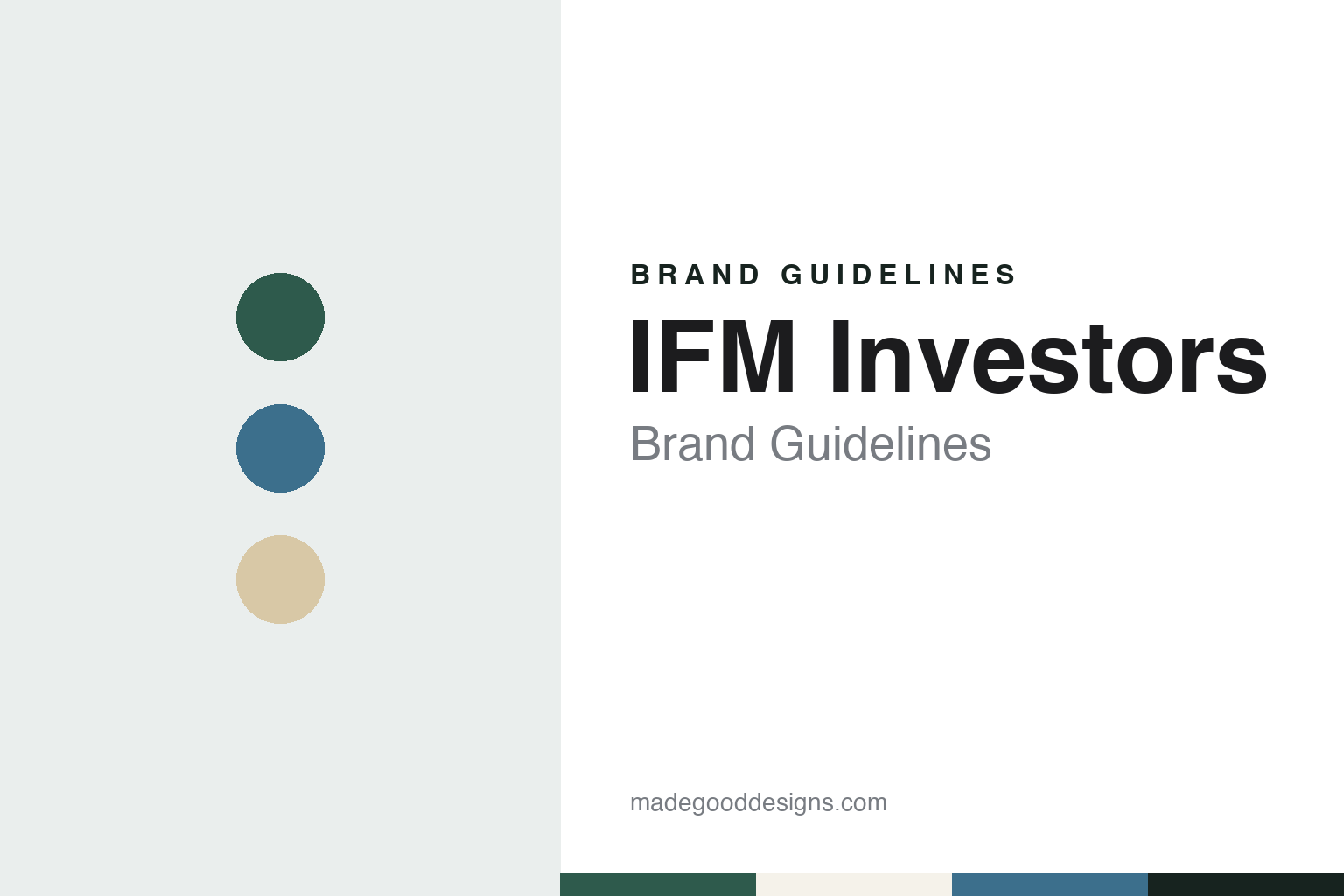
IFM Investors Brand Guidelines
The Melbourne manager owned by the pension funds it invests for.
Aa
Two constants: a eucalypt green, bay blue and sandstone palette and a steady serif register. Abstract homage — not an IFM Investors asset or mark; no logo, photograph or wordmark is reproduced.
Development Australia Fund
A trustee, a manager and a merger.
IFM Investors traces its start to Melbourne in 1990. The company says it had its origins in the Australian union movement and the idea of an investment vehicle owned by investors and investing on their behalf; that year the Development Australia Fund, known as DAF, was set up as a trustee. English Wikipedia says DAF was created to invest in growing Australian companies and infrastructure assets.
The investment business came next. In 1994, the company says, Australian industry superannuation funds came together and Industry Fund Services (IFS) was appointed manager for DAF. IFS launched infrastructure and private equity strategies in 1995, which IFM says helped pioneer private-markets investing in Australia, followed by an Australian listed equities capability in 1996 and a debt capability in 1999. English Wikipedia spells the manager’s name slightly differently, as Industry Funds Services.
The two strands were joined in 2004. IFM’s account says Industry Funds Management was created by bringing together a department of IFS, its Private Capital Group, and DAF, centralising investment and administration for the funds DAF served; Wikipedia calls the same arrangement a merger of IFS Capital Group and DAF. In the same year the new manager launched a global infrastructure capability, and it soon followed its investors’ money abroad, opening its first international office, in London, in 2006 and one in New York in 2007.
Expansion continued through the next decade and a half. IFM lists offices opened in Sydney in 2011, Berlin in 2013, Tokyo in 2014, Hong Kong in 2016, Seoul in 2017, Zurich in 2018, Amsterdam in 2021 and Milan in 2023. In 2008, IFM says, it signed the United Nations-supported Principles for Responsible Investment, a date English Wikipedia also gives.
Colour
A new name before Tokyo.
The name changed in 2013. Infrastructure Investor reported on 21 October 2013 that the Melbourne-based manager had “renamed itself” shortly before opening a new office in Tokyo the following year, and English Wikipedia dates the change from Industry Funds Management to IFM Investors to the same year. The new name kept the familiar initials while dropping the Australian industry-fund wording, and added a plain description of what the firm does.
The company frames its work through its owners. Its stated purpose is “to invest, protect and grow the long-term retirement savings of working people,” and its website says it is owned by a collective of 15 Australian industry super funds and one UK pension fund, an ownership model it says aligns its purpose with its investors’ objectives, while it operates independently of those owners. The owners listed on the website include AustralianSuper, Cbus Super, Hostplus and UniSuper. English Wikipedia says the firm invests for pension, superannuation and sovereign wealth funds, universities, insurers, endowments and foundations around the world, and its website now comes in editions for North America, the UK and Europe, Asia, Australia, Japan and Korea, each under the same IFM Investors name.
Its holdings are the kind of assets people use without noticing the owner. English Wikipedia says IFM holds a stake of about 35% in Manchester Airports Group, bought to help fund the group’s purchase of Stansted Airport, alongside the ten metropolitan borough councils of Greater Manchester; that the company operating the Indiana Toll Road is owned by IFM; and that the data centre company Switch was taken private in December 2022 by DigitalBridge and IFM Investors.
Typography
How infrastructure investors present themselves.
Infrastructure investors sell something hard to picture: long-term ownership of things other people use every day. Their websites therefore lean on the assets themselves. Macquarie Asset Management’s pages open on named portfolio companies, from a New Zealand telecoms provider to an onshore wind farm in north-eastern Brazil, and Brookfield Infrastructure sorts its portfolio into utilities, transport, midstream and data, with ports, railways, toll roads and pipelines named as the things it owns and runs.
The language is consistent too. Brookfield Infrastructure speaks of “critical infrastructure” and long-life assets with contracted and regulated revenues; Macquarie Asset Management says it seeks results “over the long term.” Responsible-investment wording sits alongside it: Macquarie’s purchase of the former UK Green Investment Bank in 2017, renamed Green Investment Group, came with a green “special share” held by independent trustees, according to the UK government’s announcement of the sale.
Listed vehicles add another layer of documents. Brookfield Infrastructure publishes quarterly results, supplemental information, letters to unitholders and investor-day presentations, and in 2026 it set out a plan to fold its two listed securities into one. Parent groups publish annual reports and history timelines; Macquarie’s runs from a three-person Sydney office in 1969 to the motorway deal of 1994 that it calls the start of its infrastructure business.
Trade rankings are part of the picture. Infrastructure Investor’s II 100 list of managers placed GIP, by then part of BlackRock, at the top in November 2024, and noted that Macquarie, first in every earlier edition, had dropped to fourth. This guide sets out what can be checked about each firm — who founded it, who owns it and how it presents its portfolio — and marks clearly what rests only on the company’s own word.
Aa
A steady serif for a manager that speaks for pension savers. (Specimen set in Source Serif 4, a serif STAND-IN; NOT the IFM Investors logo.)
IFM Investors
Real estate joins, and a British owner arrives.
Two recent changes widened the firm. In December 2024 the Australian property manager ISPT, also owned by industry super funds, joined IFM Investors. IFM’s media release of 15 December 2024 said the transaction was carried out by scheme of arrangement after the ISPT board endorsed IFM’s binding offer in August and ISPT’s shareholders voted for it in December, and that Friday 13 December was the first day of the two businesses joining together. The release said there would be no significant immediate change to day-to-day operations, branding or client services, with integration to happen gradually; it added real estate as a new asset class on IFM’s platform.
The ownership group changed in 2025. IFM’s own history says Nest, the UK workplace pension scheme, became a 10% shareholder and the firm’s first overseas owner. Pensions Expert reported on 2 June 2026 that Nest had taken the stake early in 2025, becoming the first non-Australian owner of a group set up and owned by Australian superannuation funds, and that it was continuing to commit money to IFM strategies, including a credit mandate focused on climate technologies.
Through these changes the name has stayed the same since 2013. IFM Investors presents itself in the voice of its owners and their members, with the language of retirement savings and responsible investment that runs through its own history and purpose pages.
For a design guide, IFM Investors shows how an investment brand can lead with who owns it and whom it works for. Compare GIP, another investor in airports and data centres, and Macquarie Asset Management, another Australian-born infrastructure manager. For this guide we use a eucalypt green, a bay blue and sandstone with a serif, an unofficial interpretation; no product or logo is reproduced.
Explore & save
Keep IFM Investors’s identity on hand — save it to a board in the Made Good inspiration library.
IFM Investors identity set
Save the IFM Investors eucalypt green, bay blue and sandstone palette and the steady serif register to your own board.


