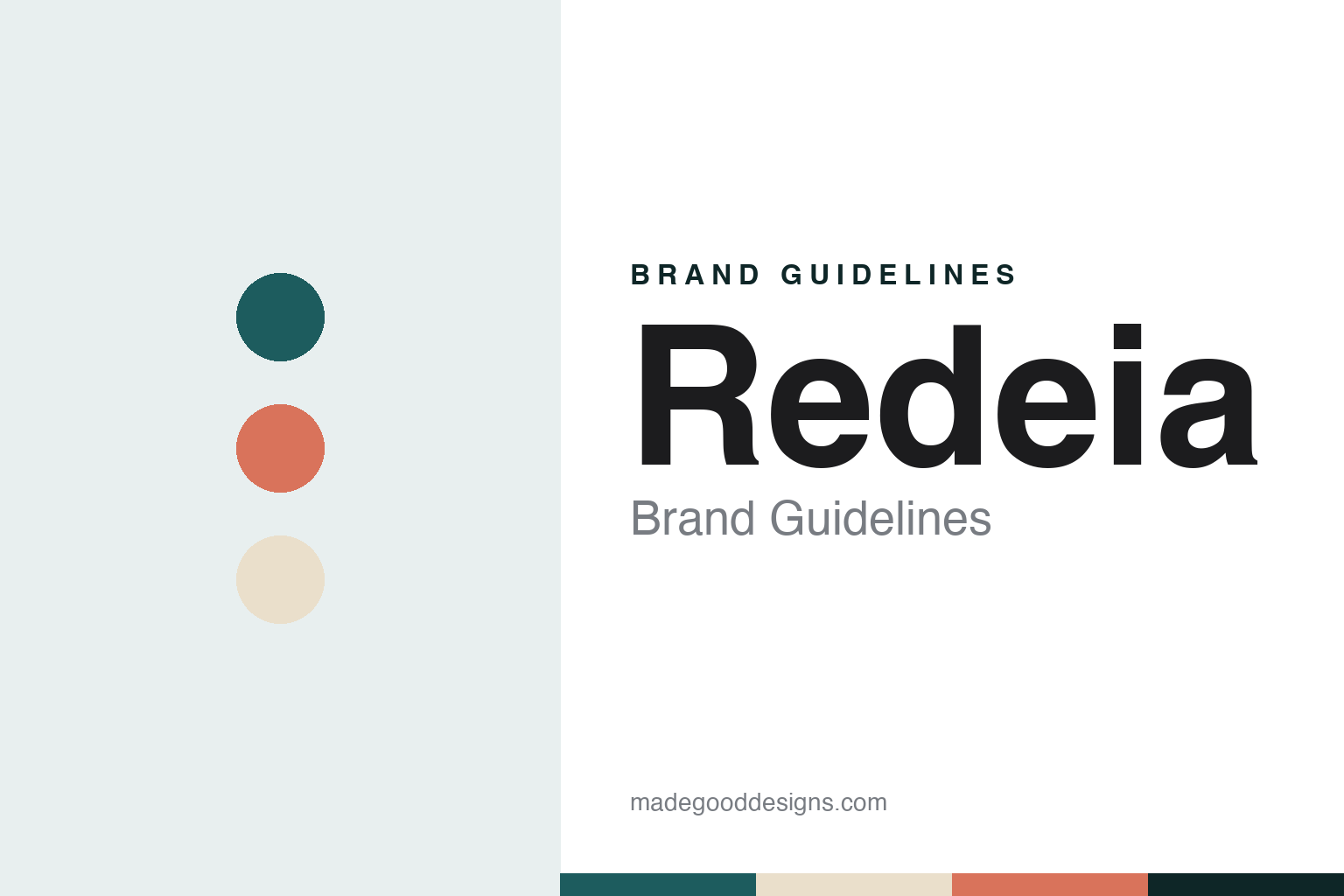
Redeia Brand Guidelines
The Spanish grid group that grew out of Red Eléctrica.
Aa
Two constants: a Redeia teal, coral and sand palette and a Geometric sans register. Abstract homage — not a Redeia asset or mark; no pylon, logo or nameplate is reproduced.
Red Eléctrica
A 1985 company for one national grid.
Redeia began as Red Eléctrica de España, founded in 1985. Spanish Wikipedia says it was set up under Law 49/1984 on the unified operation of the national electricity system, and English Wikipedia says the state industrial holding company INI created it to provide a unified national power grid. The company says it celebrated its 40th anniversary on 29 January 2025, and describes itself as having started life as the first transmission system operator anywhere; Spanish Wikipedia similarly calls it the first company devoted solely to transmitting electricity and operating the system.
Its role was fixed by law. The Electricity Sector Act of 1997 confirmed it as system operator, and a 2007 law, adapting Spanish rules to a European directive, made it the sole transmission company and operator of Spain’s high-voltage system, Spanish Wikipedia says; in 2010 it completed the purchase of the transmission assets of the electricity companies, including the Balearic and Canary Islands systems. The company says it was privatised and listed through a public offering in 1999 and joined the IBEX 35 index in 2004. The state holding company SEPI keeps 20% of the shares, with the rest traded freely, Spanish Wikipedia says.
The group was known as the Red Eléctrica Group until 2022, when, the company says, it “became Redeia.” Spanish Wikipedia also dates the trade name to 2022. The listed holding company is Redeia Corporación, S.A., and the grid company itself keeps the name Red Eléctrica.
Colour
Wires, fibre and satellites.
Red Eléctrica owns almost all of Spain’s high-voltage electricity grid, Spanish Wikipedia says — more than 45,000 kilometres of lines and more than 5,000 substation bays — and, as system operator, forecasts demand and runs generation and transmission in real time so that output matches consumption, on the mainland and on the islands. It publishes real-time figures on demand, the generation mix and the associated emissions on its website.
The company’s own timeline lists the milestones: the first electricity interconnection with Morocco in 1997; a control centre for renewable energy, CECRE, in 2006; INELFE, a company owned in equal shares with the French operator RTE, in 2008 to carry out links between Spain and France; the commissioning of a Spain–France cross-border connection in 2015; the Salto de Chira storage scheme in the Canary Islands, begun in 2022; and the submarine link between Ibiza and Formentera in 2023. Work on the first underwater interconnection with France, through the Bay of Biscay, began in 2024, it says, and in 2025 it completed the submarine link between Tenerife and La Gomera.
The group also built a telecoms arm. The company says it began developing fibre optics along the grid in 1997; Reintel, formed in 2015, runs the fibre networks of Red Eléctrica and of the rail-infrastructure body ADIF, and Spanish Wikipedia gives it more than 33,000 kilometres of fibre. Abroad, Redinter holds transmission businesses in Peru and Chile, and the company says it began transmission work in Brazil in 2020. Elewit, created in 2019, is its technology platform. In May 2012 Bolivia’s government announced the nationalisation of the Bolivian subsidiary TDE, and in November 2014 it agreed to pay compensation, English Wikipedia says.
In 2019 Red Eléctrica bought about 90% of the satellite operator Hispasat, Spanish Wikipedia says. That holding has since been sold: on 30 December 2025 Indra completed the purchase of 89.68% of Hispasat from Redeia once the conditions of the agreement were met, as both companies told Spain’s securities regulator, RTVE reported.
Typography
Design and documentation.
Electricity transmission operators sell nothing a customer can hold, so their identities lean on the network itself. Most present a short corporate name set in a clean sans-serif wordmark, often with a small symbol or a single letter given weight, and keep the type plain enough to sit on a substation gate, a hard hat or a regulatory filing without change. Blue, green and yellow are the familiar colours of the category, read as sky, landscape and current.
Photography does much of the work. Pylons are shown in fields, dunes and mountain valleys, substations are framed against open sky, and cable ships, converter platforms and offshore islands stand in for the reach of a grid that crosses borders. People appear mostly as engineers and line crews in protective clothing, photographed at work rather than posed.
The websites follow a shared pattern. A grid map and an interconnector page show where lines run and which countries they link, and a network development plan sets out future routes and upgrades as the operator dates and describes them. Many publish real-time system data, with dashboards for load, generation, cross-border flows and balancing prices, and open consultation pages where residents and landowners can comment on planned lines.
The last regular section is recruitment. Careers pages address electrical engineers, technicians, data specialists and graduates, and present grid building as long-term public work. For a designer, the category is a study in restraint: a calm wordmark, a limited palette and a library of landscape, map and data imagery carry an identity that has to be trusted more than it has to be noticed.
Aa
A geometric sans for a group built around a network. (Specimen set in Manrope, a sans STAND-IN; NOT the Redeia logo.)
Redeia
A network of five brands, and a day without power.
On 28 April 2025, at 12:33 Central European Summer Time, the power systems of mainland Spain and Portugal suffered a total blackout, according to ENTSO-E, the European association of transmission system operators. A small area of south-west France near the border saw brief disruption; the rest of the European system was not significantly disturbed. ENTSO-E set up an expert panel on 12 May 2025, with 49 members drawn from transmission operators, regional coordination centres, ACER and national regulators. Its final report, presented on a page last updated on 20 March 2026, concluded that the blackout resulted from a combination of many interacting factors, including oscillations, gaps in voltage and reactive-power control, differences in voltage-regulation practices, rapid output reductions and generator disconnections in Spain, and uneven stabilisation capabilities, which led to fast voltage increases and cascading disconnections. The panel set out recommendations on operating practice, monitoring and coordination. English Wikipedia notes that a cyberattack was ruled out.
The company presents its identity as a network. Redeia says its name and identity reflect “the network” at the heart of its business — five brands and more than 2,000 people — and describes a visual system built from “routes, lines that connect words and shapes,” meant to be fluid and adaptable; it publishes its logos and an identity book, in Spanish only. Beatriz Corredor is chairwoman and Roberto García chief executive, according to its website, which also describes a strategic plan for 2026–2029.
For a design guide, Redeia shows how a state-founded grid operator can rename its group while the grid company keeps its original name. Compare RTE, its partner in INELFE, and EDP, the Portuguese utility on the same peninsular grid. For this guide we use a deep teal, a warm coral and a sand tone with a sans, an unofficial interpretation; no product or logo is reproduced.
Explore & save
Keep Redeia’s identity on hand — save it to a board in the Made Good inspiration library.
Redeia identity set
Pin the Redeia teal, coral and sand palette and the Geometric sans register to your own board.


