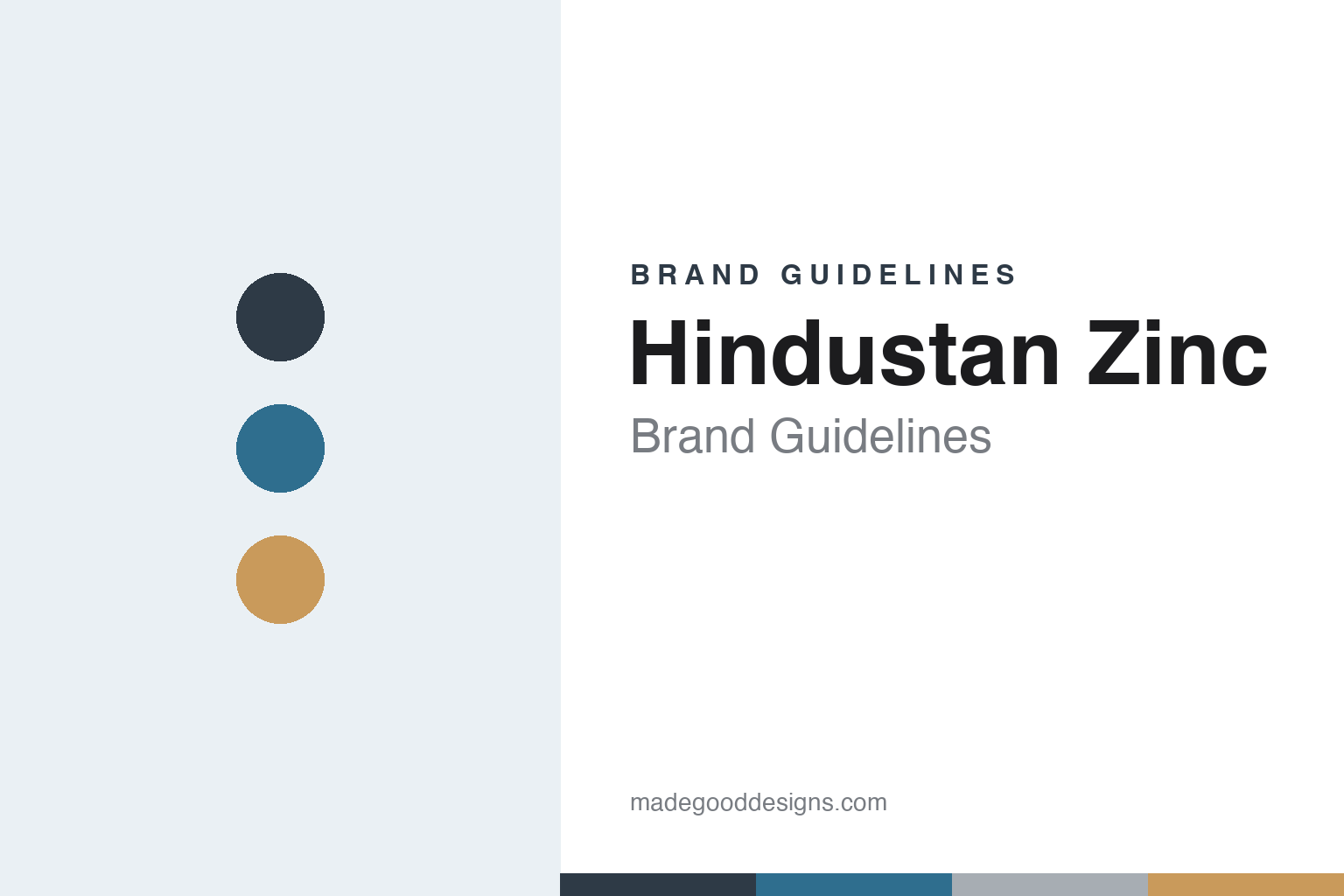
Hindustan Zinc Brand Guidelines
A 1966 state firm, Sterlite’s 2002 stake and the mines of Rajasthan.
Aa
Two constants: a slate, lake blue and silver palette and a plain Indian sans register. Abstract homage — not a Hindustan Zinc product or mark; no logo, ingot or bar is reproduced.
Hindustan Zinc
A state company carved from Metal Corporation of India.
Hindustan Zinc began as a state enterprise. English Wikipedia says Hindustan Zinc Limited was incorporated on 10 January 1966 from the former Metal Corporation of India, as a public sector undertaking of the Government of India. The company’s own timeline places the laying of the foundation of its Debari smelter, near Udaipur, in the same year, and the company now describes more than five decades of operations.
The company’s timeline lists a smelter at Vizag, on India’s east coast, and the Balaria mine at Zawar among its early projects, followed by the discovery of the Rampura Agucha deposit, the commissioning of the Rajpura Dariba mine and the opening of the Chanderiya smelter in Chittorgarh district. English Wikipedia notes that operations at the Visakhapatnam smelter have been suspended since February 2012.
Udaipur remains its home. The company describes the city as a “Zinc City,” with its mines to the south and its smelting operations to the east,.
Colour
Sterlite’s stake, then Vedanta.
The company left state control in two steps. In 2001 the government put it up for sale under its disinvestment programme, English Wikipedia says, and in April 2002 Sterlite Opportunities and Ventures bought the government’s 26 percent stake together with management control, then made an open offer that added a further 20 percent from the public. In August 2003 it used a call option to buy another 18.92 percent from the government, lifting its holding to 64.92 percent and leaving the government with 29.54 percent. The company calls the 2002 purchase by the Vedanta Group, then Sterlite, a turning point.
The parent’s name changed several times after that. Sterlite Opportunities and Ventures was merged into Sterlite Industries in April 2011; Sterlite Industries merged with Sesa Goa to form Sesa Sterlite in August 2013; and Sesa Sterlite was renamed Vedanta Limited in April 2015, English Wikipedia says. The company’s website now gives Vedanta Limited’s holding as 60.71 percent and the Government of India’s as 27.92 percent, with the shares listed on the National Stock Exchange and BSE. When Vedanta split off four businesses into separately listed companies in June 2026, the remaining Vedanta Limited kept its base-metals business, including the stake in Hindustan Zinc, News18 reported.
The 2002 sale has also been examined by investigators. India’s Central Bureau of Investigation opened a preliminary inquiry in 2013 and closed it four years later; after a public-interest case filed in 2014, the Supreme Court directed it to register a regular case, which it did on 28 April 2022. In October 2026 the agency filed a closure report saying the allegations could not be substantiated, the Press Trust of India and India Today reported; a special court was still to decide whether to accept it or order further inquiry.
Typography
How metal makers present themselves.
Platinum-group, nickel and zinc miners sell to refiners, carmakers, battery makers and investors rather than to shoppers, and their visual identities tend to reflect that. Corporate sites in this group often lean on deep blues, steel and slate greys and copper or bronze accents, tones that echo metal, rock and industrial plant without pointing to any single product. Wordmarks are usually short: a clipped group name, an acronym or a founding name kept through decades of mergers.
Photography does much of the work. Shaft heads, headgear against the sky, concentrators, smelters and refineries are commonly shown at scale, often from a distance and with people small in the frame, so that the size of an operation reads at a glance. Underground images, core trays and molten metal appear as texture beside portraits of employees and community members.
Information is organised by place and by metal. Many producers give each mine its own page, with location, depth, life of mine and headcount, and add explainers on what each metal is used for: platinum and palladium in autocatalysts, platinum in fuel cells, nickel and other metals in batteries, zinc in galvanised steel. Production updates, mineral resource and reserve statements, and annual integrated reports sit close to the surface of the site, because investors and analysts are a core audience.
Sustainability and community pages sit alongside the operations. Sections on tailings storage facilities, water, climate, employee housing, host communities and responsible sourcing are standard, and labour relations, strikes and land agreements form part of many of these companies’ public histories. The result is a register that is sober, data-heavy and place-specific, in which colour and typography stay restrained so that maps, tables and site photographs can carry the identity.
Aa
A plain Indian sans — open letters for a producer of zinc, lead and silver. (Specimen set in Hind, a sans STAND-IN; NOT the Hindustan Zinc logo.)
Mines underground
Rampura Agucha, Zawar and a silver line.
Today Hindustan Zinc runs mines and smelters from ore to refined metal. Its website lists five mining areas, all in Rajasthan: Rampura Agucha in Bhilwara district, Sindesar Khurd and Rajpura Dariba in Rajsamand, Zawar in Udaipur and Kayad in Ajmer. Its smelters are at Chanderiya, Dariba and Debari, with a metal plant at Pantnagar in Uttarakhand, where the company says a silver refinery was commissioned in 2012. English Wikipedia says the Pantnagar site was first meant for silver, with zinc and lead melting and casting plants added later. It says Rampura Agucha completed its move from an open pit to underground mining in 2018, and it gives its share of India’s primary zinc market as about 74 percent.
Silver has become a larger part of the story. English Wikipedia describes the company as a producer of zinc, lead, silver and cadmium, and the company’s timeline lists a place on the London Bullion Market Association’s list among its milestones for 2018. In September 2026 The Hindu BusinessLine, citing a company statement, reported that Hindustan Zinc had produced a record 1.114 million tonnes of mined metal in 2025–26 and had raised its total resources and reserves to 468.6 million tonnes, which the company said gave it more than 25 years of mine life. The same report said the company had drilled 464.32 kilometres of exploration holes during the year and that its ore reserves alone had risen to 219.1 million tonnes, from 189.1 million a year earlier.
The group also carries its name into sport and culture in Rajasthan: English Wikipedia notes that it owns Zinc Football Academy, based in the mining town of Zawar, and the company supports the annual Vedanta Udaipur World Music Festival, along with community programmes it runs under names such as Sakhi, for women’s microenterprises, and Zinc Kaushal, for livelihoods.
For a design guide, Hindustan Zinc shows how a former state producer presents itself through its places: a mine map of Rajasthan, Udaipur as a “Zinc City” and silver set beside zinc and lead. Compare it with Korea Zinc, a Seoul smelter of similar age, and with Vale, the Brazilian miner. For this guide we use a slate, a lake blue, a refined silver and a sandstone with a sans, an unofficial interpretation; no product or logo is reproduced.
Explore & save
Keep Hindustan Zinc’s identity on hand — save it to a board in the Made Good inspiration library.
Hindustan Zinc identity set
Save the Hindustan Zinc slate, lake blue and silver palette and the plain Indian sans register to your own board.


