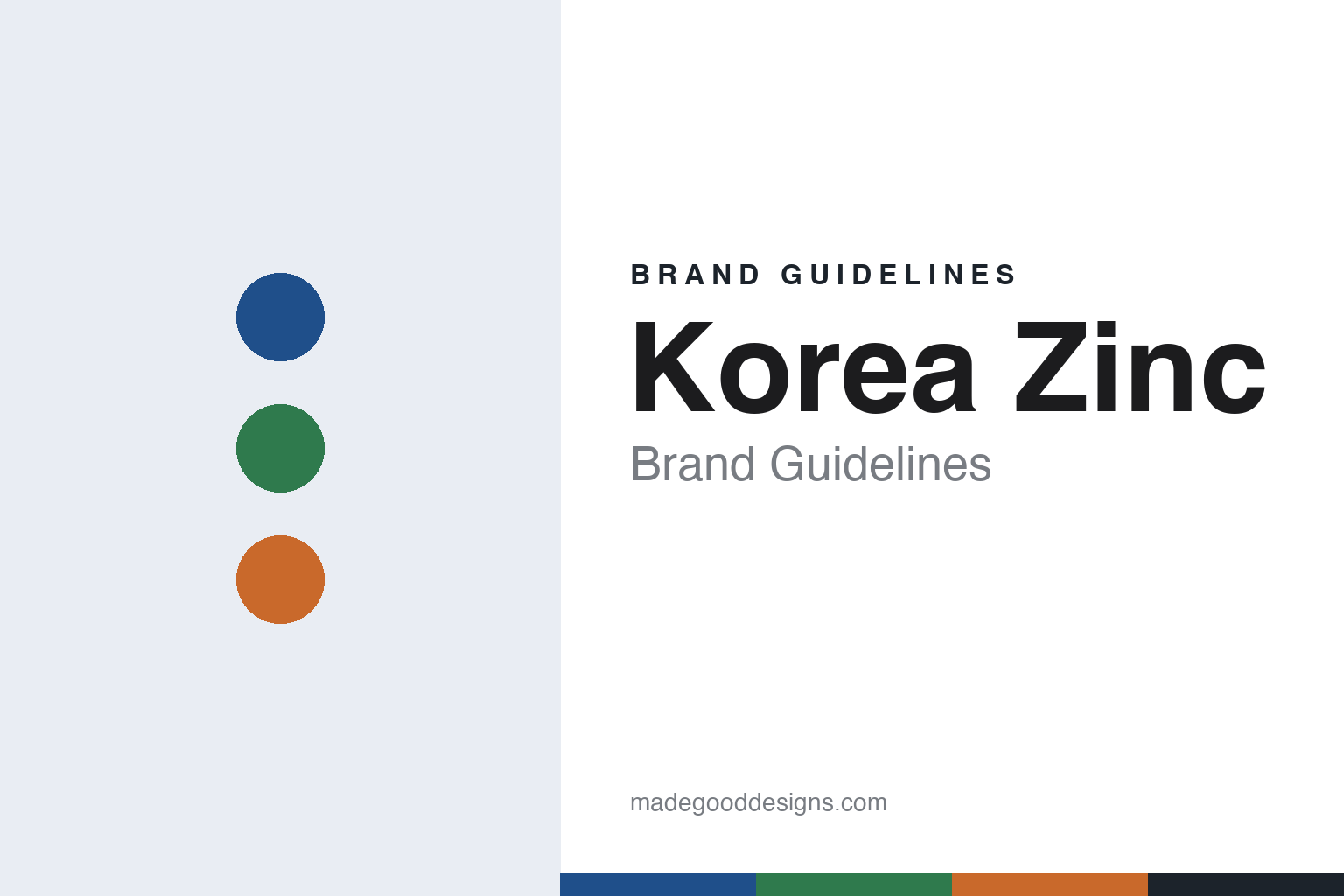
Korea Zinc Brand Guidelines
A Seoul smelter, the Onsan refinery and a wordmark cut like an ingot.
Aa
Two constants: a blue, green and orange palette and an ingot-cut Gothic sans register. Abstract homage — not a Korea Zinc product or mark; no logo, ingot or symbol is reproduced.
Korea Zinc
Two founders and a refinery at Onsan.
Korea Zinc was established in August 1974, the company’s own history says, and Korean Wikipedia gives the same month. English Wikipedia names its founders as Choi Ki-ho and Chang Byung-hee and says the company was run jointly by the Choi and Chang families for most of its life. It is headquartered in Seoul and listed on the Korean stock market, where Korean Wikipedia says its shares were registered on 28 July 1990.
The company’s production base is the Onsan refinery in Ulsan, on Korea’s south-east coast. Its timeline records a zinc smelting plant completed in April 1978 with an annual capacity of 50,000 tonnes, a copper plant in January 1982, a lead refining plant in June 1986 and a dedicated pier for the Onsan smelter in December 1991. Zinc slab ingots were registered with the London Metal Exchange in December 1988, the company says, and its gold and silver with the London Bullion Market Association in 2000 and 2001.
In June 1996 the company set up Sun Metals Corporation in Australia. Its timeline lists later additions including an indium plant at Onsan in December 2004, the recycler Steelcycle in 2016, the renewable-energy business Ark Energy in Australia and the metals trader Kataman Metals in April 2024.
Colour
Eighteen metals from one furnace line.
English Wikipedia describes Korea Zinc as a non-ferrous metal smelter. It buys zinc and lead concentrates, low-grade ores and scrap, and recovers a long list of metals from them: Korean and English Wikipedia both put the number of products at about 18, from zinc and lead to gold, silver, copper and sulphuric acid. English Wikipedia adds that, as of 2025, it was the only producer in South Korea of antimony, bismuth and indium, which it concentrates from smelting by-products, and Korean Wikipedia makes the same point about antimony.
Its product pages split that output into base metals, precious metals, rare metals and chemicals such as oleum and a semiconductor-grade sulphuric acid. It now frames its future under a three-part plan it calls Troika Drive: renewable energy and green hydrogen, resource recycling from battery and electronic waste, and secondary-battery materials such as nickel, precursors and copper foil. In November 2023, its timeline says, it broke ground on an integrated nickel smelter.
The identity is documented on its own corporate identity page. The wordmark is set in a Gothic-style typeface built on regular modules, which the company says are meant to read as precise and technical, and its corners are inspired by the shape of an ingot. A regular version is the standard for print, video and digital work, and a bold one is kept for exhibition booths, outdoor advertising and signs and banners, where the company says visibility matters most. The KZ symbol mark uses three colours, a blue, a green and an orange.
Typography
How metal makers present themselves.
Platinum-group, nickel and zinc miners sell to refiners, carmakers, battery makers and investors rather than to shoppers, and their visual identities tend to reflect that. Corporate sites in this group often lean on deep blues, steel and slate greys and copper or bronze accents, tones that echo metal, rock and industrial plant without pointing to any single product. Wordmarks are usually short: a clipped group name, an acronym or a founding name kept through decades of mergers.
Photography does much of the work. Shaft heads, headgear against the sky, concentrators, smelters and refineries are commonly shown at scale, often from a distance and with people small in the frame, so that the size of an operation reads at a glance. Underground images, core trays and molten metal appear as texture beside portraits of employees and community members.
Information is organised by place and by metal. Many producers give each mine its own page, with location, depth, life of mine and headcount, and add explainers on what each metal is used for: platinum and palladium in autocatalysts, platinum in fuel cells, nickel and other metals in batteries, zinc in galvanised steel. Production updates, mineral resource and reserve statements, and annual integrated reports sit close to the surface of the site, because investors and analysts are a core audience.
Sustainability and community pages sit alongside the operations. Sections on tailings storage facilities, water, climate, employee housing, host communities and responsible sourcing are standard, and labour relations, strikes and land agreements form part of many of these companies’ public histories. The result is a register that is sober, data-heavy and place-specific, in which colour and typography stay restrained so that maps, tables and site photographs can carry the identity.
Aa
An ingot-cut Gothic sans — a wordmark with corners shaped like a cast bar. (Specimen set in IBM Plex Sans, a sans STAND-IN; NOT the Korea Zinc logo.)
A contest for control
Young Poong, MBK Partners and a Tennessee site.
Korea Zinc’s recent history has been shaped by a long contest for control. On 12 September 2024 its largest shareholder, Young Poong, signed a shareholder agreement with the private-equity firm MBK Partners, and the next day the two announced a tender offer for Korea Zinc shares, running to 4 October, to strengthen their hold on management, Asia Economy reported at the time. Korea Zinc’s directors ran a share buyback through a tender offer of their own; the alliance sued them over it in November 2024, and on 22 October 2026 the Seoul Central District Court dismissed that suit, The Korea Herald reported, with the alliance saying it would appeal.
A second front opened at an extraordinary shareholders’ meeting in January 2025, when Korea Zinc restricted Young Poong’s voting rights after its Australian affiliate, Sun Metals Corporation, bought about a tenth of Young Poong’s shares. In August 2026 South Korea’s Supreme Court upheld a lower-court finding that the restriction was unlawful, The Korea Times reported, while a Fair Trade Commission review of the affiliate structure was still pending at the time. At the next extraordinary meeting, on 9 September 2026, management’s candidate won the contested audit-committee seat with about 82 percent of the votes present, the four independent-director seats were split two and two, and management’s majority on the board widened, Herald Business reported; the paper expected the contest to resume at the March annual meeting.
The company is also expanding in the United States. Earlier in 2026 it bought a zinc smelter at Clarksville, Tennessee, from Nyrstar along with related companies, and in April launched Project Crucible there, The Korea Times reported in September: a planned integrated smelter of about half Onsan’s size, meant to make 12 non-ferrous metals and semiconductor-grade sulphuric acid, with production scheduled from 2029.
For a design guide, Korea Zinc shows how a smelter can carry its process into its letters: a modular Gothic wordmark with ingot corners and a three-colour symbol. Compare it with Hindustan Zinc, India’s integrated zinc producer, and with Nyrstar, the former owner of the Tennessee smelter. For this guide we use a deep blue, a slag-dark grey, a green and a furnace orange with a sans, an unofficial interpretation; no product or logo is reproduced.
Explore & save
Keep Korea Zinc’s identity on hand — save it to a board in the Made Good inspiration library.
Korea Zinc identity set
Save the Korea Zinc blue, green and orange palette and the ingot-cut Gothic sans register to your own board.


