Gari Melchers built his reputation in Europe painting Dutch villagers, fishermen and church congregations in a plain northern light, then returned to the United States as a portrait painter and muralist. His pictures rarely shout. They work through placement: a figure set against a dark ground, a horizontal band that steadies a room, a single pale shape that pulls the eye.
This guide uses two paintings the Art Institute of Chicago flags as public domain. For more cleared historic images, browse the MGD museum inspiration collection.
Who was Gari Melchers?
The Metropolitan Museum of Art’s collection records give his dates as 1860–1932, born in Detroit, Michigan, and died in Falmouth, Virginia. His father, Julius Theodore Melchers, was a German-born sculptor working in Detroit, and biographies agree that the son had his early drawing lessons at home.
At seventeen, in 1877, he went to the Düsseldorf academy, where he studied under Eduard von Gebhardt and Peter Janssen. Around 1881 he moved to Paris, studying at the Académie Julian under Gustave Boulanger and Jules Lefebvre and then at the École des Beaux-Arts. In 1884, with the American painter George Hitchcock, he established an artists’ colony at Egmond aan Zee on the Dutch coast. According to the Georgia Encyclopedia, Egmond remained his working base for the next thirty years.
In 1909 he was appointed professor of painting at the Grand Ducal academy of fine art in Weimar, Germany, and by the mid-1910s he was back in the United States. He spent his later years at Belmont, an eighteenth-century estate in Falmouth, Virginia, where he died on 30 November 1932. Belmont is now the Gari Melchers Home and Studio, a museum of his work.
A dated outline of key works
- 1886: The Sermon. A church scene from his Dutch years, shown at the Paris Salon of 1886, where the Georgia Encyclopedia records an honourable mention. The painting is in the Smithsonian American Art Museum.
- 1889: Paris Exposition Universelle. A period report transcribed by the Smithsonian’s Archives of American Art lists Melchers with John Singer Sargent among the medals of honour for oil painting. Cornell University’s catalogue describes its Communion Sunday in a Church in Holland, given in 1911, as the picture that won a medal of honour in Paris in 1889.
- 1893: Arts of Peace and Arts of War. Two large lunettes for the Manufacturers and Liberal Arts Building at the World’s Columbian Exposition in Chicago, later installed at the University of Michigan in Ann Arbor.
- Mid-1890s: War and Peace. A second pair of lunettes for the Thomas Jefferson Building of the Library of Congress in Washington, which the Library’s own blog says have greeted visitors since 1896.
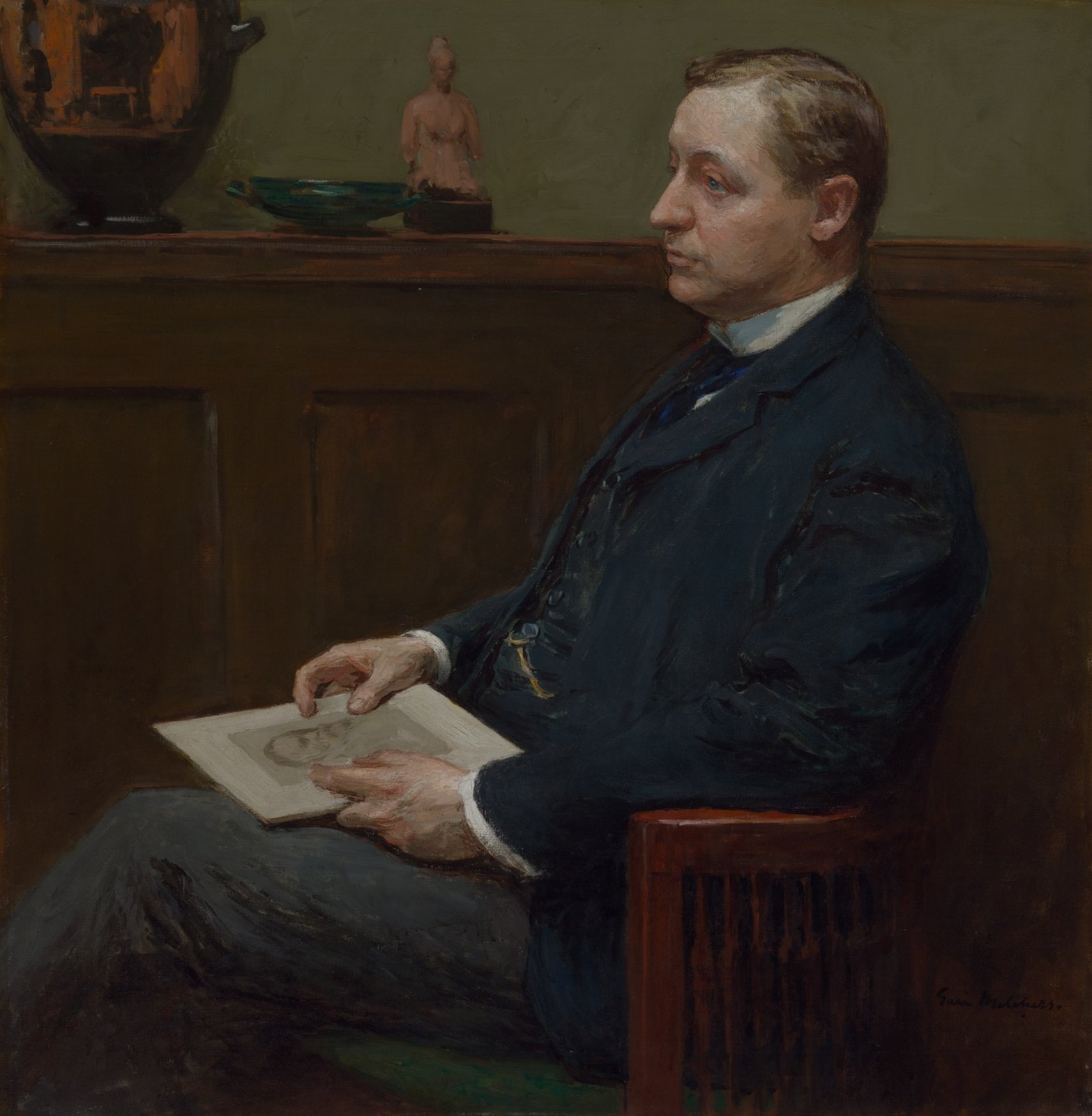
- About 1902: Portrait of Charles Lawrence Hutchinson. Oil on canvas, 101.6 × 99.1 cm, given to the Art Institute of Chicago by the sitter.
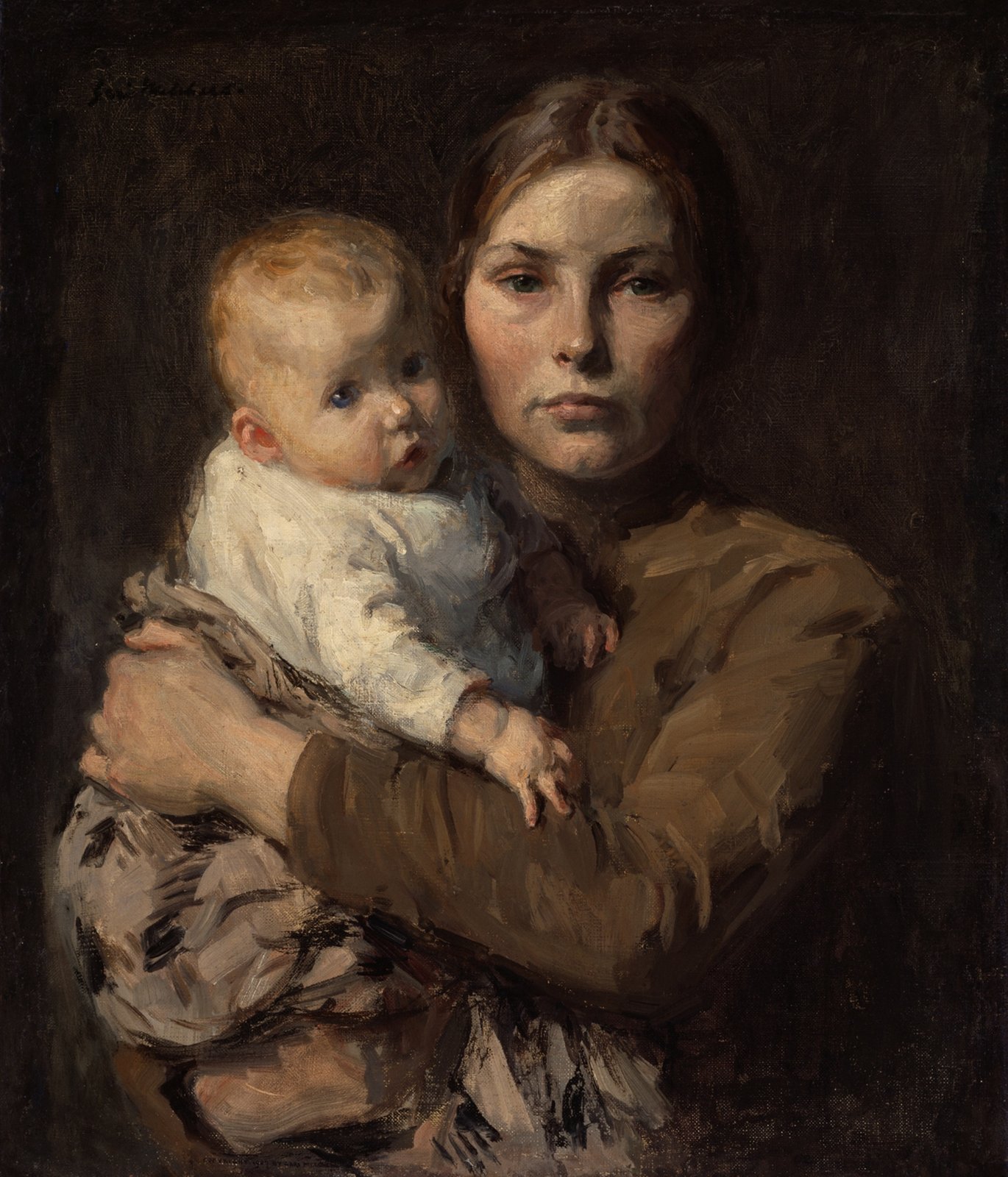
- About 1906: Mother and Child. Oil on canvas, 63.5 × 54.3 cm, which the Art Institute catalogues as painted in the Netherlands.
- 1906 or 1907: Madonna. Oil on paper mounted on canvas, bought by the Met in 1911.
- 1912: In the Studio (Gari Melchers and Hugo Reisinger). A double portrait at the Met, 137.6 × 119.9 cm.
The Met also holds a group of his etchings, among them In Holland and A Wayside Madonna, the latter dated about 1925. The Cleveland Museum of Art holds his Christ, dated about 1905. None of these Met or Cleveland works is flagged public domain by its museum, so they are described here in text only.
What to look at in Gari Melchers’s figure paintings
One light, one focal shape. In Mother and Child the background is close to black and the brightest area is the baby’s white smock. Everything else, the mother’s brown dress and the patterned skirt below, sits in a narrow middle range. Measured from the Art Institute’s scan of this painting, the dark ground reads around #110B09, the dress around #463222 and #947356, and the lightest flesh and fabric tones around #BD9F7C. The picture holds together through value, not hue.
Frontal gaze, offset subject. The mother looks straight out of the canvas, but the child is pushed to the left and turned in three-quarter view. The two heads form a diagonal from upper right to centre left, and the mother’s arm locks the group into a compact block.
Brushwork as texture. Up close the paint is loose: broad strokes across the sleeve, quick dark marks on the skirt. At reading distance those marks resolve into fabric. The finish is concentrated on the faces, and detail drops away towards the edges.
The signature as a graphic mark. Melchers signed Mother and Child in small dark letters at the upper left, tucked into the background where it balances the weight of the figures on the right.
Reading the Hutchinson portrait as a layout
The Portrait of Charles Lawrence Hutchinson is close to square, and Melchers uses that format like a page grid. A dark wooden wainscot runs across the canvas about a fifth of the way down, splitting the picture into an upper strip of olive wall and a lower field of warm brown. A vase, a green bowl and a figurine sit on the ledge like objects on a shelf.
The sitter is seen in strict profile, facing left into the open space of the room. His dark suit forms one big shape on the right half of the canvas; the pale sheet he holds on his lap is the brightest rectangle in the picture and sits almost exactly at its centre. The red-brown chair arm at the lower right closes the composition, and the signature, “Gari Melchers,” is lettered in small pale script in the lower right corner.
Measured from the Art Institute’s scan, the wall reads around #46412C, the suit around #1E1F20, the wood around #271910, and the warmer mid-tones around #6E5F4E. As with Mother and Child, the range is narrow and dark, so the sheet of paper does the work of a highlight. You can sample these scans yourself with the image colour picker.
Technique
Melchers’s training was academic: drawing from the model in Düsseldorf, then the Paris ateliers, where structure and accurate values came first. The museum records for the works listed above are almost all oil on canvas, with the Met’s Madonna painted in oil on paper and later mounted on canvas, and a body of etchings alongside the paintings.
His subject matter places him with the naturalist painters of the 1880s, who treated ordinary rural people with documentary seriousness; for the wider context see the guide to Realism in art. He is also sometimes grouped with the American painters who absorbed Impressionism. His shared 1889 honour links him with John Singer Sargent, another American trained in Paris, and his portraits and figure pieces can be compared with those of Frank Weston Benson.
The mural commissions demanded a different discipline. A lunette is a half-round field high on a wall, seen from below and from a distance, so figures have to be simplified, grouped and spread across the curve.
How designers can borrow from Gari Melchers
Design in value first. Both paintings here work almost without colour. Block a poster or cover in three or four greys first and check that the focal point is the lightest or darkest area.
Use one highlight. Give a composition a single bright shape, like the white smock or the sheet of paper, and keep everything else in a narrow range. On a screen, that is the one primary button.
Steady a layout with a horizon band. The wainscot in the Hutchinson portrait is a strong horizontal that every other element can sit on or against. On a web page or a slide, a full-width rule or a change of background at a fixed height does the same job.
Point the subject into open space. Place portraits, product shots and illustrated characters so they look towards the text or the open area of the layout.
Frequently asked questions
Who was Gari Melchers?
Gari Melchers (1860–1932) was an American painter born in Detroit. He trained in Düsseldorf and Paris, worked for about three decades at Egmond in the Netherlands, taught in Weimar from 1909, and died at Belmont in Falmouth, Virginia.
What is Gari Melchers known for?
He is known for paintings of Dutch village life such as The Sermon (1886), for portraits, and for mural lunettes made for the 1893 World’s Columbian Exposition in Chicago and for the Library of Congress in Washington.
Where can I see Gari Melchers’s work?
The Gari Melchers Home and Studio at Belmont in Falmouth, Virginia, holds a large collection. The Smithsonian American Art Museum, the Met, the Art Institute of Chicago and the Cleveland Museum of Art also hold works, and his murals remain at the Library of Congress.
Are Gari Melchers paintings public domain?
The Art Institute of Chicago flags Mother and Child and the Portrait of Charles Lawrence Hutchinson as public domain. His works at the Met and the Cleveland Museum of Art are not flagged public domain or CC0, so check each museum’s record before reusing an image.