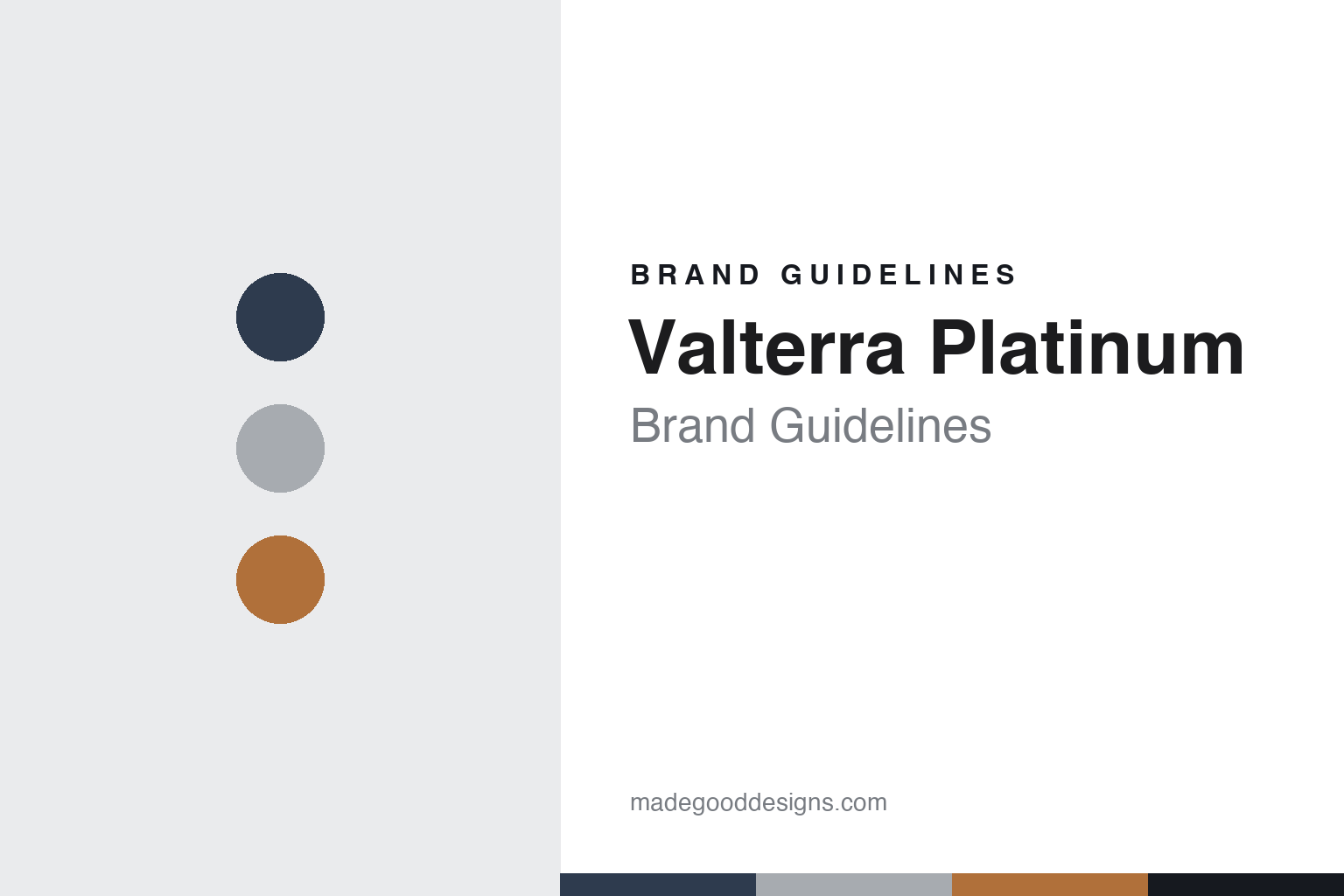
Valterra Platinum Brand Guidelines
Amplats, a 2025 demerger and a name made from value and terra.
Aa
Two constants: a slate, platinum grey and ochre palette and a geometric sans register. Abstract homage — not a Valterra Platinum product or mark; no logo or brand asset is reproduced.
From Amplats
An old platinum business under a new name.
Valterra Platinum is a new name for an old business. Until 2025 the Johannesburg company was Anglo American Platinum, widely shortened to Amplats, and for most of its listed life it was controlled by the mining group Anglo American. English Wikipedia describes it as one of the largest primary producers of platinum, and places most of its operations in the Bushveld Igneous Complex, the geological region north of Johannesburg that also holds chromium and vanadium.
The company’s own timeline reaches back much further than the Amplats name. It starts with Johannesburg Consolidated Investments (JCI), founded in 1889, and with Anglo American, established in 1917. The company says mining began at Potgietersrust Platinums, today’s Mogalakwena, in 1925 and at Rustenburg in 1926, and that in 1928 it began a partnership with Hans Merensky, the geologist credited with finding South Africa’s platinum-bearing reef. Rustenburg Platinum Mines was registered in September 1931 under JCI’s administration, according to the same timeline.
The modern company took shape in the 1990s. English Wikipedia and the company agree that JCI unbundled in 1995 and that its platinum interests became Amplats. In 1997, the company says, Amplats, Rustenburg Platinum Holdings, Potgietersrust Platinums and Lebowa Platinum Mines were restructured into a single listed entity; Anglo American took its holding above half in 1999 and above two-thirds in 2002, and the business was renamed Anglo American Platinum.
Colour
Four mines, smelters and two refineries.
Valterra Platinum describes itself as an integrated producer: it mines the ore, concentrates and smelts it, and refines the metal in its own plants. Its website lists four mining operations. Mogalakwena, near Mokopane on the Northern Limb of the Bushveld Complex, is an open-pit mine with exploration declines at Sandsloot; Amandelbult, with its Dishaba and Tumela sections, lies between Northam and Thabazimbi; Mototolo, south-west of Burgersfort on the Eastern Limb, includes the Lebowa, Borwa and Der Brochen shafts; and Unki sits on the Great Dyke in Zimbabwe, south-east of Gweru. In May 2025 Miningmx reported that Mogalakwena produces about half of the company’s managed output, and put the company’s metal resources at more than 600 million ounces, which it described as the largest of any platinum group metals miner.
The processing chain is large. The company says it runs seven concentrators and three chrome recovery plants beside its mines, smelters at Rustenburg, Swartklip (Mortimer), Polokwane and Unki, and a converter plant at Rustenburg, before the matte goes to its Base Metals Refinery and Precious Metals Refinery. It calls the first the largest producer of nickel cathode in South Africa.
Its products are the platinum group metals — platinum, palladium, rhodium, ruthenium and iridium — and co-products including copper, nickel, cobalt sulphate, sodium sulphate, chrome and gold. Its products page shows each metal as a periodic-table tile with its symbol, atomic number and atomic weight. Sales run through marketing offices in Johannesburg, London, Singapore and Shanghai, the company says.
Much of its public voice is about demand rather than mining. Its market development pages describe work on hydrogen fuel cell vehicles, a battery venture called Lion Battery Technologies with Platinum Group Metals Ltd and Florida International University, and PlatAfrica, an annual platinum jewellery design showcase run with Platinum Guild International and Metal Concentrators.
Typography
How metal miners present themselves.
Platinum-group, nickel and zinc miners sell to refiners, carmakers, battery makers and investors rather than to shoppers, and their visual identities tend to reflect that. Corporate sites in this group often lean on deep blues, steel and slate greys and copper or bronze accents, tones that echo metal, rock and industrial plant without pointing to any single product. Wordmarks are usually short: a clipped group name, an acronym or a founding name kept through decades of mergers.
Photography does much of the work. Shaft heads, headgear against the sky, concentrators, smelters and refineries are commonly shown at scale, often from a distance and with people small in the frame, so that the size of an operation reads at a glance. Underground images, core trays and molten metal appear as texture beside portraits of employees and community members.
Information is organised by place and by metal. Many producers give each mine its own page, with location, depth, life of mine and headcount, and add explainers on what each metal is used for: platinum and palladium in autocatalysts, platinum in fuel cells, nickel and other metals in batteries, zinc in galvanised steel. Production updates, mineral resource and reserve statements, and annual integrated reports sit close to the surface of the site, because investors and analysts are a core audience.
Sustainability and community pages sit alongside the operations. Sections on tailings storage facilities, water, climate, employee housing, host communities and responsible sourcing are standard, and labour relations, strikes and land agreements form part of many of these companies’ public histories. The result is a register that is sober, data-heavy and place-specific, in which colour and typography stay restrained so that maps, tables and site photographs can carry the identity.
Aa
A geometric sans for a name built from two words. (Specimen set in Sora, a sans STAND-IN that the company’s website also loads; NOT the Valterra Platinum logo.)
Valterra
Value, plus the Latin for earth.
The new name arrived with independence. Anglo American announced in May 2024 that it would demerge Amplats as part of a plan to focus on copper, iron ore and crop nutrients, Miningmx reported in March 2025, when the name Valterra Platinum was set out in a notice to shareholders ahead of the annual general meeting. The name is a portmanteau of “value” and terra, Latin for earth, the same report said. The company began trading under the new name in Johannesburg on 28 May 2025, with a secondary listing in London; English Wikipedia dates the completed demerger to 31 May 2025. The company’s purpose line is “unearthing value to better our world.”
Anglo American kept a 19.9% stake at first and gave up its board seats. After a 90-day lock-up ended, it sold the whole remaining stake through a bookbuild, and on 4 September 2025 Miningmx reported that the sale had been concluded. Craig Miller leads the company as chief executive, Miningmx reported in May 2025.
The business carries a labour history from its Amplats years. In October 2012, during a wave of strikes across South African gold and platinum mines, Anglo American Platinum announced the dismissal of about 12,000 striking workers, English Wikipedia reports, citing Reuters; in 2014 a five-month strike affected the platinum industry, including the company. English Wikipedia also records disputes over platinum mining on community land in the 2000s.
For a design guide, Valterra Platinum shows how a renamed company can keep its history in plain view: its website opens with a timeline running from JCI in 1889 to the 2025 name, and it treats each metal as a labelled element. Compare Anglo American, its former parent, and Northam Platinum, whose Zondereinde mine lies beside Amandelbult. For this guide we use slate blue, platinum grey and an earthy ochre with a sans, an unofficial interpretation; no product or logo is reproduced.
Explore & save
Keep Valterra Platinum’s identity on hand — save it to a board in the Made Good inspiration library.
Valterra Platinum identity set
Pin the Valterra Platinum slate, platinum grey and ochre palette and the geometric sans register to your own board.


