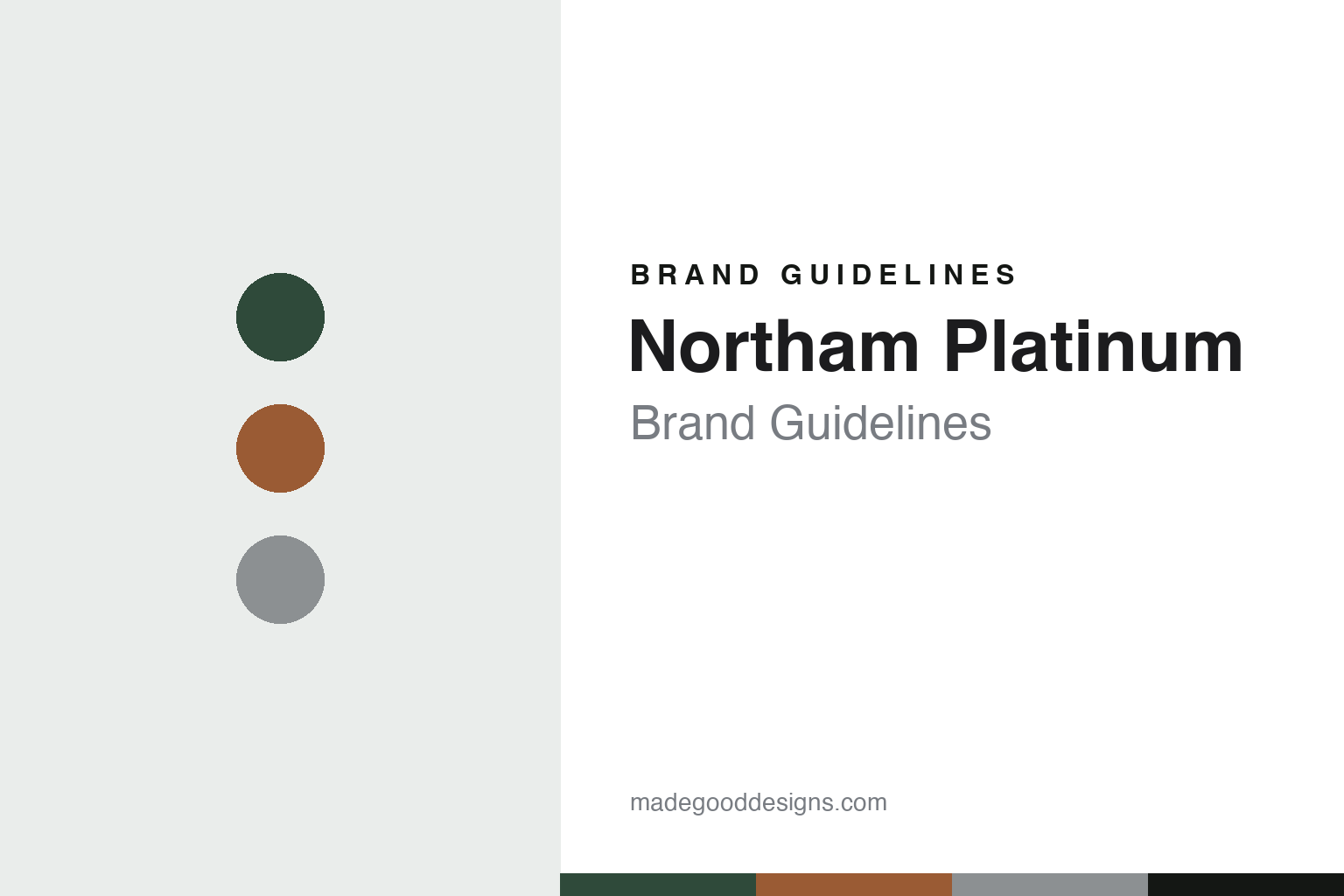
Northam Platinum Brand Guidelines
Zondereinde, Booysendal, Eland and a smelter since 1993.
Aa
Two constants: a green, copper and grey palette and a humanist sans register. Abstract homage — not a Northam Platinum product or mark; no logo or brand asset is reproduced.
Zondereinde
A deep mine that took decades to come good.
Northam Platinum is a Johannesburg producer of platinum group metals, listed on the JSE through its holding company, Northam Holdings. English Wikipedia gives its founding year as 1977. Its story is tied to one mine, Zondereinde, on the northern end of the western limb of the Bushveld Complex, about 30 km south of the town of Thabazimbi in Limpopo.
Zondereinde began as a project of the former Gold Fields of South Africa, which decided to develop the mine in 1986, according to a column in Miningmx in August 2026. The same column describes it as the deepest mine in the platinum sector at the time, and says the early years were hard: heat at depth and a geological feature called potholing disrupted large parts of the Merensky reef and upset mining layouts. Northam came close to failing, the column says, and was helped by acquiring shallower reserves from Anglo American Platinum’s neighbouring Amandelbult operation.
The company says Zondereinde produced its first platinum group metals in 1993, mining both the Merensky and UG2 reefs, and that its smelting complex was commissioned in the same year. In December 2017 Northam bought the ground along the mine’s western boundary from Anglo American Platinum; the company says this western extension gives Zondereinde a life of more than 30 years. In February 2026 Miningmx reported that the board had approved work on a number four shaft, widening an existing exploratory hole that descends about 1.4 km, to create an option to expand the mine’s output; the same report said Northam had raised its production forecast for the 2026 financial year to 1.07 million ounces.
Colour
Three mines, one smelter and outside refiners.
Northam now runs three wholly owned mines, its website says. Booysendal, near Mashishing (formerly Lydenburg) on the eastern limb of the Bushveld Complex, is a shallow, mechanised room-and-pillar operation; English Wikipedia says its UG2 North mine opened in July 2013, and the company lists a Merensky North mine and a Booysendal South mine, which includes the Everest mine that English Wikipedia says was bought from Aquarius Platinum in 2015. Eland, about 12 km east of Brits in North West province, was bought from Glencore in December 2017 while under care and maintenance; the company says it is being brought back to a steady state planned for 2029.
The metallurgical complex sits at Zondereinde. The company says the smelter began with a single 15 MW furnace and has since been expanded to 35 MW, treating concentrate from all three mines and from third parties. The furnace matte goes to a base metals removal plant, which takes out nickel as crystalline nickel sulphate and copper as copper cathode. The remaining precious-metal concentrate is toll-refined by Heraeus at Hanau in Germany and Port Elizabeth in South Africa, and by Johnson Matthey in the United Kingdom.
Its main products are platinum, palladium and rhodium, which the company says it sells in sponge or ingot form to customers in the United States, Europe and the Far East, for uses that include autocatalysts, jewellery and industry. Northam also has a recycling arm in Pennsylvania: in July 2017, the company says, it agreed to buy recycling equipment and premises from A-1 Specialized Services, and the business, Northam Recovery Services, processes salvaged automotive catalytic converters.
Typography
How metal miners present themselves.
Platinum-group, nickel and zinc miners sell to refiners, carmakers, battery makers and investors rather than to shoppers, and their visual identities tend to reflect that. Corporate sites in this group often lean on deep blues, steel and slate greys and copper or bronze accents, tones that echo metal, rock and industrial plant without pointing to any single product. Wordmarks are usually short: a clipped group name, an acronym or a founding name kept through decades of mergers.
Photography does much of the work. Shaft heads, headgear against the sky, concentrators, smelters and refineries are commonly shown at scale, often from a distance and with people small in the frame, so that the size of an operation reads at a glance. Underground images, core trays and molten metal appear as texture beside portraits of employees and community members.
Information is organised by place and by metal. Many producers give each mine its own page, with location, depth, life of mine and headcount, and add explainers on what each metal is used for: platinum and palladium in autocatalysts, platinum in fuel cells, nickel and other metals in batteries, zinc in galvanised steel. Production updates, mineral resource and reserve statements, and annual integrated reports sit close to the surface of the site, because investors and analysts are a core audience.
Sustainability and community pages sit alongside the operations. Sections on tailings storage facilities, water, climate, employee housing, host communities and responsible sourcing are standard, and labour relations, strikes and land agreements form part of many of these companies’ public histories. The result is a register that is sober, data-heavy and place-specific, in which colour and typography stay restrained so that maps, tables and site photographs can carry the identity.
Aa
A humanist sans for a miner that explains itself mine by mine. (Specimen set in Fira Sans, a sans STAND-IN; NOT the Northam Platinum logo.)
Northam
Ownership, a takeover contest and an open process.
Northam calls itself an “independent, empowered, integrated” producer, and its ownership has changed several times. Its website records the 2021 composite transaction that wound up the Zambezi Platinum structure, an empowerment ownership scheme set up in 2015; Northam bought back Zambezi’s remaining Northam shares, and the scheme was implemented in September 2021.
The company also tried to grow by takeover. In November 2021 it bought a 32.8% interest in Royal Bafokeng Platinum (RBPlat) and raised it to 34.95% in December, according to its announcements, and in November 2022 it announced a firm intention to offer for the remaining shares, in competition with Implats. On 5 April 2023 Northam announced the termination of its offer, citing material adverse changes; Moneyweb reported that month that it had pulled out of the race, pointing to lower metal prices, leaving the path clear for Implats.
In August 2026 Northam opened a strategic, competitive process to invite proposals for one or more potential transactions, after an informal approach from a third party, Miningmx reported. In an announcement dated 29 October 2026 the company said the process had drawn interest from South African and multinational companies ahead of a deadline of 1 December 2026, and a cautionary notice remained in place; no transaction had been agreed at the time of writing. The company has also set out a “Vision 2031” plan to raise annual output to about 1.5 million ounces, Miningmx reported.
For a design guide, Northam Platinum shows a miner that presents itself mine by mine: each operation has its own page with location, reefs and resource figures, and the products page explains where each metal ends up. Compare Gold Fields, whose former South African parent first developed Zondereinde, and Valterra Platinum, owner of the neighbouring Amandelbult mine. For this guide we use a deep green, copper and a mid grey with a sans, an unofficial interpretation; no product or logo is reproduced.
Explore & save
Keep Northam Platinum’s identity on hand — save it to a board in the Made Good inspiration library.
Northam Platinum identity set
Pin the Northam Platinum green, copper and grey palette and the humanist sans register to your own board.


