IDFC First Bank Brand Guidelines
A Mumbai bank built from an infrastructure lender and a retail lender.
Aa
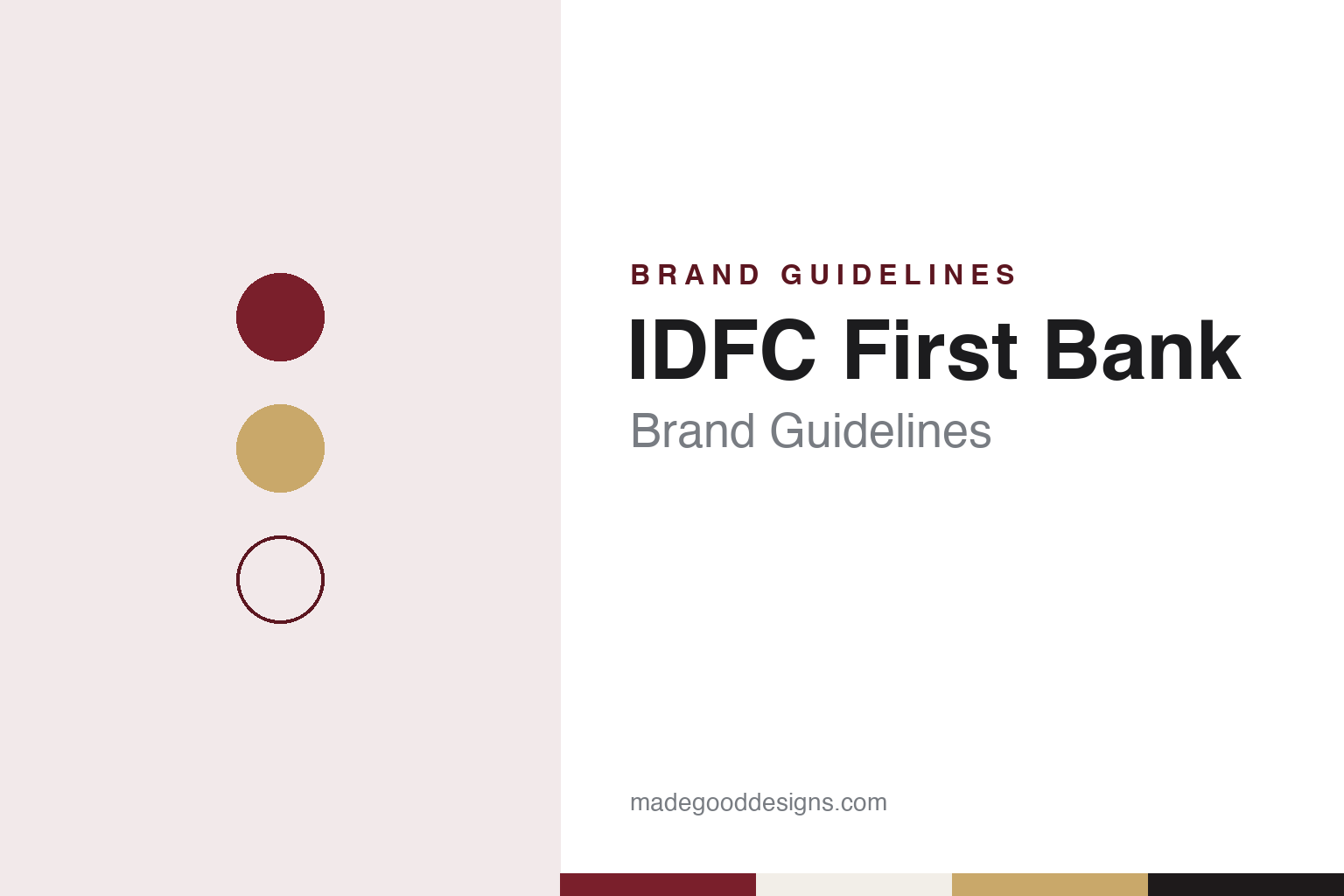
Two constants: an oxblood, brass and stone palette and a geometric sans register. Abstract homage — not an IDFC First Bank asset; no logo, card or app screen is reproduced.
IDFC Bank
A bank carved out of an infrastructure lender.
IDFC First Bank traces its banking licence to IDFC Limited, an infrastructure lender. English Wikipedia says IDFC Limited was set up in 1997 by the government of India to finance infrastructure projects, following the recommendation of an expert group formed in 1994, and that it later added asset management, institutional broking and investment banking. The bank’s own history page describes the same start: a company built for project finance and for raising capital for private-sector infrastructure.
In 2013 IDFC applied for a commercial banking licence, and in 2014 the Reserve Bank of India gave it in-principle approval, the Press Trust of India reported in October 2018. IDFC then moved its infrastructure lending assets and liabilities into a new company, IDFC Bank, through a demerger. The bank opened in 2015: English Wikipedia dates its official inauguration to 19 October 2015 in New Delhi, when it started with 23 branches, while the bank’s history page says it was launched in November 2015. The parent kept its asset management, broking and infrastructure debt fund businesses through a holding company.
The early years were difficult. English Wikipedia says the bank carried bad loans from legacy infrastructure accounts and that a planned merger with the Shriram Group was called off. The bank’s history page says it spent its first three years building its technology, a treasury system and a corporate banking business, then decided to move into retail lending and to look for a merger partner that already had a retail loan book with scale.
One step in that direction came in 2016, when IDFC Bank bought Grama Vidiyal Micro Finance, a microlender in Tamil Nadu whose roots go back to a charitable trust set up in 1986, according to English Wikipedia. The business is now called IDFC First Bharat and leads much of the bank’s rural lending in southern and central India.
Colour
Capital First, and a new name.
The partner was Capital First, a lender to small businesses and consumers. The bank’s history page says V. Vaidyanathan, who had built the retail banking business at ICICI Bank between 2000 and 2009, bought a stake in an existing non-bank lender in 2010 and in 2012 completed a management buyout backed by private equity, founding Capital First as a new entity with new shareholders and a new board. It financed small entrepreneurs and consumers with technology-led credit models, and the bank says Capital First was looking for a route to a banking licence from the start.
IDFC Bank and Capital First announced their merger in January 2018, English Wikipedia says. It was an all-stock deal: IDFC Bank would issue 139 shares for every 10 Capital First shares, the Press Trust of India reported. In October 2018 the IDFC Bank board decided to ask the Reserve Bank for approval to rename the bank IDFC First Bank Limited; PTI noted that the merger had by then been cleared by the Competition Commission of India, the stock exchanges, the Reserve Bank and the shareholders and creditors involved, and was waiting on the National Company Law Tribunal.
The merger took effect on 18 December 2018. A joint statement quoted by PTI the next day said the merged entity would be called IDFC First Bank, subject to shareholders’ approval. Capital First’s founder became managing director and chief executive of the combined bank; English Wikipedia says the Reserve Bank approved the appointment from 19 December 2018. The bank styles its name as IDFC FIRST Bank, with FIRST in capitals, English Wikipedia notes.
English Wikipedia describes the years after 2018 as a shift from infrastructure finance to retail banking, with retail deposits growing as a share of the total. The last piece of the old structure went in 2024. In July 2023 the bank’s board approved a merger with its former parent; after clearances from the Competition Commission and the Reserve Bank, the National Company Law Tribunal approved the scheme in May 2024, and on 1 October 2024 IDFC Limited merged into the bank, with 155 bank shares issued for every 100 IDFC Limited shares, according to English Wikipedia. The bank is based in Mumbai.
Typography
Indian banking and its marks.
Indian banks tend to present themselves through a short name and a bold symbol. The State Bank of India’s keyhole, drawn at the National Institute of Design in Ahmedabad and adopted in 1971, replaced a banyan tree, The Hindu BusinessLine reported, and in 2017 the bank cut its long name to the letters SBI beside that symbol, The Economic Times reported. Across the sector, blues, reds and oranges are common in bank marks, usually pairing one symbol with a short wordmark.
Language is part of the identity. The keyhole came with matching lettering of the bank’s name in nine Indian languages, according to BusinessLine, and Indian bank signs and websites commonly set Hindi and English names side by side, with regional scripts added in different states. Names change too: UTI Bank became Axis Bank in 2007 because other organisations used the UTI name, Mint reported, and the merger of five associate banks into SBI on 1 April 2017 took their names off branch signboards, The Hindu reported.
Bank websites follow a common pattern. Pages on savings accounts, loans and cards sit beside digital banking apps, branch and cash-machine locators, and photographs of branches and staff. Financial inclusion has a long history in the sector’s self-presentation: BusinessLine dates its start to the nationalisation of fourteen banks in 1969, and government schemes such as the Pradhan Mantri Jan Dhan Yojana appear in the State Bank of India’s website menus. The websites of both the State Bank of India and Axis Bank now sit at addresses ending in .bank.in.
Annual reports and corporate social responsibility programmes complete the picture, setting out branch networks, rural reach and foundation work. This guide sets out what can be checked about each bank — when it was founded, how its name and ownership changed, and what is documented about its symbol — and marks clearly what rests only on the bank’s own word.
Aa
A geometric sans for a mark built on three bars. (Specimen set in Manrope, a sans STAND-IN; NOT the IDFC First Bank logo.)
IDFC First Bank
A growth chart turned into a symbol.
The bank explains its mark on its history page. It says the identity of IDFC First Bank “signifies growth and energy” and draws on the theme of progress: the symbol is inspired by a forward-moving bar graph, and its three bars stand for a threefold purpose — the progress of the bank, of its customers and of the nation. The same page states the bank’s mission as building “India’s most customer friendly Bank.”
The page also sets out what the bank calls its founding philosophy. It says the bank will try to sell customers the right products, avoid mis-selling, and avoid third-party products that earn the bank high fees at the customer’s expense; if it makes a mistake, it says, it will apologise and correct it. Its listed values are customer focused, collaborative, innovative, empowered, decisive and action oriented.
In February 2026 the bank disclosed a fraud detected at a branch in Chandigarh involving accounts linked to the Haryana government, News18 reported on 24 February 2026; the state government then removed the bank, along with another lender, from the banks allowed to take fresh government deposits. English Wikipedia says the irregularities, which also touched other banks in the Chandigarh area, came to light after the state finance department began closing and transferring accounts in January 2026. In June 2026 the Central Bureau of Investigation arrested two former bank officials, one of them a former IDFC First Bank area head, The Indian Express reported; the investigation was continuing at the time of that report.
For a design guide, IDFC First Bank shows how a merged lender can build one identity from two histories, with a mark that turns a growth chart into a symbol. Compare HDFC Bank, another Mumbai-based private-sector bank, and ICICI Bank. For this guide we use a deep oxblood, warm brass and stone with a sans, an unofficial interpretation; no product or logo is reproduced.
Explore & save
Keep IDFC First Bank’s identity on hand — save it to a board in the Made Good inspiration library.
IDFC First Bank identity set
Pin the IDFC First Bank oxblood, brass and stone palette and the geometric sans register to your own board.