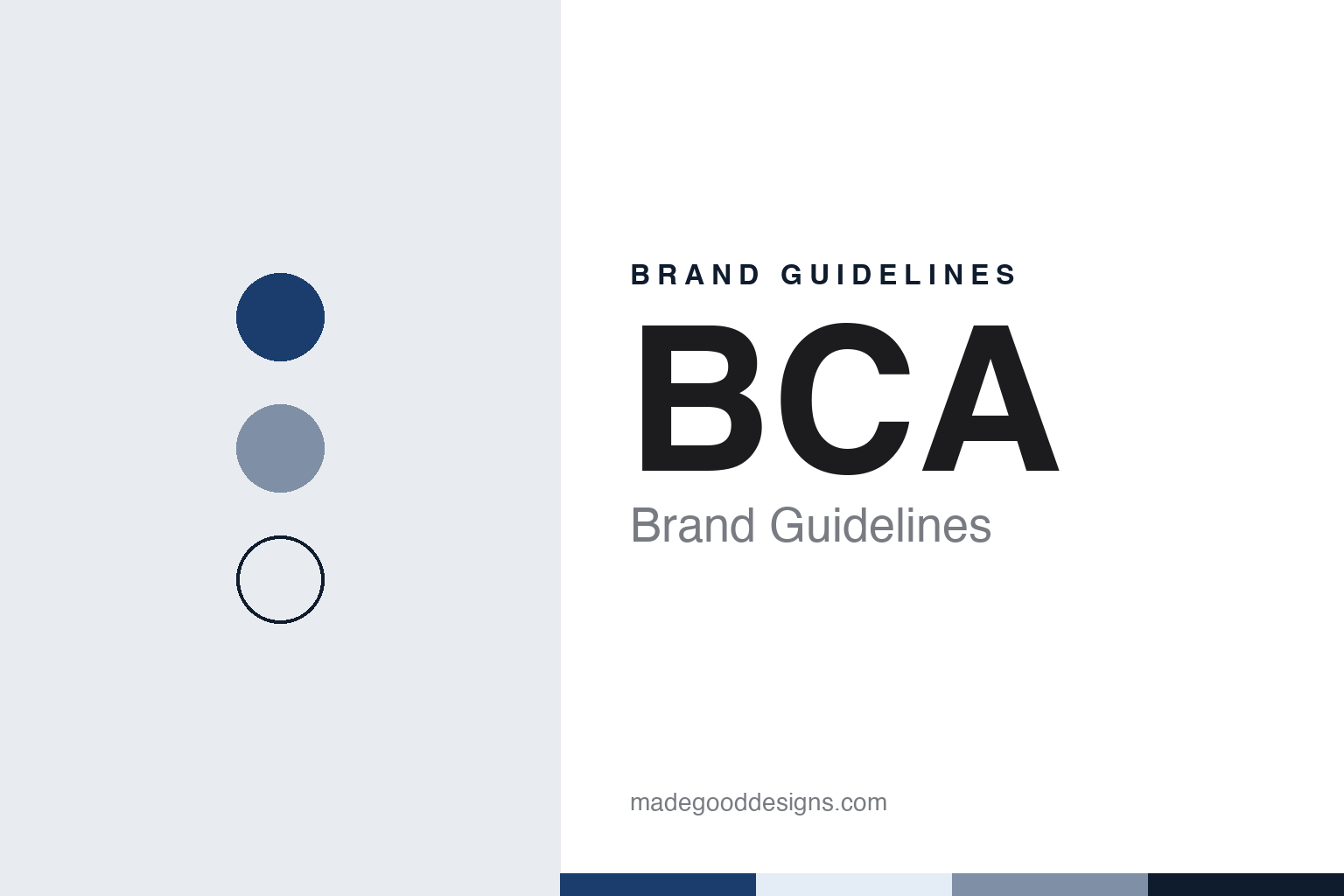
BCA Brand Guidelines
A 1957 Jakarta bank, a 1998 rescue and the Djarum owners.
Aa
Two constants: a BCA blue and pale sky palette and a plain banking sans register. Abstract homage — not a BCA product or mark; no card, logo or app screen is reproduced.
From Semarang to Asemka
A Semarang company, a Jakarta bank and a 1998 rescue.
BCA, in full PT Bank Central Asia Tbk, is a Jakarta bank with roots in Semarang, Central Java. The bank’s own history page says it began in 1955 as NV Perseroan Dagang Dan Industrie Semarang Knitting Factory, and that it started banking operations on 21 February 1957 with its head office in Jakarta; its first branch opened in Asemka, a trading district of the capital. Indonesian Wikipedia adds two names in between, NV Bank Asia in October 1956 and then Central Bank Asia, and says 21 February 1957 is kept as the bank’s anniversary.
The name became PT Bank Central Asia on 2 September 1975, the company says, and in 1977 it received a licence to operate as a foreign-exchange bank. Indonesian Wikipedia links the bank in these decades to the Salim group and dates its BCA Card credit card to 1979. In the 1980s, as Indonesia deregulated its banking sector, BCA says it expanded its branch network aggressively, connected its branches through an online system and launched Tahapan, a savings account whose name is short for Tabungan Hari Depan, or “savings for the future”; Indonesian Wikipedia places the launch after the October 1988 deregulation package known as Pakto 88.
Machines followed branches. BCA says it installed 50 ATMs around Jakarta in 1991, and then worked with the telecoms company Telkom and with Citibank so that customers could pay phone bills and Citibank credit-card bills at its cash machines.
The Asian financial crisis interrupted that growth. BCA’s history page says it suffered a bank run in 1998 and became a Bank Take Over under the Indonesian Bank Restructuring Agency, known as IBRA in English and BPPN in Indonesian, the government body set up to restructure the banking system; Indonesian Wikipedia dates the takeover to 28 May 1998. Recapitalisation was completed in 1999, when the government, through IBRA, came to hold 92.8% of BCA’s shares in exchange for liquidity support from Bank Indonesia, and loans to related parties were swapped for government bonds, the bank says. The business daily Warta Ekonomi set out the same sequence in November 2026.
Colour
Branches, cash machines and a family of apps.
BCA presents itself as a transaction bank, and much of its published timeline is a list of channels. Between 2000 and 2005 it says it launched Debit BCA, the internet bank KlikBCA and the mobile service m-BCA, and moved into car lending through its subsidiary BCA Finance. In 2007 it introduced Flazz, a prepaid stored-value card, along with weekend branch opening, and the bank describes itself as a pioneer of fixed-rate home loans in Indonesia that year.
The group widened in the 2010s. BCA says it entered sharia banking, motorcycle financing, general insurance and securities between 2010 and 2013, and in 2013 raised its holding in its general insurer, now PT Asuransi Umum BCA, from 25% to 100%. In January 2014 it raised its effective stake in the two-wheeler lender CS Finance from 25% to 70%, and it obtained a life-insurance licence for BCA Life. Between 2014 and 2016 it opened self-service digital outlets under the name MyBCA, extended its network of cash-recycling machines and launched Sakuku, an electronic wallet app.
The current apps keep the same naming habit. English and Indonesian Wikipedia list myBCA as the main mobile app, alongside BCA mobile, KlikBCA and Sakuku, and say the bank moved its QR payments onto QRIS, the national QR standard set by Bank Indonesia. Indonesian Wikipedia says the contactless version, QRIS Tap, can be used on TransJakarta buses, the MRT, the LRT and commuter trains.
The bank still keeps a large physical network. Wikipedia, citing year-end 2025 figures, gives about 1,270 branch offices and 20,163 ATMs, and says BCA has kept adding branches selectively in eastern Indonesia. Its presence abroad is small: Indonesian Wikipedia says its Hong Kong representative office closed in August 2025, and that it runs no retail branch network outside Indonesia.
Typography
Southeast Asian banks.
Southeast Asian banks speak to a wide range of customers at once: city professionals and market traders, exporters and farmers, families in the capital and small businesses in provincial towns. Their identities are built to read clearly on a branch sign, a card and a phone screen. Strong symbols and wordmarks are common, often set in deep blues, greens, purples or golds, and many marks carry a symbol with local meaning: Bangkok Bank, for example, has used the royal lotus as its emblem since 1972, according to Thai Wikipedia.
Names often work in more than one language. Many banks pair a name in the local language with an English name or a short set of initials, and some add a Chinese name for business in China; Kasikornbank introduced a logo in Thai, Chinese and English in 2007, English Wikipedia says. Photography of branches, city skylines and everyday customers carries much of the visual message on websites and in campaigns.
Digital channels sit at the centre of the brand. Bank websites give prominent space to everyday banking, loans and mobile apps, such as Bangkok Bank’s Bualuang mBanking and Kasikornbank’s K PLUS, and to QR payments for shops and market stalls. Many banks also present programmes for small businesses, farmers and communities with less access to banking, and an increasing number present themselves as regional banks, linking customers across borders through subsidiaries in neighbouring countries.
Reporting is the other half of the identity. Listed banks publish annual and sustainability reports, and these documents often carry the most considered typography and photography a bank produces. This guide looks at each brand’s history and what can be checked about how it presents itself, and treats the colours and type shown here as an unofficial interpretation rather than official brand assets.
Aa
A plain banking sans for a bank known by its initials. (Specimen set in Plus Jakarta Sans, a sans STAND-IN; NOT the BCA logo.)
BCA
From state ownership to the Djarum owners.
The state sold its holding in stages. IBRA floated 22.5% of BCA in an initial public offering in May 2000, cutting its stake to 70.3%, and a secondary offering of 10% in 2001 reduced it to 60.3%, according to the bank and Warta Ekonomi. In 2002 FarIndo Investment (Mauritius) Limited won a tender for 51% of the shares through a strategic private placement. The government sold 1.4% to domestic investors in 2004 and its remaining 5.02% in 2005, through the state asset company PPA, after which it held no BCA shares, the bank says.
FarIndo itself changed hands. In January 2007 detikFinance reported that it had been mostly owned by the American investment firm Farallon Capital, with Alaerka, the vehicle of the Hartono family that owns the Djarum group, holding 9.36%; Alaerka had then raised its share of FarIndo to 92.18%, making the Djarum owners BCA’s main shareholders. BCA’s management told the paper at the time that the change would not alter the bank’s strategy. Warta Ekonomi reported in November 2026 that PT Dwimuria Investama Andalan, a company linked to the Hartono family, has been BCA’s controlling shareholder since 2016, with 54.94% of the shares according to stock-exchange data, and described BCA as the largest private bank in Indonesia.
BCA’s published identity is built more on names than on statements. Its product names form a recognisable family: Tahapan for savings, Flazz for prepaid payments, KlikBCA and myBCA for online and mobile banking, and Sakuku for the wallet. The bank’s vision, as published on its website, is to be the bank of choice that the public relies on, acting as an important pillar of the Indonesian economy, and its listed values include customer focus, integrity and teamwork. Its history page, written as a decade-by-decade timeline that begins with a knitting company and runs through the 1998 takeover, presents the crisis years plainly as part of the story.
For a design guide, BCA shows how a bank known by three initials can carry a whole family of product names through branches, cards and apps. Compare Bank Mandiri, another large Jakarta bank, and BRI, Indonesia’s state-majority micro-lender. For this guide we use a deep harbour blue, ink, a pale sky tone and a cool grey with a sans, an unofficial interpretation; no product or logo is reproduced.
Explore & save
Keep BCA’s identity on hand — save it to a board in the Made Good inspiration library.
BCA identity set
Pin the BCA blue and pale sky palette and the plain banking sans register to your own board.