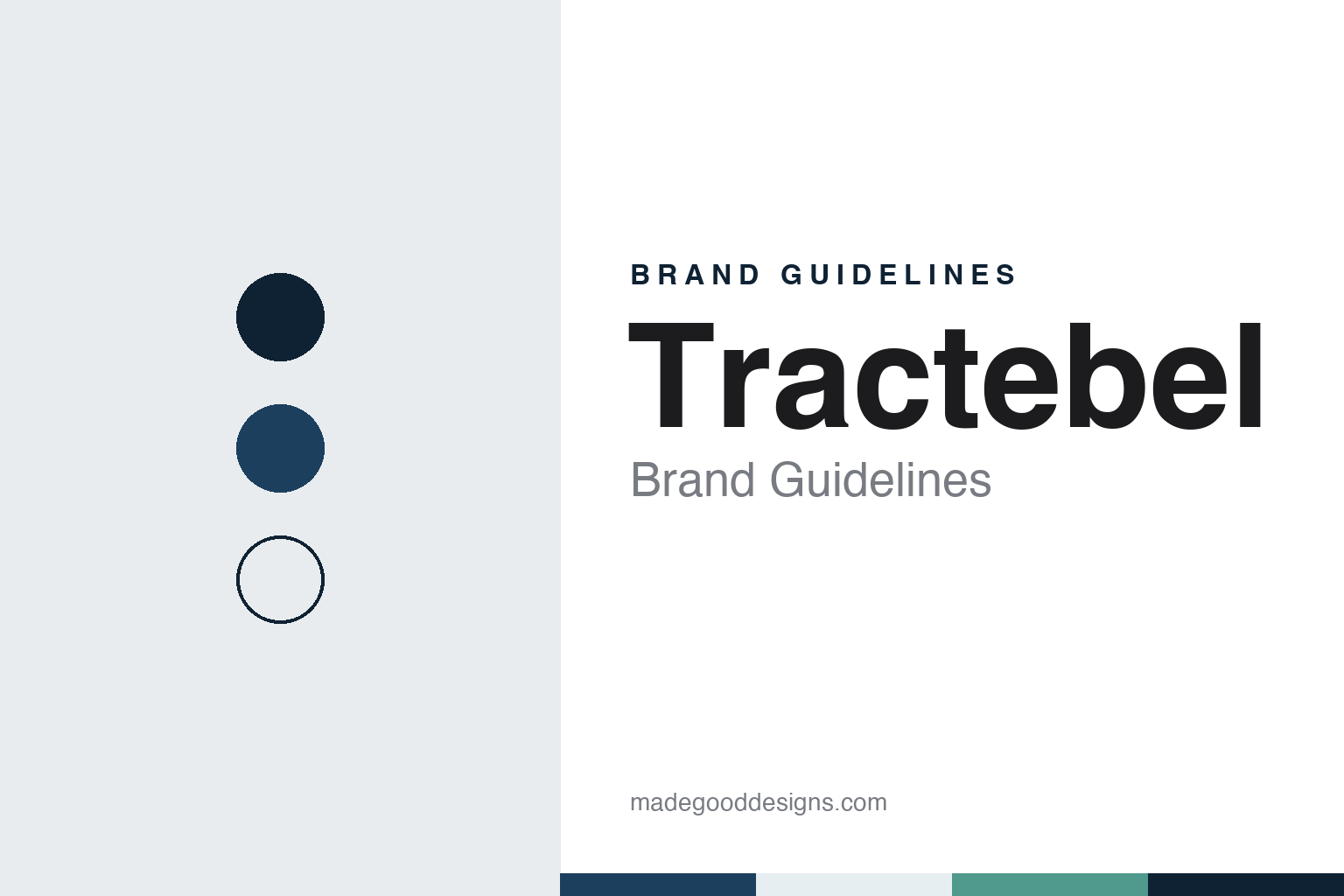
Tractebel Brand Guidelines
Tramway roots, a 1986 merger and an ENGIE name.
Aa
Two constants: a harbour blue and canal green palette and an Engineering sans register. Abstract homage — not a Tractebel or ENGIE asset; no logo or mark is reproduced.
Tractionel and Electrobel
Gas lamps, light railways and tramways.
Tractebel is an engineering and consulting company based in Brussels, working in energy, water, nuclear and infrastructure for the ENGIE group and for outside clients, according to French Wikipedia. Its name is a contraction of two older Belgian firms, and its story begins well before either of them.
The company says it is backed by “more than 150 years of experience.” On its own history page it names the predecessors: the Compagnie Générale pour l’Éclairage et le Chauffage par le Gaz, a gas lighting and heating company created in 1862; the Société Générale des Chemins de Fer Économiques, a light-railway company of 1880; the Société Générale Belge d’Entreprises Électriques of 1895; and the Compagnie Mutuelle des Tramways, of which it calls Tractionel “the heir.”
French Wikipedia sets out how those strands came together. In 1929 three of the companies merged to form the engineering bureau Electrobel, which built several Belgian power stations. The fourth, the Mutuelle des Tramways, renamed itself Traction & Électricité and later became Tractionel. After the Second World War both firms worked on the extension and modernisation of the Belgian electricity grid, and from 1969 on the installation of Belgium’s nuclear power stations, along with pipelines, dams, hydroelectric plants and complex buildings at home and abroad. The sources used for this guide do not say how Tractebel’s predecessors operated during the occupation of 1940–1944.
In 1976 the French dam and nuclear specialist Coyne et Bellier joined the group. The company says it was set up in 1947 by the civil engineer André Coyne as a consultancy with Jean Bellier, and that Coyne designed dams including Kariba, on the border of Zimbabwe and Zambia, and the Daniel-Johnson Dam in Quebec.
Colour
A merger in 1986, and Suez.
After decades of collaboration, French Wikipedia says, Electrobel and Tractionel merged in 1986 to form Tractebel, with a new engineering division, Tractebel Engineering. The division built a network of subsidiaries: Cheming in the Czech Republic in 1992, Citec in Poland in 1993, Technum from several Flemish practices in 1995, Trapec in Romania in 1997 and the Brazilian firm Leme Engenharia in 2000, the year it also set up offices in Italy and India. The company says Leme dates from 1965 and that Technum, which worked on the Antwerp mobility master plan and the Albert II Dock at Zeebrugge, was rebranded Tractebel in 2016.
Ownership moved upwards through Belgian and French holding companies. In 1988 the Paris-based Suez Company took control of the Société Générale de Belgique through a competitive takeover bid, English Wikipedia says; French Wikipedia adds that the Société Générale then owned about 40 percent of Tractebel, became its majority shareholder in September 1996, and that Suez gained almost all of the shares through an exchange offer in November 1999. In 2003 Suez merged the Société Générale with Tractebel, ending the old Belgian holding company, according to English Wikipedia; French Wikipedia calls the result Suez-Tractebel. After Suez combined with Gaz de France in 2008, Tractebel Engineering became the group’s engineering arm.
Acquisitions continued. French Wikipedia lists IMDC, the Belgian marine and dredging consultancy founded in 1982, Lahmeyer International in 2014, Engie Laborelec in 2017 and DOC Offshore and Overdick in 2018. The company says it bought RED, a London-based specialist in low-energy building and data-centre design founded in 2004, in January 2023.
Typography
Design and documentation.
Engineering and infrastructure consultancies sell expertise rather than objects, so their identities have to stand in for work that is often invisible once it is finished: a tunnel, a water network or a power connection. Most of them present themselves with restraint. Their wordmarks tend to be short, set in a clean sans, and many are acronyms, founders’ surnames or invented names left over from mergers. Colour is usually limited to one strong tone, often a blue, an orange or a green, used against plenty of white space.
The pictures do much of the talking. Websites and reports in this field lean on project photography of bridges, rail lines and stations, water and wastewater works, energy plants and city districts, often taken wide and from the air so that the scale of the work is clear. People appear as teams on site or in the studio rather than as models, and diagrams, maps and drawings sit beside the photographs.
The structure of the websites is similar from firm to firm. Pages are commonly organised by sector, such as transport, water, energy, buildings and industry, and by service, such as design, engineering, project management and advisory work. Sustainability usually has a section of its own, and careers pages carry a large share of the message, since these businesses depend on recruiting architects, engineers and other specialists.
Much of the brand also lives in documents. Listed consultancies publish annual reports and sustainability reports, and many put out technical papers, research reports, indexes and case studies on individual projects. Typography in those documents is usually plain and functional, with charts and tables carrying the detail, so the identity has to work as well on a page of figures as on a hoarding around a building site.
Aa
An engineering sans — one short name. (Specimen set in IBM Plex Sans, a sans STAND-IN; NOT the Tractebel logo.)
Tractebel
One short name inside ENGIE.
The current name dates from 24 April 2015, when GDF Suez announced that it would call itself ENGIE. To give the group’s subsidiaries more visibility, French Wikipedia says, Tractebel Engineering became simply Tractebel. The company now describes itself as “part of the ENGIE Group” and says it has more than 6,000 experts.
Nuclear work remains central to how the trade press describes it. In August 2023 World Nuclear News reported that Tractebel and the Canadian engineering firm Hatch would cooperate on small and large nuclear projects in North America and Europe, and that Tractebel had been working with EDF on the Nuward small modular reactor since 2021. In August 2025 the same publication reported a new agreement with NRG-Pallas extending Tractebel’s role as owner’s engineer, held since 2015, for the planned Pallas research reactor at Petten in the Netherlands. The company also lists the Snowy 2.0 pumped-storage hydropower scheme in Australia among its references.
There is a legal record too. On 29 November 2021 the Inter-American Development Bank debarred Tractebel Engineering in Brussels for 46 months for fraudulent and corrupt practices related to a project in Haiti in 2015–16, the trade newsletter African Energy reported on 3 December 2021, after a deal with the bank; the decision made it eligible for cross-debarment by the World Bank Group and other multilateral lenders.
A naming note: Electrobel, the engineering bureau of 1929, is a different company from Electrabel, the Belgian electricity utility.
For a design guide, Tractebel shows how a name built from two older firms can survive mergers, takeovers and a group rename. Compare Egis, another French-speaking engineering group, and Arcadis, a design and consultancy firm from the neighbouring Netherlands. For this guide we use a harbour blue and a canal green with a sans, an unofficial interpretation; no product or logo is reproduced.
Explore & save
Keep Tractebel’s identity on hand — save it to a board in the Made Good inspiration library.
Tractebel identity set
Pin the Tractebel harbour blue and canal green palette and the Engineering sans register to your own board.