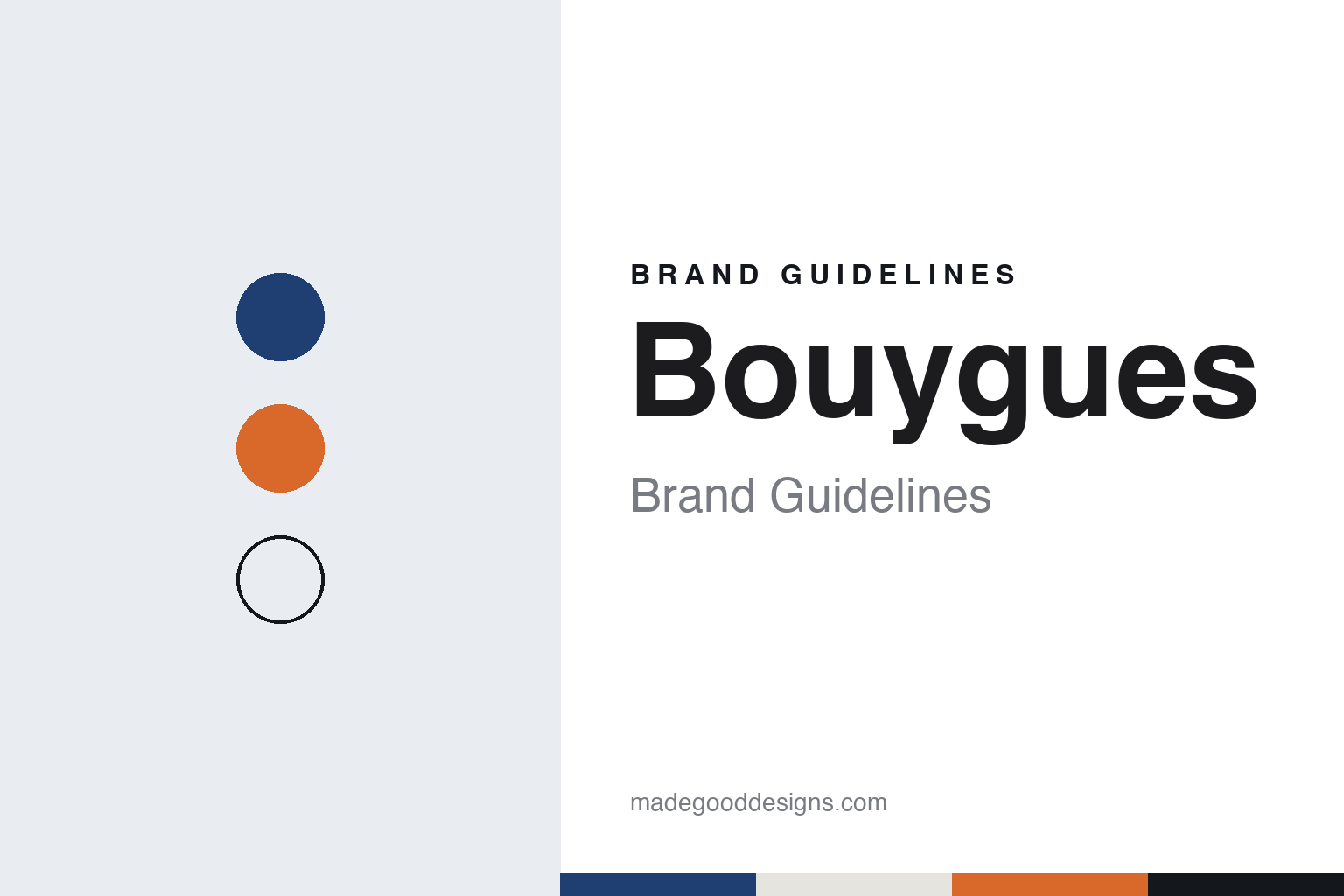
Bouygues Brand Guidelines
A 1952 Paris builder that became a construction, media and telecoms group.
Aa
Two constants: a blue, concrete and orange palette and an engineering sans register. Abstract homage — not a Bouygues asset; no logo, building or site photograph is reproduced.
Post-war Paris
A building firm born in the rebuilding of France.
Bouygues was founded in 1952 by Francis Bouygues in the Paris region, as France rebuilt after the Second World War, French Wikipedia says; the firm started out constructing buildings and had earlier traded as EFB. In 1955 it moved into large social-housing estates, the HLM programmes funded mainly by the French state, and in 1959 it took up industrial prefabrication.
The motorway programme of the 1960s let Bouygues build a public-works and civil-engineering arm from 1965, and it went on to win high-profile contracts such as the Parc des Princes stadium in Paris, completed in 1972, the Palais des congrès at Porte Maillot and Paris-Charles-de-Gaulle airport, according to French and English Wikipedia.
The company was listed on the Paris stock exchange in 1970, the same year it began an employee share scheme. French Wikipedia records that, at the end of 2022, employees held about a fifth of the capital, which it describes as the highest employee stake of any CAC 40 company. In the 1970s Bouygues built offshore oil platforms, the start of the international work that grew in the 1980s.
Francis Bouygues also created an internal order for site workers, the Compagnons du Minorange, in 1963; French Wikipedia counts more than a thousand members in 2013. His son Martin Bouygues has led the group since 1989, English Wikipedia says; in February 2021 Olivier Roussat became chief executive, with Martin Bouygues remaining chairman.
Colour
Bouygues Construction, Colas and Bouygues Immobilier.
Construction is where the group began, and it still spans several brands. Bouygues Construction covers building, civil works and energy services. Its projects listed by English and French Wikipedia include the Musée d’Orsay (1986), the Île de Ré bridge (1988), the Grande Arche at La Défense (1989), the Channel Tunnel (1994), the Bibliothèque nationale de France and the Pont de Normandie (both 1995), the Stade de France (1998), the Hassan II Mosque in Casablanca (1992), the Port of Miami Tunnel and the Singapore Sports Hub (both 2014).
The construction arm still works under several named entities. On 4 November 2026 Bouygues Bâtiment Industrie, part of Bouygues Construction, announced it had started work on Les Amarres, the conversion of the former Magasins Généraux of the port of Austerlitz in Paris’s 13th arrondissement into about 6,000 square metres of mixed space, including urban logistics served by the Seine, Voxlog reported on 6 November 2026; structural work is due to finish in spring 2027. In the United States, Bouygues Construction completed its purchase of Vannoy Construction, a general contractor founded in 1952 in Jefferson, North Carolina, on 30 June 2026, Idéal Investisseur reported.
Colas, the roads and rail arm, is older than the group. The Société routière Colas was set up in 1929 by Shell and the Société Générale d’Entreprises to use a bitumen emulsion, and its name is a contraction of “cold asphalt,” French Wikipedia says. Bouygues took control in the mid-1980s, alongside the road builders Screg and Sacer. The sources used for this guide do not say how Colas operated during the occupation of 1940–1944.
The construction arms have also grown abroad by acquisition. English Wikipedia records the purchase of the Australian builder A. W. Edwards in May 2018, and French Wikipedia says Bouygues bought the energy-services and construction businesses of the Swiss group Alpiq in March 2018. In Croatia the group holds a stake in BINA Istra, the company formed in 1995 to build and run the Istrian Y motorway, according to English Wikipedia.
Bouygues Immobilier, the property developer, dates from 1956. The group added the technical-services business Equans, bought from Engie, in October 2022, French Wikipedia says.
Typography
How construction groups present themselves.
Large construction groups present themselves less through products than through places. Their identities usually rest on a strong wordmark, often in a blue, a red or an orange, used across hoardings, site vehicles, workwear and reports, with the group name repeated in the names of its subsidiaries. Eiffage, for example, runs its business lines as Eiffage Construction, Eiffage Route, Eiffage Métal and so on, while Bouygues keeps separate names such as Colas alongside Bouygues Construction.
Photography does much of the work. Group websites tend to alternate pictures of active sites — cranes, tunnel-boring machines, road crews — with finished bridges, stadiums, towers and rail lines, and they organise their pages by activity: infrastructure, buildings, concessions such as motorways and airports, and energy works. Named landmark projects serve as the main proof of capability, from the Channel Tunnel to the Millau Viaduct.
Commitments are presented in a structured way. Groups describe their environmental and social aims through named programmes, plans and reports rather than slogans; Eiffage, for instance, publishes a climate report and a biodiversity action plan alongside its universal registration document. Values pages, codes of ethics and statements on site safety appear as standard sections, written in the language of programmes and targets.
Two other audiences shape these identities. Careers pages address the large numbers of engineers, site managers and trades staff the groups recruit each year, and many groups promote employee shareholding as part of their story. Investors and lenders read the annual and sustainability reports, where the identity system is often applied most completely, in charts, maps and project photographs. This guide sets out what can be checked about each group: who founded it, how it was formed, who owns it, and which projects dated sources connect to its name.
Aa
An engineering sans for a builder’s register. (Specimen set in Archivo, a sans STAND-IN; NOT the Bouygues logo or any typeface the group uses.)
Bouygues
Builder first, then television and telecoms.
From the 1980s Bouygues diversified beyond building. It took control of the water company Saur in 1984 and of the television channel TF1 in 1987, after the channel’s privatisation, French Wikipedia says. Under Martin Bouygues the group obtained France’s third mobile licence in 1994, and English Wikipedia dates the commercial launch of Bouygues Telecom to 29 May 1996.
In the early 2000s the group narrowed its focus to construction, telecoms and media. It sold Bouygues Offshore to Saipem in 2002 and Saur to PAI Partners in November 2004. In 2006 it took a large stake in the industrial group Alstom, which it reduced to a fraction of a per cent in June 2021, according to French Wikipedia.
The group’s buildings have also carried its name. In 1988 Bouygues moved into Challenger, a head-office campus at Guyancourt in the Saint-Quentin-en-Yvelines new town designed by the American architect Kevin Roche, which is now home to Bouygues Construction. Since 2006 the group has been based on Avenue Hoche in Paris’s 8th arrondissement, in a building also designed by Roche, with interiors by Jean-Michel Wilmotte. English Wikipedia says the group has taken part in the United Nations Global Compact since 2006.
English Wikipedia sets out the group’s holdings in each business: it owns all of Bouygues Construction and Bouygues Immobilier, most of Colas and Bouygues Telecom, and a minority stake in TF1. The group has also invested beyond its core trades: in December 2019 it became a shareholder in Flying Whales, a French company developing rigid airships for heavy loads.
For a design guide, Bouygues shows how a family-founded builder can keep one surname across very different businesses while each construction arm — Bouygues Construction, Colas and Bouygues Immobilier — keeps its own name. Compare VINCI, another French construction and concessions group, and Eiffage. For this guide we use a deep blue, concrete grey and a warm orange with a sans, an unofficial interpretation; no product or logo is reproduced.
Explore & save
Keep Bouygues’s identity on hand — save it to a board in the Made Good inspiration library.
Bouygues identity set
Pin the Bouygues blue, concrete and orange palette and the engineering sans register to your own board.