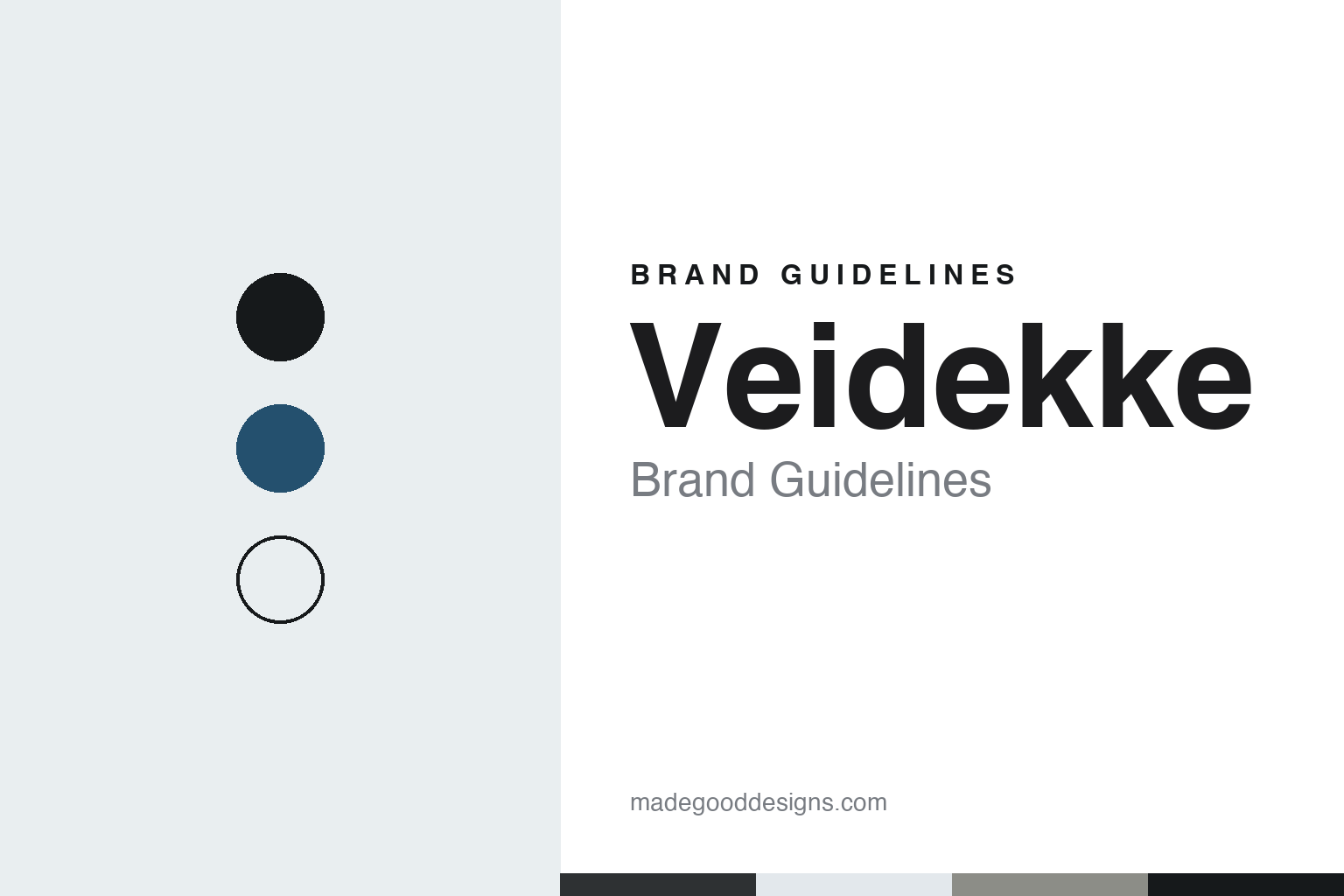
Veidekke Brand Guidelines
A 1936 paving firm named for the road surface.
Aa
Two constants: a Veidekke asphalt grey and fjord blue palette and a Plain sans register. Abstract homage — not a Veidekke project or mark; no building, logo or sign is reproduced.
Cobblestones, 1936
Two founders and a paving trade.
Veidekke was founded on 6 February 1936 by Nico S. Beer and Gustav Piene, according to English and Norwegian Wikipedia; Store norske leksikon, the Norwegian encyclopedia, gives the same year and the same founders. The name is a Norwegian word for a road surface — the layered pavement that spreads the weight of traffic, as the encyclopedia defines it — and the early work matched it. Store norske leksikon says the company began with asphalt laying and stone setting on a modest scale, and Norwegian Wikipedia says it started by paving streets with cobblestones in Østfold before taking road-improvement contracts in eastern Norway. The company still opens its story the same way: “It began with cobblestones in Norway in 1936,” its website says.
The German occupation of Norway interrupted that start. Veidekke’s own history, as reproduced on English Wikipedia, says that when war reached Norway in 1940 the company completed the contracts it had already signed and then shut down all operations until after the war; Norwegian Wikipedia dates the restart to 1947.
The breakthrough came in 1948, when the small company won the contract to build runways at Stavanger Airport, Sola. Store norske leksikon says that job gave Veidekke its expertise in airfield runways, later extended to motorway surfacing. English Wikipedia says airport work in Ethiopia followed in the mid-1950s. In the 1970s, the encyclopedia says, Veidekke worked in East Africa for NORAD, the Norwegian development agency, through a subsidiary called Noremco, while its main business at home turned to hydroelectric dams — beginning, English Wikipedia says, with the Heggmoen dam in northern Norway in 1972.
Colour
Growth by acquisition.
Veidekke grew by buying and merging. English Wikipedia says that when Norwegian contracting began to consolidate in the early 1980s, the company chose to build itself into a nationwide contractor of its own, and that more than 60 companies have since become part of it. It was listed on the main list of the Oslo Stock Exchange on 23 June 1986, and its employees have owned shares in it since the late 1960s, the same source says. In 1989, Store norske leksikon says, the road business of A/S Sigurd Hesselberg, founded in 1897, joined the group, and in 1991 Veidekke took over Aker Entreprenør — the merged Astrup & Aubert and Høyer-Ellefsen — from the Aker group, a purchase Norwegian Wikipedia says opened a decade of strong growth.
Expansion abroad followed. Veidekke set up in Sweden in 1998, starting with civil works in Gothenburg, and in 2000 bought the Danish contractor H. Hoffmann & Sønner, founded in 1863, which Norwegian Wikipedia calls Denmark’s oldest contractor. Those older firms give the group roots that reach back before 1936: English Wikipedia traces them to 1863 in Denmark and to 1896 in Norway, through Høyer-Ellefsen. Norwegian Wikipedia says Veidekke ran property development in Norway from the 1990s and in Sweden from the 2000s, and sold that business in September 2020.
Today Store norske leksikon describes Veidekke ASA as Norway’s largest contractor in its field and one of the largest in Scandinavia, with operations in Denmark, through Hoffmann, and in Sweden. Its headquarters are in Oslo, and its largest owners, the encyclopedia says, are the property company OBOS Forretningsbygg, Folketrygdfondet and the group’s own employees. Norwegian Wikipedia, citing the company’s 2024 annual and sustainability report, puts the workforce at about 8,000, of whom about 5,200 work in Norway, 2,300 in Sweden and 440 in Denmark. Its work covers buildings, civil engineering, road maintenance and the production of asphalt, crushed stone and gravel.
Typography
Design and documentation.
Large construction groups present themselves less through products than through places. Their identities usually rest on a strong wordmark, often in a blue, a red or an orange, used across hoardings, site vehicles, workwear and reports, with the group name repeated in the names of its subsidiaries. Eiffage, for example, runs its business lines as Eiffage Construction, Eiffage Route, Eiffage Métal and so on, while Bouygues keeps separate names such as Colas alongside Bouygues Construction.
Photography does much of the work. Group websites tend to alternate pictures of active sites — cranes, tunnel-boring machines, road crews — with finished bridges, stadiums, towers and rail lines, and they organise their pages by activity: infrastructure, buildings, concessions such as motorways and airports, and energy works. Named landmark projects serve as the main proof of capability, from the Channel Tunnel to the Millau Viaduct.
Commitments are presented in a structured way. Groups describe their environmental and social aims through named programmes, plans and reports rather than slogans; Eiffage, for instance, publishes a climate report and a biodiversity action plan alongside its universal registration document. Values pages, codes of ethics and statements on site safety appear as standard sections, written in the language of programmes and targets.
Two other audiences shape these identities. Careers pages address the large numbers of engineers, site managers and trades staff the groups recruit each year, and many groups promote employee shareholding as part of their story. Investors and lenders read the annual and sustainability reports, where the identity system is often applied most completely, in charts, maps and project photographs. This guide sets out what can be checked about each group: who founded it, how it was formed, who owns it, and which projects dated sources connect to its name.
Aa
A plain sans — a road surface for a name. (Specimen set in Inter Tight, a sans STAND-IN; NOT the Veidekke logo.)
Veidekke
A road surface for a name.
Its projects range from national landmarks to local offices. Norwegian Wikipedia lists the Oslo Opera House, the Munch Museum, the new Holmenkollen ski jump and the Hardanger Bridge among the buildings and structures Veidekke has worked on. In November 2026 the Norwegian trade paper Tungt reported that Veidekke had won the design-and-build contract for Eidsvågbakken 13, an office building of 3,300 square metres with four office floors in Åsane, Bergen, for Tertnes Holding; the project was developed together with the client, with work due to start in February 2027 and finish by the end of November 2028.
Its record also includes competition cases. The Norwegian broadcaster NRK reported in January 2011 that Økokrim, the Norwegian authority for economic crime, had fined Veidekke’s asphalt subsidiary, Kolo Veidekke, in 2006, alongside other asphalt firms, for illegal market sharing and price cooperation. The same report said the Norwegian Competition Authority had searched offices of Kolo Veidekke and NCC Roads in February 2010 over suspected price cooperation in central Norway; Veidekke said it had itself asked the authority and the police to investigate its operations there, and the investigation was still under way when the report appeared.
On its website the company describes its work as roads, tunnels, bridges and buildings across Scandinavia, and sets out its values under the line “We put people first.” For a design guide, Veidekke shows how a contractor can carry a literal name — a road surface — from cobblestones in Østfold to a Scandinavian group. Compare Skanska, another Scandinavian builder, and NCC, its Swedish neighbour in roads and asphalt. For this guide we use an asphalt grey, a cobblestone grey and a fjord blue with a sans, an unofficial interpretation; no product or logo is reproduced.
Explore & save
Keep Veidekke’s identity on hand — save it to a board in the Made Good inspiration library.
Veidekke identity set
Pin the Veidekke asphalt grey and fjord blue palette and the Plain sans register to your own board.