China Railway Group Brand Guidelines
A 1950 railway bureau that became a listed builder of lines, bridges and tunnels.
Aa
Two constants: a survey blue, steel and amber palette and an engineering sans register. Abstract homage — not a China Railway Group product or mark; no emblem, logo or project image is reproduced.
From bureau to group
A ministry department that became a company.
China Railway Group Limited, which trades under the English abbreviation CREC, is a construction group headquartered in Beijing. The abbreviation belongs to its parent, China Railway Engineering Corporation, English Wikipedia notes; the parent is state-owned and remains the major shareholder. The group says it combines survey and design, construction and installation, industrial manufacturing, property, resources and financial investment under one roof.
The company dates its present structure to March 1950, when the Ministry of Railways set up an engineering bureau and a design bureau; according to the company’s own history, the two were merged in 1958 into the ministry’s Basic Construction General Bureau. In July 1989, with State Council approval, that bureau became China Railway Engineering Corporation, a state enterprise that, the company says, still relied on the ministry for most of its work through the 1990s. It was separated from the Ministry of Railways in September 2000 and has been supervised by SASAC, the State Council’s asset-supervision commission, since May 2003.
The company also claims a longer lineage. Its “century origins” page traces the group to the Shanhaiguan Bridge Works, which it says opened on 11 April 1894 as China’s first bridge-making plant, made the steel bridges for the Beijing–Zhangjiakou railway from 1905 and produced the country’s first railway turnout in 1912. It names railway construction offices of the 1930s and 1940s in Sichuan and on the Longhai line as forerunners of today’s No. 1, No. 2 and No. 5 groups. The sources used for this guide do not say how the company’s predecessors operated during the occupation of 1937–1945.
In 2003, the company says, it absorbed China Overseas Engineering Corporation and 22 railway design and construction firms, a reorganisation that created five new engineering groups numbered six to ten.
Colour
A Shanghai and Hong Kong listing in one week.
On 12 September 2007 China Railway Engineering Corporation set up China Railway Group Limited as sole promoter, passing it the main business, qualifications and principal assets. The new company listed its A shares on the Shanghai Stock Exchange on 3 December 2007 and its H shares in Hong Kong on 7 December 2007; Chinese Wikipedia describes it as the first state-owned company to list A shares first and H shares second. The H shares joined the Hang Seng China Enterprises Index on 10 March 2008, English Wikipedia says. After share transfers in 2018 the parent held about 50.67 per cent of the group, according to Chinese Wikipedia. In December 2017 the parent itself became a wholly state-owned company and took the name China Railway Engineering Group.
Railways remain the core. The company says it has helped build more than two-thirds of China’s railway mileage, about 90 per cent of its electrified railway, roughly an eighth of its expressways and three-fifths of its urban rail lines. Its business pages also cover highways, municipal works, buildings, water conservancy and hydropower, airports and ports. Among the works it lists are the Qinghai–Tibet railway, the Beijing–Shanghai high-speed line, the Nanjing Yangtze River Bridge and the Qinling tunnel. English Wikipedia says the group ranked first by revenue in Engineering News-Record’s 2015 Top 225 Global Contractors list, and the company says it placed 43rd in the 2025 Fortune Global 500.
The group is organised as a family of numbered subsidiaries. English Wikipedia lists the former No. 1 to No. 10 bureaux of the Ministry of Railways, now China Railway First Group through China Railway No. 10 Engineering Group, alongside specialist companies such as China Railway Major Bridge Engineering Group, China Railway Tunnel Group and China Railway Engineering Equipment Group, which makes tunnel boring machines. In 2016, English Wikipedia says, that equipment arm supplied a rectangular tunnel boring machine for an underpass on Singapore’s Thomson–East Coast MRT line. The company says it has about 290,000 employees.
Typography
Design and documentation.
Asia’s large construction and engineering groups tend to present themselves through scale rather than ornament. A short wordmark or a set of initials, often in a bold sans and a single strong colour such as red, blue or green, sits above aerial photographs of towers, bridges, dams, plants and rail lines. Larsen & Toubro, for example, greets visitors to its website under its initials, “L&T,” and describes its aim as being “a builder of nations.”
Their websites are usually organised by business rather than by product. Building, civil works, plant and housing appear as separate divisions, and Korean Wikipedia describes Hyundai E&C’s business in exactly those terms: civil engineering, building, housing and plant. L&T adds manufacturing, defence and technology arms alongside construction, according to English Wikipedia.
Housing often carries a second identity. In South Korea the large builders sell apartments under their own consumer brands: Hyundai E&C uses Hillstate and THE H, according to Korean Wikipedia, alongside the company name. Overseas work is presented project by project, with named highways, ports, stadiums and metro lines standing in for a portfolio; a metro extension in Noida, reported by IBEF in November 2026, is a recent example for L&T.
Corporate reporting is part of the identity too. Annual reports, annual reviews and sustainability reports sit alongside the project pages; L&T, for instance, offers an Annual Review for 2026 on its corporate pages. This guide sets out what can be checked about each group — who founded it, who owns it today, and what it builds — and marks clearly what rests on the company’s own word.
Aa
An engineering sans — a squared, rail-like register. (Specimen set in Archivo, a sans STAND-IN; NOT the China Railway Group logo.)
China Railway Group
A character drawn like a steel rail.
Abroad, the company says its overseas work began in the 1970s with the 1,861-kilometre Tanzania–Zambia railway, and that it now has offices or projects in more than 100 countries and regions. Its project pages include the Kamchiq tunnel in Uzbekistan, the Addis Ababa light rail, the Jakarta–Bandung high-speed railway and the Padma Bridge in Bangladesh. Not every overseas contract went to plan: in 2009 its subsidiary COVEC, with two Chinese partners, won tenders for two sections of Poland’s A2 motorway, and the work ended in failure, with other contractors taking over, English Wikipedia says.
The identity is documented by the company itself. On its brand page, dated January 2021, CREC says the emblem pairs the Chinese short name 中国中铁 with the English abbreviation “CREC” and uses blue as its standard colour, chosen to suggest technology and height. A globe crossed by lines of latitude and longitude sits behind a squared character 工, meaning work, which the company says is shaped both like a steel rail and like a rising building. The brand line is “永远的开路先锋,” roughly “forever the trailblazer,” and the company traces the trailblazer idea to a banner presented to its builders at the June 1950 groundbreaking of the Chengdu–Chongqing railway, which opened in July 1952.
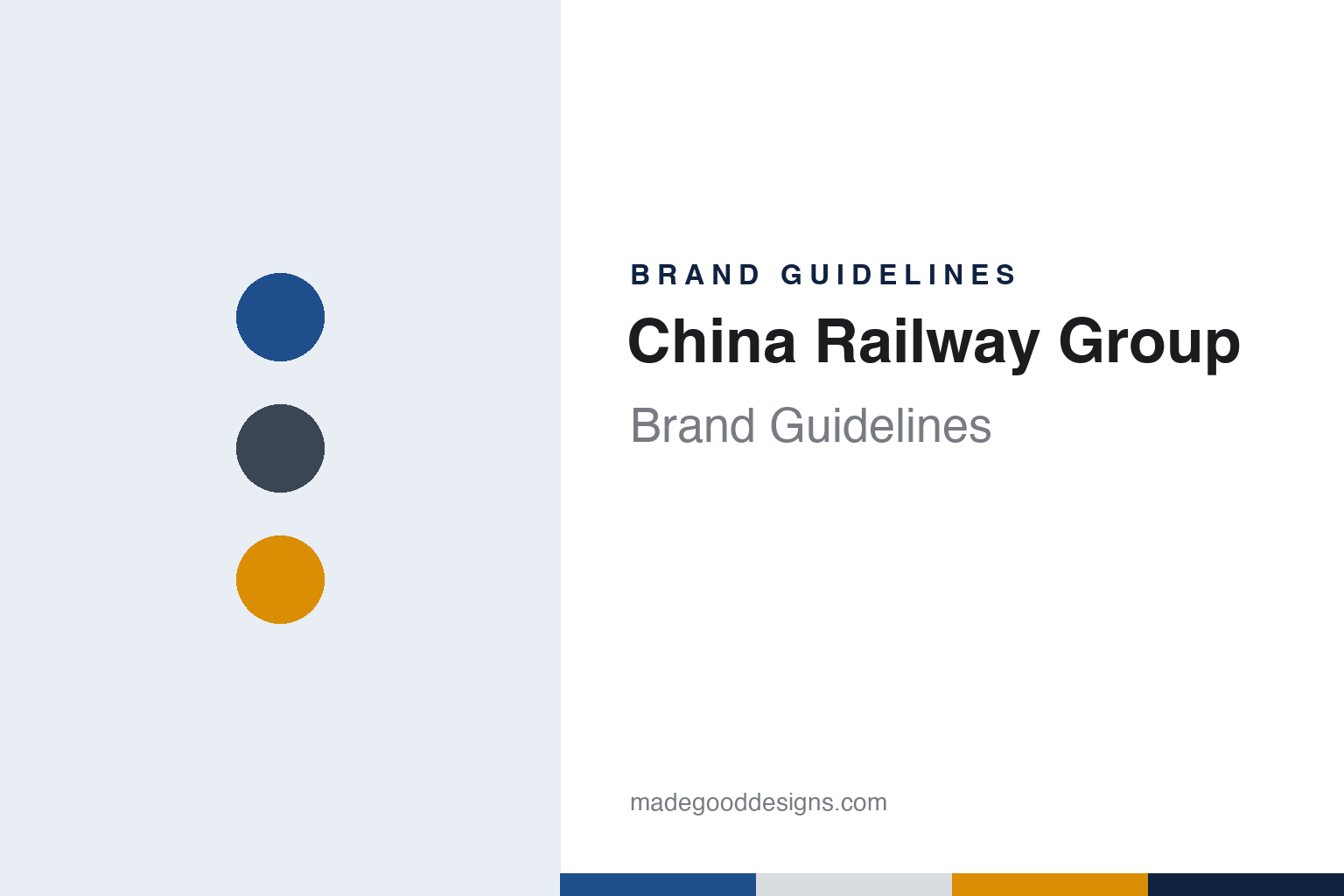
For a design guide, China Railway Group shows how a state engineering group can carry a long institutional history in one compact emblem: a blue rail-shaped character on a globe, a bilingual name and a single slogan. Compare China State Construction and PowerChina. For this guide we use survey blue, rail-steel grey and signal amber with a sans, an unofficial interpretation; no product or logo is reproduced.
Explore & save
Keep China Railway Group’s identity on hand — save it to a board in the Made Good inspiration library.
China Railway Group identity set
Pin the survey blue, steel and amber palette and the engineering sans register to your own board.