POSCO E&C Brand Guidelines
The POSCO group’s builder, formed from its steelworks units in 1994.
Aa
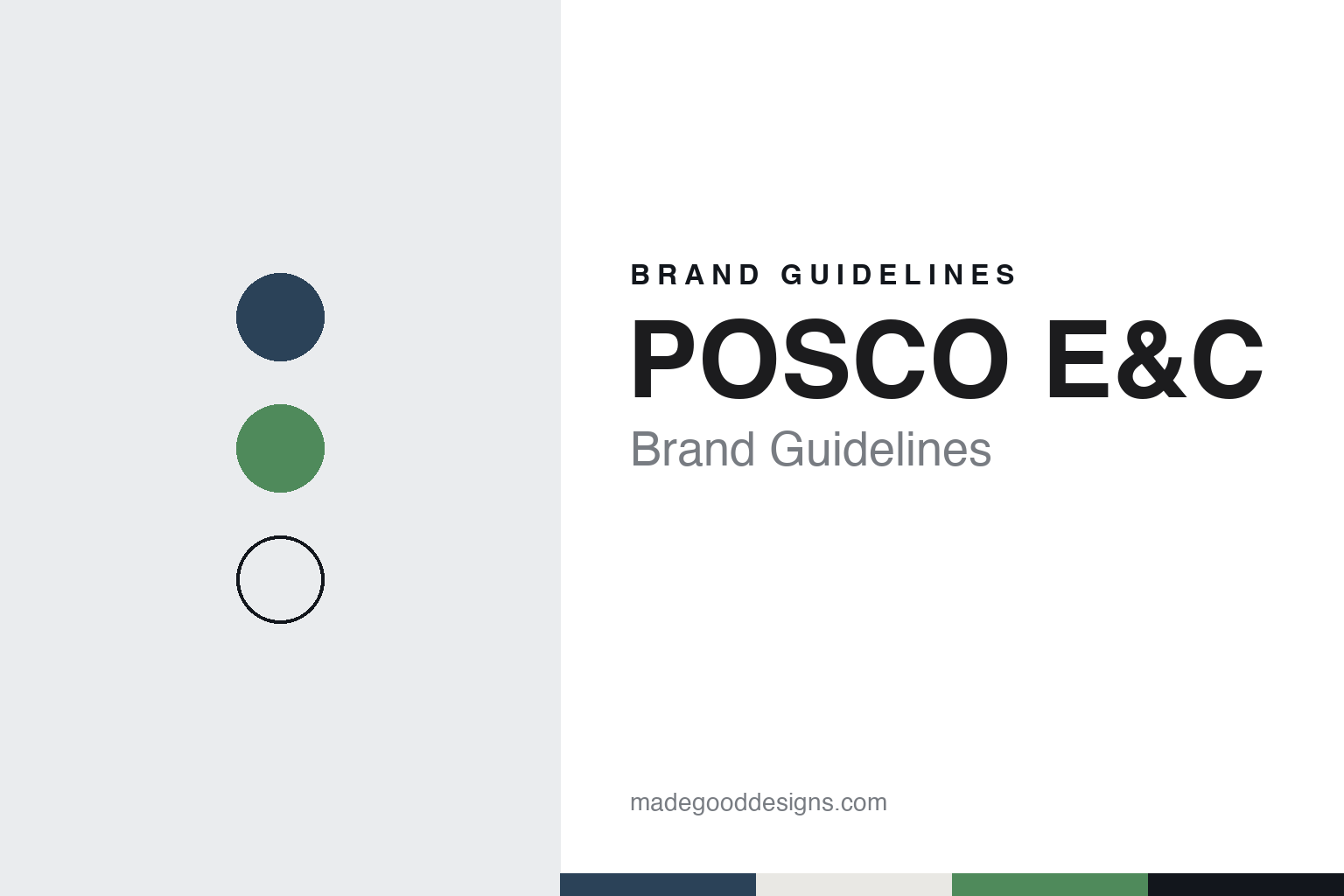
Two constants: a POSCO E&C slate and green palette and a Structural sans register. Abstract homage — not a POSCO E&C product or mark; no building, logo or nameplate is reproduced.
POSCO Development
Steelworks builders, merged in 1994.
POSCO E&C was formed on 1 December 1994 as POSCO Development, Korean Wikipedia says, by merging several engineering and construction units of the steelmaker POSCO. Its oldest part was a maintenance company set up on 2 February 1982 to fabricate equipment for POSCO’s steelworks and to build and design for them; renamed Geoyang Development in August 1991, it was combined in 1994 with POSCO Engineering and with the steelmaker’s own engineering and construction divisions.
Korean Wikipedia places the merger within “POSCO Vision 2005,” a plan of that year in which the group named steel, engineering and construction, and information and communications as its three core businesses. The new company drew on the experience of building POSCO’s steelworks at Pohang and Gwangyang. From steel plants it widened into environmental, energy and public infrastructure work, then private power plants and LNG terminals, and in the late 1990s it followed POSCO’s investments in China and Vietnam abroad, the same source says.
The name changed to POSCO Engineering & Construction in March 2002, the month it launched its apartment brand, and to POSCO E&C in March 2023. Its registered address is in Pohang, the steel city, according to its website and Korean Wikipedia, while its main offices are in Songdo, Incheon, which the JoongAng Ilbo called its headquarters in 2025.
Colour
The Sharp and Hauterre.
Housing became central after the 1997 financial crisis, when, Korean Wikipedia says, the company drew on POSCO’s stable finances to move into homes and offices, starting with apartments in Dogok-dong, Seoul. In March 2002 it launched The Sharp (더샵), a name taken from the musical sharp sign and meant to suggest a quality of life “rounded up.” A 2010 renewal brought a new logo and a slogan that translates as “reading your mind,” which the company called The Sharp 2.0, and a 2020 renewal, The Sharp 3.0, stressed comfort, convenience and design, according to Korean Wikipedia.
The company’s own brand pages give The Sharp the identity line “Advance in Core.” They describe its symbol as vertical and horizontal strokes crossing in a firm structure inspired by high-rise buildings and proportioned to the golden ratio, and a logotype that stresses the capital T and S so that it reads clearly on buildings. Its colour, the company says, is a deep Prussian blue “created by steel,” the material it treats as POSCO’s symbol. In 2022 it added Hauterre (오티에르), a high-end brand whose name joins the French words haute and terre; Korean Wikipedia says it won its first contract in Seoul’s Gangnam area, the rebuilding of an apartment complex in Bangbae-dong, in January 2023.
Its larger projects include the Songdo International Business District in Incheon, the Parc1 towers on Yeouido, an integrated steelworks for CSP in Brazil completed in 2016, and the main construction works for the Shin Hanul 3 and 4 nuclear units, begun in 2024, according to Korean Wikipedia. The same source lists newer work in battery materials: cathode and anode plants for its sister company POSCO Future M at Pohang, Gwangyang and Sejong, and lithium extraction plants in Argentina, a demonstration unit from 2019 and a first phase completed in 2024.
Typography
Design and documentation.
Asia’s large construction and engineering groups tend to present themselves through scale rather than ornament. A short wordmark or a set of initials, often in a bold sans and a single strong colour such as red, blue or green, sits above aerial photographs of towers, bridges, dams, plants and rail lines. Larsen & Toubro, for example, greets visitors to its website under its initials, “L&T,” and describes its aim as being “a builder of nations.”
Their websites are usually organised by business rather than by product. Building, civil works, plant and housing appear as separate divisions, and Korean Wikipedia describes Hyundai E&C’s business in exactly those terms: civil engineering, building, housing and plant. L&T adds manufacturing, defence and technology arms alongside construction, according to English Wikipedia.
Housing often carries a second identity. In South Korea the large builders sell apartments under their own consumer brands: Hyundai E&C uses Hillstate and THE H, according to Korean Wikipedia, alongside the company name. Overseas work is presented project by project, with named highways, ports, stadiums and metro lines standing in for a portfolio; a metro extension in Noida, reported by IBEF in November 2026, is a recent example for L&T.
Corporate reporting is part of the identity too. Annual reports, annual reviews and sustainability reports sit alongside the project pages; L&T, for instance, offers an Annual Review for 2026 on its corporate pages. This guide sets out what can be checked about each group — who founded it, who owns it today, and what it builds — and marks clearly what rests on the company’s own word.
Aa
A structural sans — the POSCO E&C name with the group symbol. (Specimen set in Sora, a sans STAND-IN; NOT the POSCO E&C logo.)
POSCO E&C
Eco and Challenge.
POSCO remains the controlling shareholder. In June 2015 Newsis reported that the company’s board had approved issuing new shares to Saudi Arabia’s Public Investment Fund, and that POSCO had approved selling part of its own stake, which would make the fund the second-largest shareholder. Korean Wikipedia now lists POSCO Holdings with 52.8 percent and a Saudi investment company of the fund with 38 percent. The shares trade on the over-the-counter K-OTC market rather than on the main exchange.
The current name was approved at the shareholders’ meeting of 20 March 2023, the Dong-A Ilbo reported: E&C now stands for “Eco & Challenge,” eco for building an eco-friendly future society and challenge for pursuing the value of life, ahead of the company’s 30th anniversary the next year. The same round of meetings renamed POSCO Chemical as POSCO Future M and POSCO ICT as POSCO DX. The website states the company’s vision as “an innovative company challenging industry limits to build an eco-friendly future society,” built on a “dual core” of eco and urban businesses that spans battery-materials plants, low-carbon steel, offshore wind, small modular reactors and housing. Its corporate mark combines its English and Korean names with the POSCO group symbol, which the group describes as five letters balanced around the S.
For a design guide, POSCO E&C shows how a steel group’s builder can carry the group mark at corporate level and a separate apartment brand, with its own deep blue, on its buildings. The two layers do different jobs: the group mark speaks to investors and partners, while the apartment brand speaks to the people who will live behind it, so each can be judged on its own terms. Compare Hyundai E&C and Samsung E&A, two other Korean engineering companies tied to large industrial groups. For this guide we use a slate blue, a green and a concrete grey with a sans, an unofficial interpretation; no product or logo is reproduced.
Explore & save
Keep POSCO E&C’s identity on hand — save it to a board in the Made Good inspiration library.
POSCO E&C identity set
Pin the POSCO E&C slate and green palette and the Structural sans register to your own board.