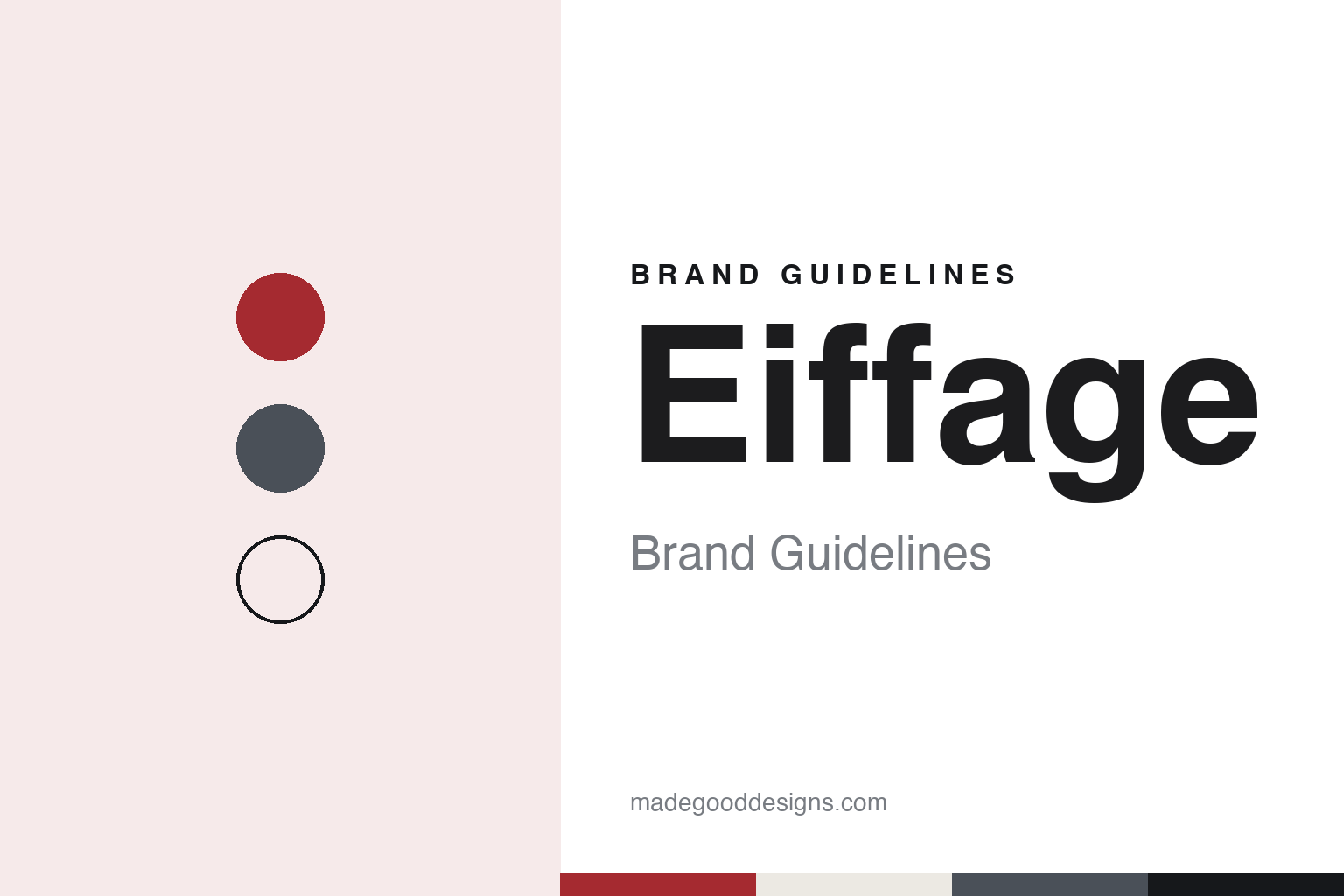
Eiffage Brand Guidelines
A name made from Eiffel, SAE and Fougerolle, with roots back to 1844.
Aa
Two constants: a red, steel grey and limestone palette and a structural sans register. Abstract homage — not an Eiffage asset; no logo, structure or site photograph is reproduced.
Three names in one
Eiffel, SAE and Fougerolle.
Eiffage is a young name built on old companies. French Wikipedia traces its roots to the building and public-works firms Fougerolle, Quillery and Beugnet, founded in 1844, 1863 and 1871, the Société Auxiliaire d’Entreprises, known as SAE, founded in 1924, and the metal-construction business Eiffel, founded in 1866 by Gustave Eiffel. The company’s own history page starts with the Fougerolle family business in 1844.
The modern group took shape around 1990. Eiffel joined SAE that year, while Fougerolle was bought by its own employees. The two groups then combined: English Wikipedia dates the merger to 1992, and French Wikipedia and the company date the creation of Eiffage to 1993. French Wikipedia says the name is a contraction of Eiffel, SAE and Fougerolle, and that the companies brought references such as the Tancarville bridge, the Sydney Opera House and the Louvre pyramid.
The sources used for this guide do not say how its predecessors operated during the occupation of 1940–1944.
The early years were spent pulling the businesses together. Eiffage bought Beugnet and its subsidiaries in August 1995; in 2000 SAE, Fougerolle and Quillery merged into Eiffage Construction; and in 2005–2006 a consortium of Eiffage and Macquarie took over the state’s holdings in the motorway operator APRR, French Wikipedia says. In 2009 Eiffage bought the German rail contractor Heitkamp Rail from the Dutch group Heijmans.
Colour
Losing Eiffel, keeping the name.
The Eiffel link did not stay on the steel arm’s door. On 5 January 2010 the first civil chamber of the court in Bordeaux barred the Eiffage subsidiary Compagnie française Eiffel construction métallique from using the Eiffel name in any form, including as a trade mark, company name or trading name, and cancelled its Eiffel marks, the trade site Batiweb reported on 13 January 2010; the case had been brought against a descendant of Gustave Eiffel who had registered the name. In April 2012 Eiffage said it would not appeal and renamed the business Eiffage Constructions Métalliques, Batiactu reported with AFP on 18 April 2012. The group name itself was unchanged; today the business line is Eiffage Métal.
The company describes itself through eight business lines in four divisions: Eiffage Construction, Eiffage Immobilier, Eiffage Aménagement, Eiffage Route, Eiffage Génie Civil, Eiffage Métal, Eiffage Énergie Systèmes and Eiffage Concessions. It says it runs more than 100,000 projects a year with about 87,000 employees.
Its signature work is the Millau Viaduct. Eiffage says it built the bridge in three years under a concession that runs to 2079, has operated it since it opened in 2004, and became sole shareholder of the operator in 2023. Other projects listed by English and French Wikipedia include the Channel Tunnel (1994), the Perpignan–Figueras high-speed line (2009) and the Stade Pierre-Mauroy near Lille (2012). The company also lists the Bretagne–Pays de la Loire high-speed line, inaugurated on 20 June 2017, and the Hypérion tower in Bordeaux, a 17-storey timber and concrete building delivered in 2021, which it calls the largest wooden structure in France.
Typography
How construction groups present themselves.
Large construction groups present themselves less through products than through places. Their identities usually rest on a strong wordmark, often in a blue, a red or an orange, used across hoardings, site vehicles, workwear and reports, with the group name repeated in the names of its subsidiaries. Eiffage, for example, runs its business lines as Eiffage Construction, Eiffage Route, Eiffage Métal and so on, while Bouygues keeps separate names such as Colas alongside Bouygues Construction.
Photography does much of the work. Group websites tend to alternate pictures of active sites — cranes, tunnel-boring machines, road crews — with finished bridges, stadiums, towers and rail lines, and they organise their pages by activity: infrastructure, buildings, concessions such as motorways and airports, and energy works. Named landmark projects serve as the main proof of capability, from the Channel Tunnel to the Millau Viaduct.
Commitments are presented in a structured way. Groups describe their environmental and social aims through named programmes, plans and reports rather than slogans; Eiffage, for instance, publishes a climate report and a biodiversity action plan alongside its universal registration document. Values pages, codes of ethics and statements on site safety appear as standard sections, written in the language of programmes and targets.
Two other audiences shape these identities. Careers pages address the large numbers of engineers, site managers and trades staff the groups recruit each year, and many groups promote employee shareholding as part of their story. Investors and lenders read the annual and sustainability reports, where the identity system is often applied most completely, in charts, maps and project photographs. This guide sets out what can be checked about each group: who founded it, how it was formed, who owns it, and which projects dated sources connect to its name.
Aa
A structural sans for an engineering register. (Specimen set in Barlow, a sans STAND-IN; NOT the Eiffage logo or any typeface the group uses.)
Eiffage
Concessions, Europe and the CAC 40.
Eiffage has had three chief executives: Jean-François Roverato from its creation to 2012, Pierre Berger from 2012 to 2015, and Benoît de Ruffray since 18 January 2016, French Wikipedia says. In 2008 a Paris appeal court ruled in a two-year shareholder dispute involving the Spanish group Sacyr, which had frozen the company’s capital; the court found that Sacyr had acted in concert with other Spanish shareholders but did not require it to bid for the rest of the shares.
Concessions now sit beside contracting. The group bought stakes in Lille and Toulouse airports in 2019, and in 2018 it bought 5.03 per cent of Getlink, the Channel Tunnel operator, the company says; English Wikipedia reports that by October 2022 Eiffage had become Getlink’s largest shareholder. Its European growth has come through purchases such as Priora in Switzerland and the Kropman group in the Netherlands, both in 2018. In 2023 it won the civil-engineering contract for EDF’s first two EPR2 reactors at Penly.
Rail and road work in the Paris region and beyond fills much of its recent order book. The company says it has won 35 contracts on the Grand Paris Express, including, through Eiffage Génie Civil and a consortium, work package 1 of line 16 in 2018 and a section of line 15 East in 2023. In 2020 it was named concession operator of the future A79 motorway in the Allier, and it won a 30-year partnership contract for a 76-kilometre stretch of the A3 motorway in northern Bavaria; in 2022 it signed a 35-year concession to manage housing for the French Ministry of Armed Forces.
Eiffage joined the CAC 40 index on 22 December 2025, the company says. It also says nearly 80 per cent of its employees are shareholders, and it names six values on its website: exemplarity, courage and tenacity, responsibility, clarity, trust and transparency.
For a design guide, Eiffage shows how a merged group can build one coined name out of its founders’ names and then keep it when one of those names is lost. Compare VINCI and Bouygues, the other large French construction groups. For this guide we use a deep red, steel grey and limestone with a sans, an unofficial interpretation; no product or logo is reproduced.
Explore & save
Keep Eiffage’s identity on hand — save it to a board in the Made Good inspiration library.
Eiffage identity set
Pin the Eiffage red, steel grey and limestone palette and the structural sans register to your own board.