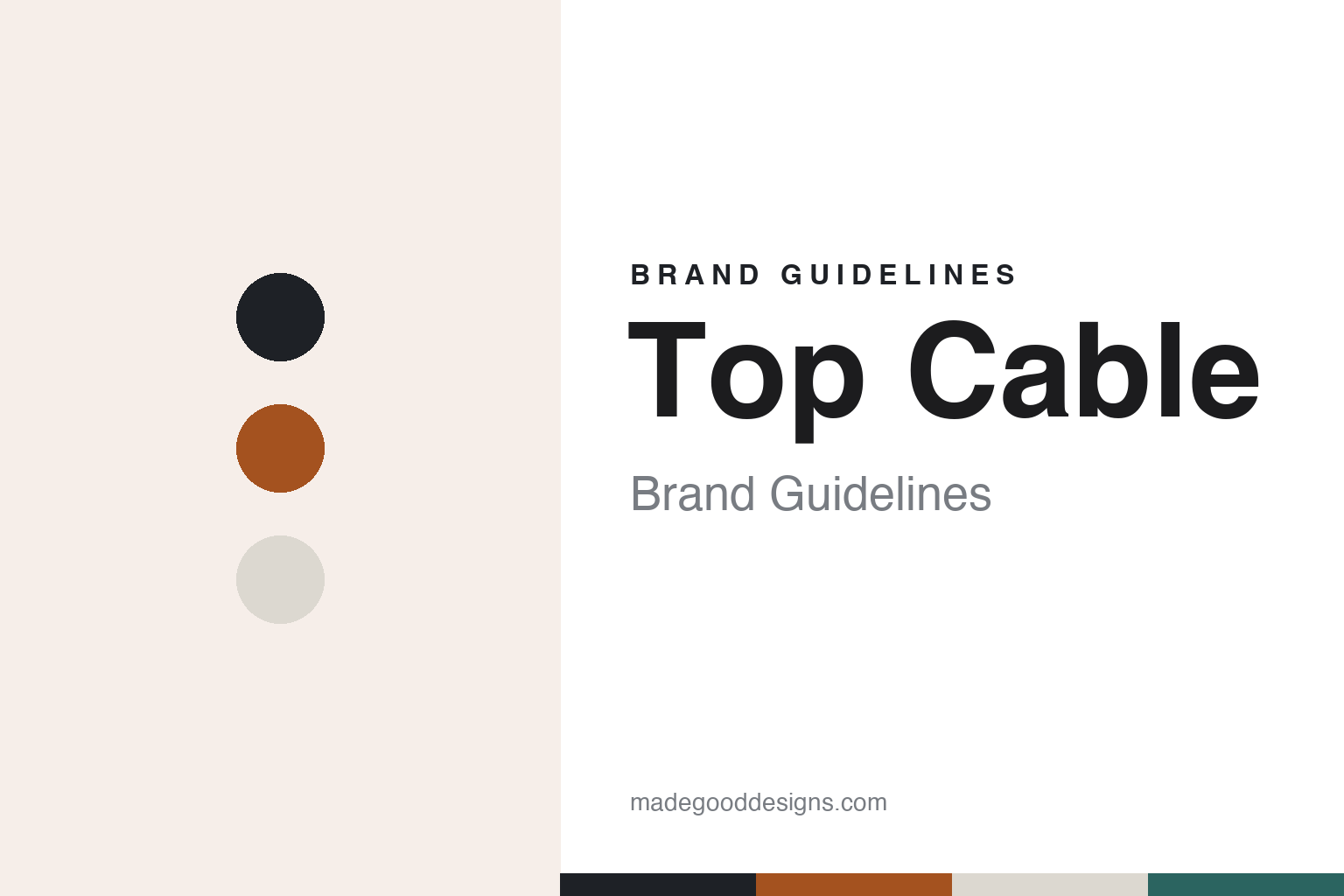
Top Cable Brand Guidelines
A family cable maker from Rubí, built one plant at a time.
Aa
Two constants: a graphite, copper and sheath-grey palette and an industrial grotesque register. Abstract homage — not a Top Cable product or mark; no cable, drum, logo or label is reproduced.
Alcabe
Four brothers, a father’s trade and a plot in Rubí.
Top Cable is a family business from Rubí, an industrial town about twenty minutes’ drive from Barcelona. The local paper Tot Rubí reported in November 2017 that the four Parera brothers — Albert, Jordi, Josep and Àlex — founded the company in 1985, taking up a trade their father, Albert Parera Amposta, had followed as a cable maker in Venezuela. The company’s own history adds detail: it says he emigrated to Venezuela in 1954, sold machinery and trucks to electrical and oil companies, began collecting and recycling the old cable his customers left behind, and then adapted a small machine in a Caracas warehouse to make new cable. Tot Rubí places the start of that cable work in the 1960s; the company’s timeline gives the earlier emigration date.
The company says the brothers, their father and two workers created Alcabe in 1985, bought land in Rubí and built their first factory there in 1986, and began selling cable in 1987. English Wikipedia gives the same sequence. Branches in Valencia and Madrid followed in 1988, and in 1991, when Alcabe had become too small, the family set up a second manufacturing company, Orbitel Cables. A larger factory opened in Rubí in 1997. Tot Rubí reported that the second Rubí site, built in 2001, became the first robotised logistics centre in the Spanish cable sector; the company itself describes a fully automated warehouse for large cable drums dating from 2002.
The firm has stayed in family hands. Tot Rubí described a business still run by the Parera Martinell brothers in 2017, with about 170 people working in Rubí, and the company today calls itself family-owned. Its slogan is “Driving your energy.” In the same 2017 interview, the director general, Jordi Parera, told the paper that innovation was the company’s distinguishing factor, and described a policy of reinvesting in the group’s own companies and training its staff rather than borrowing heavily.
Colour
Rubí, Sallent, Binaced.
Top Cable’s growth is easiest to read as a map of plants. In 2006 it began making medium-voltage cable, Tot Rubí reported, and in 2007 it opened the Akan Cables factory in Sallent, in the Bages district north of Barcelona, for that work. The town council of Sallent wrote in November 2021 that the company had been present there since 2007 with one of the most important factories in the municipality, and that the group then employed more than 600 people. On that visit the council reported that all the plants ran on self-generated solar power, that the forklifts were electric, and that one roof carried 4,000 solar panels, which the council called the largest photovoltaic installation in Catalonia.
The Sallent site has kept growing. Nació Digital reported in May 2019 that the town council approved a change to its urban plan, promoted by Top Cable, to join two of the company’s plots on the Plans de la Sala industrial estate by removing the road between them, and that the company already held licences for two new buildings, one of them for wire drawing. In 2020 the group set up Akan Compounds to make its own cable compounds, and in 2021 it started the Akson factory for rubber and solar cable, according to the company and English Wikipedia.
Outside Catalonia, Alimarket reported in February 2016 that the group had added its fourth factory and its first outside Catalonia; the company dates the founding of Iconel in Binaced, Huesca, for DIY and special cables, to 2014. English Wikipedia also lists a plant in Bellpuig, Lleida. The company says all of its manufacturing plants are in Europe.
Typography
Design and documentation.
Cable makers sell products that most people never see once they are installed. Power lines run under streets and seabeds, data cable sits inside walls, and magnet wire is wound into motors. Their public image therefore leans on what can be photographed before installation: the cable itself, the plant that makes it and the ships that lay it.
The most common picture is the cut end. Company pages and catalogues show a cable in cross-section, with copper or aluminium conductor, insulation, screens and outer sheath set out in rings, often against a plain background. Wide shots of full reels and drums stacked in a yard do the same job at a larger scale, turning a long product into a single object that a camera can frame.
Submarine work has added another set of images. Press releases about offshore wind and grid links are often illustrated with cable-laying vessels, carousels of coiled cable and tall factory towers where high-voltage cable is made. These photographs carry the story of size and reach without needing a consumer product, and they are usually credited to the company that issued them.
Words matter as much as pictures. Makers organise their ranges into product families with short trade names, voltage classes and standard codes, and their corporate pages spend a lot of space on plants, subsidiaries and owners: where a factory stands, when it opened and which group holds the shares. For a designer, the category offers a practical vocabulary of rings, coils, ships and site maps, and a reminder that an industrial identity is often built from documentation rather than from packaging.
Aa
An industrial grotesque — set wide and heavy, like print on a cable sheath. (Specimen set in Archivo, a sans STAND-IN; NOT the Top Cable logo.)
Top Cable
Named ranges and a long export list.
Most of what a customer sees of Top Cable is a set of product names. The company lists its own registered ranges, among them Powerflex for flexible power cables, Toxfree for low-smoke halogen-free cables, Xtrem for rubber cables and Topsolar for photovoltaic cable. It describes a catalogue that runs from power, armoured and control cables to medium-voltage, marine, electric-vehicle charging and fibre-optic lines, made with copper or aluminium conductors, and it names certifications from TÜV, AENOR and Bureau Veritas as bodies that test its products.
Export came early. Tot Rubí reported in 2017 that the company had opened a French subsidiary in 1992 and had since added subsidiaries in Chile, Denmark, the Netherlands, Poland and Singapore, and that distributors carried its cable to about 80 countries; the company’s own pages give figures of more than 70 and more than 80 countries in different places. The company’s timeline records an export department set up in 1995, Top Cable Chile in 1998 and an investment in the Danish distributor Scankab in 2003.
For a design guide, Top Cable shows how a family manufacturer can build a brand from plain parts: a short, literal company name, a row of trademarked range names printed on cable, drum and box, and a slogan about energy. The identity is technical rather than decorative, and the Catalan plants are part of the story the company tells. Compare it with the much older Italian group Prysmian and the French maker Nexans. For this guide we use graphite, copper and a pale sheath grey, with a solar teal accent, set in a sans, an unofficial interpretation; no product or logo is reproduced.
Explore & save
Keep Top Cable’s identity on hand — save it to a board in the Made Good inspiration library.
Top Cable identity set
Keep the Top Cable graphite, copper and sheath-grey palette and the industrial grotesque register for your own reference board.