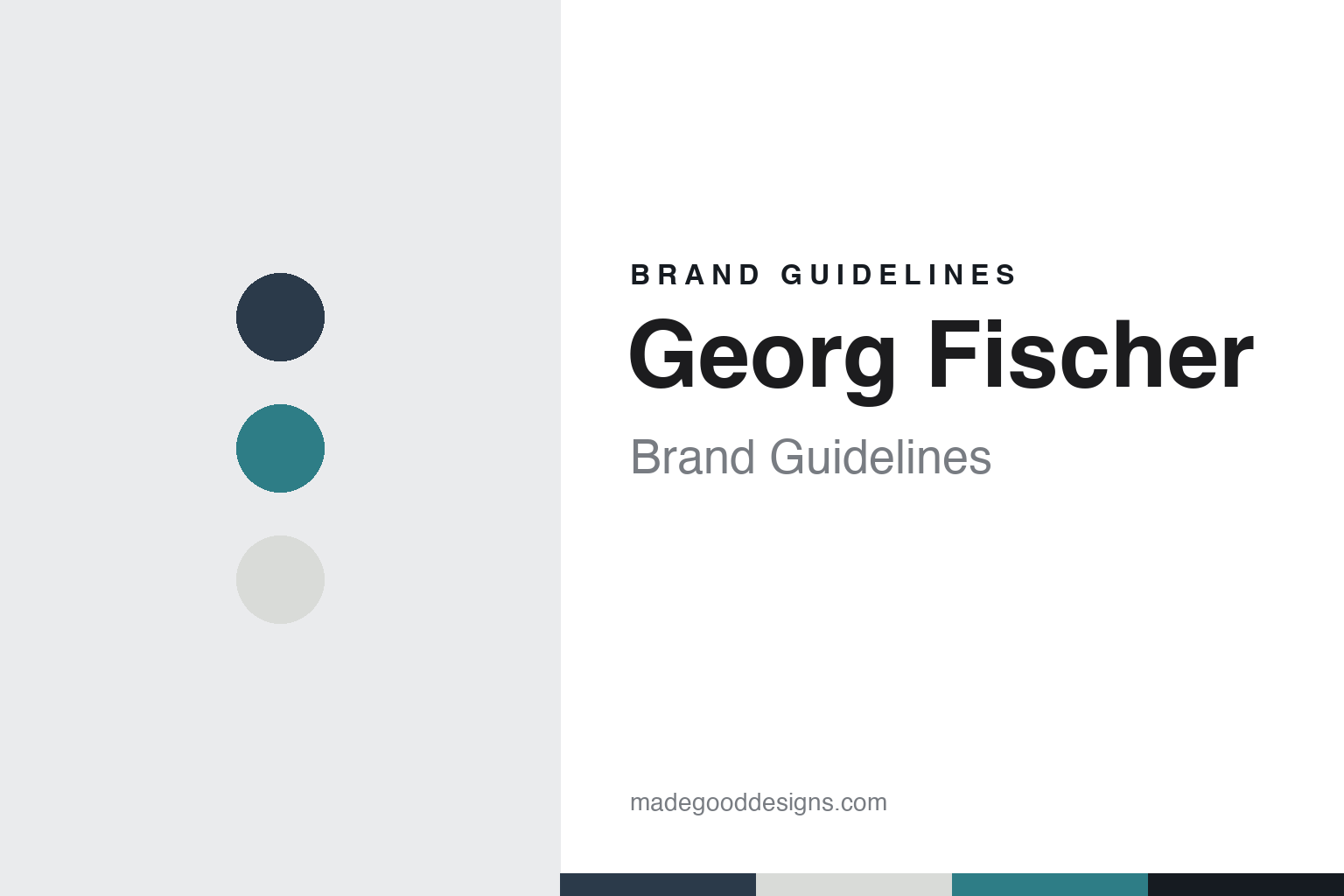
Georg Fischer Brand Guidelines
A Schaffhausen cast-steel works that became a maker of pipes, fittings and valves.
Aa
Two constants: a slate, cast grey and teal palette and an engineered grotesque sans register. Abstract homage — not a Georg Fischer product or mark; no fitting, valve, logo or plus sign is reproduced.
A Mill in the Mühlental
Cast steel, then fittings, then a works across the border.
Georg Fischer dates its start to 3 June 1802, when Johann Conrad Fischer, a 29-year-old coppersmith from Schaffhausen, bought a water-driven mill in the Mühlental valley outside the town. The company says he used it for copper smelting and for work on new alloys, and that by 1805 he was “probably the first person in continental Europe” to make cast steel in crucibles. Working outside the town’s craft guilds gave him room to experiment, its history pages say.
The family business spread into Austria, with a steel mill at Hainfeld in 1827 and a steelworks at Traisen in 1833. The turn towards the products that still define the company came in 1864, when his grandson Georg Fischer II took over the Schaffhausen works and began making malleable cast iron fittings — the company says he was the first in Europe to do so commercially. A first fittings brochure followed in 1865, listing 91 items for gas lighting.
In 1895 Georg Fischer III opened a fittings factory in Singen, in Germany, a short distance from Schaffhausen, run as a branch of the Swiss works. The firm became a joint-stock company in 1896, and from 1902 Ernst Homberger managed it for about fifty years, completing what the company calls its move from family firm to commercially run enterprise. In 1933 it opened a malleable-iron plant in Bedford, England, to keep selling into Britain and its colonies, and from 1933 to 1968 it also made enamelled cast-iron cooking pots in Switzerland.
The Second World War put the Singen plant under German law and, in the words of the Independent Commission of Experts Switzerland – Second World War, the “economic demands of the Nazi regime.” The commission’s Final Report (2002) says that no Swiss subsidiary supplied arms, but that several supplied components and were drawn into war-material programmes, Georg Fischer “to a lesser extent.” The report places the Singen works among Swiss-owned plants in Germany that used forced labourers and prisoners of war: in March and April 1943, according to an official list it cites, 704 of the plant’s 2,127 workers were foreign workers, about a third. It says food at the Singen plant “must also have been very poor,” though Georg Fischer was among the firms that tried to obtain more, and that the Swiss management told the German Labour Front it was willing not to interfere with the Singen works’ personnel management “according to National Socialist ideology.” Georg Fischer says the historian Hans Ulrich Wipf published a study of the period in 2001.
Colour
Plastics, machines and a long narrowing.
After the war, the company says, Swiss staff sent clothes, food and toys to colleagues in Germany and England through the International Committee of the Red Cross. In 1947 it shortened its name to Georg Fischer Aktiengesellschaft, and in 1948 it set up the Eisenbibliothek, an iron library run as a foundation, which opened at its Klostergut Paradies estate in 1952.
The shift to plastics began at Singen in 1957, when the first plant for PVC and PE fittings went into production after four years of research, the company says. A Georg Fischer engineer developed the PVC adhesive Tangit in 1963, made by Henkel since 1964; a plastics plant opened at Huntingdon, England, in 1966, and a plant for plastic fittings at Seewis, in Graubünden, in 1971, later known for plastic valves and actuators.
For decades Georg Fischer was a broad industrial group. It bought the electrical-discharge machining business of Ateliers des Charmilles in Geneva in stages in 1983 and 1988, and between 1987 and 1991 it gathered its foundries at Singen and its plastic piping at Schaffhausen. In 2004 it named three groups — GF Automotive, GF Piping Systems and a machine-tool group that became GF Machining Solutions in 2014.
Then the group narrowed. It sold its iron foundries in Singen and Mettmann to members of their management on 1 December 2018. In 2023 it bought the pipe-systems maker Uponor, which it calls the largest acquisition in its history; the business became GF Building Flow Solutions in 2024. In 2025 GF Piping Systems was renamed GF Industry and Infrastructure Flow Solutions, with the claim “Excellence in Flow.” The machining arm passed to United Grinding Group on 30 June 2025; VAG-Group, a Mannheim maker of metal valves for water networks, joined on 1 October 2025; and the Leipzig iron foundry went to Linamar on 31 December 2025. On 12 February 2026 the sale of the automotive casting business to Nemak was completed, and the company describes itself as a “pure-play Flow Solutions company.”
Typography
How flow-control makers present themselves.
Valve and flow-control makers sell to engineers, and their public material reads that way. Product pages are built around clear photographs of the hardware itself — a valve body, a fitting, an actuator housing — usually on a plain ground, so that shape, connection ends and materials can be read at a glance. Where a maker publishes cutaway drawings or sectioned views, they serve the same purpose: to show how a part is put together rather than to set a mood.
Colour on valves, fittings and pipes can be technical as well as decorative. Where a product range uses colour to mark a material, a medium or a pressure class, the maker’s own catalogue is the place to check what each colour stands for, since meanings can differ between companies, materials and markets. For a design guide, that is a reason to keep brand colour on paper and screens separate from the colours of the products themselves.
Much of the work happens in catalogues and tools. The tradition is old: Georg Fischer says its first fittings brochure, in 1865, listed 91 items for gas lighting. Today the same makers organise their websites by product family, industry and application, and offer downloads and online tools; Rotork, for example, publishes a sizing and selection toolkit for its actuators. Product range names, such as Rotork’s IQ, often do as much brand work as the company name.
The corporate pages tell a story of owners and divisions. Many of these companies have been reshaped by acquisitions, disposals and renamed divisions, and their sites set out which brands sit under which parent. This guide follows that record — when each company was founded, who owns it, and what it says about its own history — and marks clearly what rests on a company’s own word.
Aa
An engineered grotesque sans — for a mark built around a plus sign. (Specimen set in IBM Plex Sans, a sans STAND-IN; NOT the Georg Fischer logo.)
The Plus Sign
A stylised fitting, used since 1890.
The company’s brand history says the GF brand was officially registered on 23 December 1881, and that since 1890 its logo has carried a plus sign representing a stylised fitting, still among its most important products. Its main history timeline dates the registration of the GF trademark “with its characteristic crosses” to 1903, the year the brand page marks as the mark coming into general use; both are the company’s own accounts.
The lettering and appearance of the mark have changed many times, the company says, with milestones in 1885, 1987, 2004 and 2013. In 2004 it introduced a new brand policy and corporate design built on the GF trademark, with the motto “Adding Quality to People’s Lives,” and in 2013 it carried out a rebranding and aligned its brand architecture, so that divisions carried the GF prefix. The 1802 founding date is part of the identity too: in January 2026 a hotel opened at Klostergut Paradies under the name “1802.”
Today the company presents its work through three areas — buildings, industry and infrastructure — with pages organised by sector and application, and downloads and online tools for each. Georg Fischer AG is based in Schaffhausen, where it opened a renovated headquarters in 2023.
For a design guide, Georg Fischer shows how a mark tied to one product can outlast a long run of changes to the business behind it. Compare Belimo, another Swiss maker of flow-control equipment, and Emerson. For this guide we use slate, cast grey and teal with a sans, an unofficial interpretation; no product or logo is reproduced.
Explore & save
Keep Georg Fischer’s identity on hand — save it to a board in the Made Good inspiration library.
Georg Fischer identity set
Keep the slate, cast grey and teal palette and the engineered grotesque sans register for your own reference.