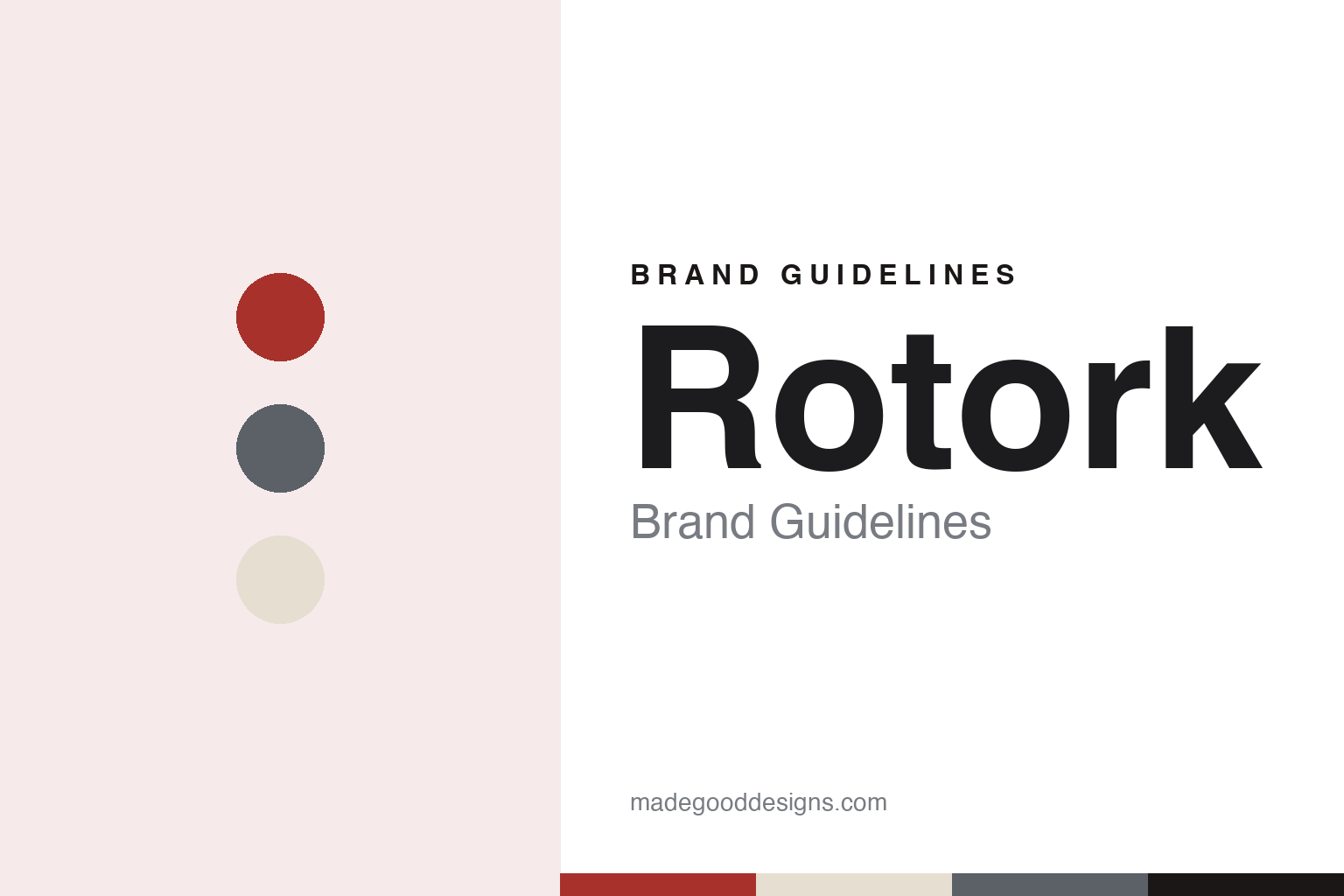
Rotork Brand Guidelines
A Bath engineering firm that built a business on turning valves by motor.
Aa
Two constants: a red, Bath stone and gear grey palette and a sturdy industrial sans register. Abstract homage — not a Rotork product or mark; no actuator, logo or nameplate is reproduced.
The 100A
One actuator, then a factory in Bath.
Rotork’s own history starts in 1957, when Rotork Engineering Company Ltd began trading with its first actuator, the 100A. An actuator is the motorised unit that opens and closes an industrial valve, and Rotork describes the 100A Mk2 of 1959 as a design that worked electrically to open valves that would otherwise have been turned by hand. The company names Jeremy Fry as its founder.
Its first customers were in oil. In those early years, the company says, orders came from the Kuwait Oil Company, which led to contracts with some of Esso’s refineries and large orders from Shell. In 1961 it built a manufacturing plant at Brassmill Lane in Bath, which the company says is still its headquarters.
The 1960s set the pattern for what followed. Rotork France was set up, and the A Range Syncropak, a multi-turn actuator with standard control circuitry, was launched. Rotork Inc. was established at Babylon, New York, in 1967, and licence agreements were signed with the Japanese firm Shimadzu. In 1968 the company changed from a private to a public limited company and was launched on the London Stock Exchange as Rotork Controls Ltd; in 1969 it bought ElectroPower Gears.
The 1970s brought Rotork Italy in 1971, a joint venture in India, further offices in Germany and India, and the purchase of the American company Evans. The company also dates a design change to that decade: a double O-ring seal to keep water out of the actuator. It says the idea came from Fry’s trip to the Middle East, where he noticed moisture forming inside actuators as hot days gave way to cold nights, and that the design is still used.
Colour
From Syncropak to IQ.
Electronics arrived in the 1980s. Rotork says the A Range 1600 Series of 1983 was the first Syncropak actuator with electronic control circuitry, followed in 1985 by the quarter-turn AQ Range and in 1986 by Pakscan, which it describes as the first dedicated bus control system for actuators. New offices opened in Canada, Spain, Singapore, Korea and Australia.
The product most associated with the company today dates from 1992. The IQ range let engineers commission an electric actuator without removing any electrical covers, which the company says allowed set-up in wet or hazardous areas. The IQ Mk2 followed in 2000, the IQ3 in 2012, and the IQ3 Pro in August 2023, configured through a phone app. In 2022 Rotork launched IQ3 SET to replace older actuators going back to the 1960s with the current platform.
Growth came through new countries and acquisitions. Through the 1990s Rotork opened companies in the Netherlands, Hong Kong, Venezuela, Beijing, Malaysia, Thailand, Moscow and Japan, reaching subsidiaries in 18 countries; it bought the gearbox maker Exeeco in 1993 and the Italian firm Fluid Systems in 1999, which took it into fluid-power actuators. A manufacturing company in Malaysia followed in 2002. Other purchases included Skilmatic in the UK, for electro-hydraulic actuators, Omag in Italy and Remote Control in Sweden, and the company says it made six acquisitions in 2011 alone, moving into instruments and control. In August 2023 it bought Hanbay, a maker of miniature electric actuators for small valves.
The organisation changed with it. Rotork says it worked for years through four divisions — Rotork Controls, Rotork Instruments, Rotork Gears and Rotork Fluid Systems — before moving on 1 January 2020 to a structure built around markets: Oil & Gas, Water & Power, and Chemical, Process & Industrial. Service lines followed, including Intelligent Asset Management, a cloud-based system launched in 2021, and a three-tier Reliability Services programme in 2023.
Typography
How flow-control makers present themselves.
Valve and flow-control makers sell to engineers, and their public material reads that way. Product pages are built around clear photographs of the hardware itself — a valve body, a fitting, an actuator housing — usually on a plain ground, so that shape, connection ends and materials can be read at a glance. Where a maker publishes cutaway drawings or sectioned views, they serve the same purpose: to show how a part is put together rather than to set a mood.
Colour on valves, fittings and pipes can be technical as well as decorative. Where a product range uses colour to mark a material, a medium or a pressure class, the maker’s own catalogue is the place to check what each colour stands for, since meanings can differ between companies, materials and markets. For a design guide, that is a reason to keep brand colour on paper and screens separate from the colours of the products themselves.
Much of the work happens in catalogues and tools. The tradition is old: Georg Fischer says its first fittings brochure, in 1865, listed 91 items for gas lighting. Today the same makers organise their websites by product family, industry and application, and offer downloads and online tools; Rotork, for example, publishes a sizing and selection toolkit for its actuators. Product range names, such as Rotork’s IQ, often do as much brand work as the company name.
The corporate pages tell a story of owners and divisions. Many of these companies have been reshaped by acquisitions, disposals and renamed divisions, and their sites set out which brands sit under which parent. This guide follows that record — when each company was founded, who owns it, and what it says about its own history — and marks clearly what rests on a company’s own word.
Aa
A sturdy industrial sans — for an engineering brand built on one product type. (Specimen set in Archivo, a sans STAND-IN; NOT the Rotork logo.)
An Offer From ABB
A Bath company, with a pending change of owner.
Rotork’s independence is set to end, though not yet. In July 2026 the engineering group ABB agreed the terms of a recommended cash offer for Rotork, the Chinese business site Sina Finance reported on 17 July 2026. Rotork’s board unanimously approved the proposal and intended to recommend it to shareholders. ABB said Rotork would run as a separate division within its automation business, and that it had no plans for major changes to Rotork’s presence in the UK, which would stay an important manufacturing and technology centre.
In November 2026 Rotork’s investor site still presented the deal as an offer, made by ABB through its subsidiary ABB Automation Holding UK Limited under the UK takeover code; it had not been completed at the time of writing, and Rotork plc remains based in Bath. The company describes its purpose as “keeping the world flowing for future generations” and its aim as leading in intelligent flow control.
Its public face is technical. The website is organised by product family — electric, fluid and electro-hydraulic actuators, gearboxes, instruments and network systems — and by industry, with a sizing and selection toolkit for engineers. Product names do much of the brand work: IQ, CK, Skilmatic and Pakscan recur across decades of the company’s own history.
For a design guide, Rotork shows how a single product type, the valve actuator, can carry a company name for nearly seventy years. Compare Emerson, a larger maker of valves and automation equipment, and Flowserve. For this guide we use a red, Bath stone and gear grey with a sans, an unofficial interpretation; no product or logo is reproduced.
Explore & save
Keep Rotork’s identity on hand — save it to a board in the Made Good inspiration library.
Rotork identity set
Keep the red, Bath stone and gear grey palette and the sturdy industrial sans register for your own reference.