Dudson Brand Guidelines
A Hanley pottery that turned to hotel tableware, now a Churchill brand.
Aa
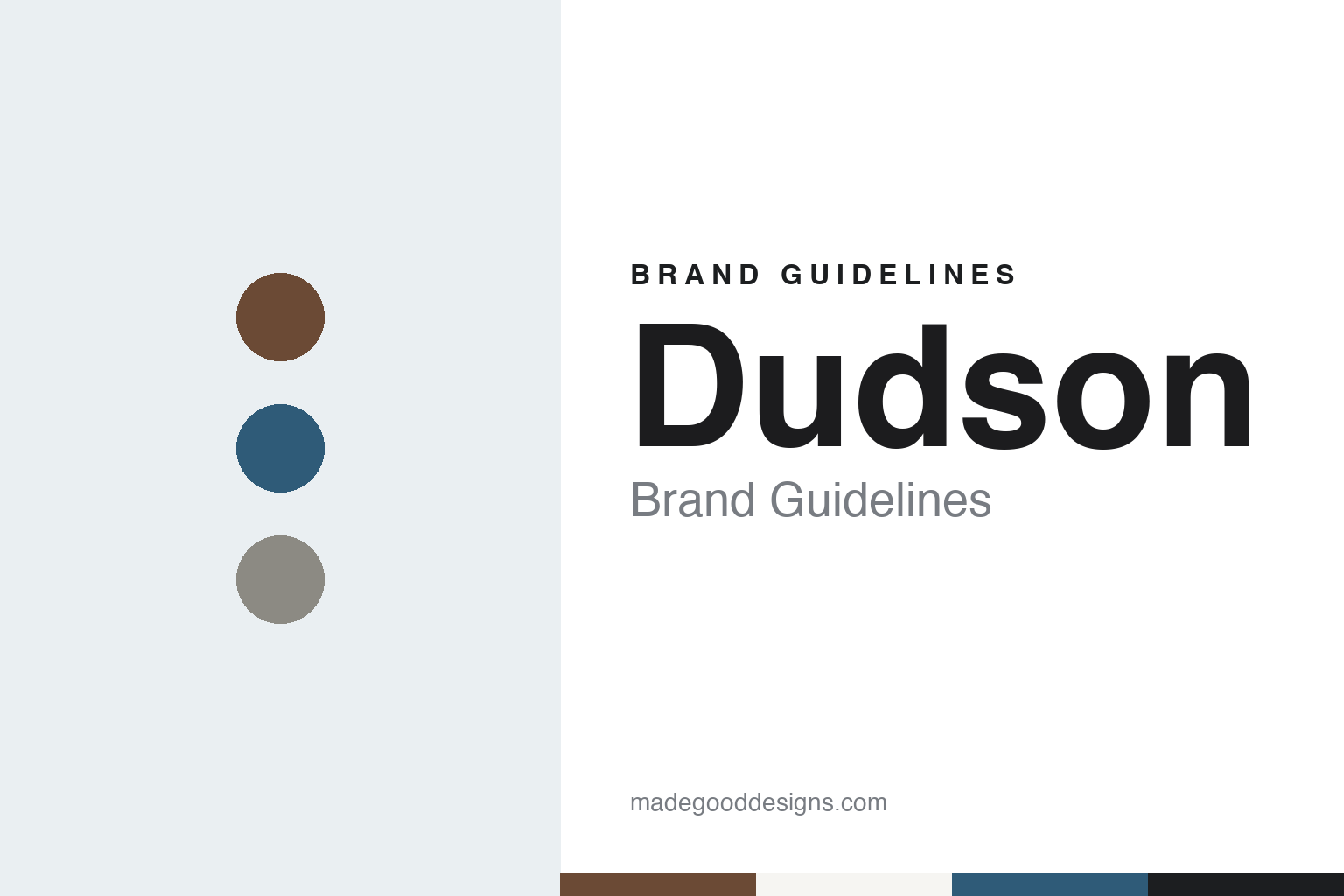
Two constants: a kiln brown, glaze blue and stoneware grey palette and a workmanlike sans register. Abstract homage — not a Dudson product or mark; no range, backstamp or logo is reproduced.
Hanley, 1800
Domestic ware first, then hotels.
Dudson was founded in 1800 in Hanley, Stoke-on-Trent, by Richard Dudson, English Wikipedia says. The Stoke Sentinel reported in 2021 that the family’s Hanley site was where he opened his first factory; the BBC, reporting in June 2026, dated manufacturing on that factory site from 1810 to 1980. In its early decades the company made a broad range of domestic ware, which the Sentinel listed as Staffordshire figures, relief-moulded stoneware, jasper ware, ebony ware and rouletted “mosaic” ware.
The change of direction came in the 1880s. In 1882, the Sentinel reported, James Thomas Dudson, the founder’s great-grandson, became owner of the Hanley factory and turned it from domestic pottery towards the growing catering trade, as railways, shipping lines and new hotels put more people on the move. A strong vitrified body developed by his father suited that work, and by 1891 the company had turned its full attention to the hospitality market, English Wikipedia and the Sentinel both say.
The business stayed in the family for two centuries. The Sentinel described it as the oldest privately owned family business in the UK tableware industry, eight generations after its founding, and English Wikipedia uses the same description. Production later moved to a newer factory in Burslem, the Sentinel reported, and the original Hanley works took on a different life as a community centre and museum.
Colour
Tableware made for the trade.
From the 1890s Dudson made tableware specifically for hotels, restaurants and caterers, and that is still how the brand is presented. On its Dudson pages, Churchill China says the brand has a heritage of producing tableware specifically for the hospitality market dating back to 1800, and pitches it at chefs and professional kitchens rather than home buyers.
The Dudson ranges sold today are described in craft terms. Harvest, Churchill says, has a hand-finished sponged rim whose glaze runs naturally, so that each piece differs; Evo is made from vitrified stoneware to look like hand-thrown pottery and is hand dipped in reactive glazes; Dudson White has a slightly irregular edge and embossing modelled on hand-throwing; and The Maker’s Collection, including Finca and Urban, uses semi-matte glazes decorated in-glaze. Churchill lists fifteen Dudson ranges in all, several of them variations on Harvest.
The catalogue is organised the way trade buyers shop. Churchill sorts the Dudson ranges by glaze colour, finish and shape, and by uses such as café and hot-beverage service, with product codes and sizes for each piece. In those pages the brand is shown through its surfaces — sponged rims, reactive glazes, embossed white — set out range by range.
Distribution follows the same trade model. Churchill says Dudson is sold worldwide through its network of distributors, except in the United States and Canada, where it has an exclusive partnership with Arc Cardinal. It also says the brand is still made by potters in Stoke-on-Trent; that is the company’s own statement.
Typography
How tableware makers present themselves.
Tableware and glassware makers mostly present themselves through the table rather than the logo. Their catalogues and websites lean on collection photography: a single glass against a plain ground, a stack of plates, or a full place setting with cutlery, napkins and food. The setting does much of the work, signalling whether a range is meant for a family kitchen, a formal dinner or a busy restaurant, and the same pieces are often shown in more than one of those roles.
Names carry a large share of the identity. Ceramic makers mark the underside of a plate with a backstamp that gives the maker’s name, often with a pattern name and a place, and collectors and buyers use that mark to identify a piece. Patterns and shapes are usually given their own names, so that a single company may sell dozens of named ranges, each with its own photography and description, while the company name stays small.
Many makers also split their identity between home and trade. Arc, for example, keeps separate brand names for consumer tableware and for bars, hotels and restaurants, according to French Wikipedia. Hospitality catalogues tend to be practical documents, organised by shape, capacity and use, with product codes and packing details, while the consumer side is closer to a lifestyle magazine. Some makers add their own shops: Paşabahçe, the Turkish glassware brand, runs a chain of stores under its own name.
Behind the products sits a corporate layer. Company pages describe factories, founding dates and owners, and in this sector those stories often involve old works, family control, takeovers and court-supervised restructurings, as the profiles in this guide show. For a designer, the useful lesson is how these makers keep a recognisable voice across a long range of named collections, a trade catalogue and a corporate history at once.
Aa
A workmanlike sans for a trade pottery. (Specimen set in Archivo, a sans STAND-IN; NOT the Dudson logo.)
Administration and after
Churchill China, 2019, and a museum in a bottle oven.
The family company did not survive. Dudson went into administration on 4 April 2019, with PwC appointed as administrators, the Stoke Sentinel reported that day. The administrators said the business had faced significant cash-flow pressures from a deterioration in sales and increased costs, and that efforts to sell it as a going concern had not succeeded, so it was not commercially viable to keep trading. The company stopped trading and its staff were made redundant.
The same day, Churchill China, another Stoke-on-Trent maker of hospitality tableware, announced that it had bought certain assets from Dudson Holdings Limited and Dudson Limited: the Dudson brand, the intellectual property for the Harvest and Evo ranges, and some plant and equipment; the Sentinel described Harvest and Evo as two of Dudson’s most popular ranges. The purchase did not include the Dudson group’s operating businesses, its statement said, as quoted by the Sentinel. English Wikipedia says Churchill began making the ranges in its own factory straight away and relaunched the Dudson brand on 6 June 2019. Since then Dudson has been a Churchill brand, not an independent company.
The original Hanley works survives as the Dudson Centre. The family donated the site to the local voluntary sector in the mid-1990s — the BBC gives 1994, Daily Focus 1996 — and after redevelopment it was officially opened by Queen Elizabeth II in 1999. It is managed by Voluntary Action Stoke-on-Trent and houses more than twenty community organisations, Daily Focus reported. The Dudson Museum, inside the Grade II listed bottle oven, shows the Dudson Collection, from jasperware jugs and Staffordshire figures to hotel wares, and in January 2026 it was awarded full accreditation under the UK Museum Accreditation Scheme, administered by Arts Council England. In June 2026 the BBC reported that the centre was asking former pottery workers to share memories of the factory for an exhibition during Heritage Open Days that September, covering the site from its working years to the present day.
For a design guide, Dudson shows how a pottery name can outlive its company when the brand and its ranges are bought by another maker. Compare Churchill China, its owner since 2019, and Steelite, another maker of hospitality tableware. For this guide we use a kiln brown, a glaze blue and a stoneware grey with a sans, an unofficial interpretation; no product or logo is reproduced.
Explore & save
Keep Dudson’s identity on hand — save it to a board in the Made Good inspiration library.
Dudson identity set
Pin the Dudson kiln brown, glaze blue & stoneware grey palette and the workmanlike sans register to your own board.