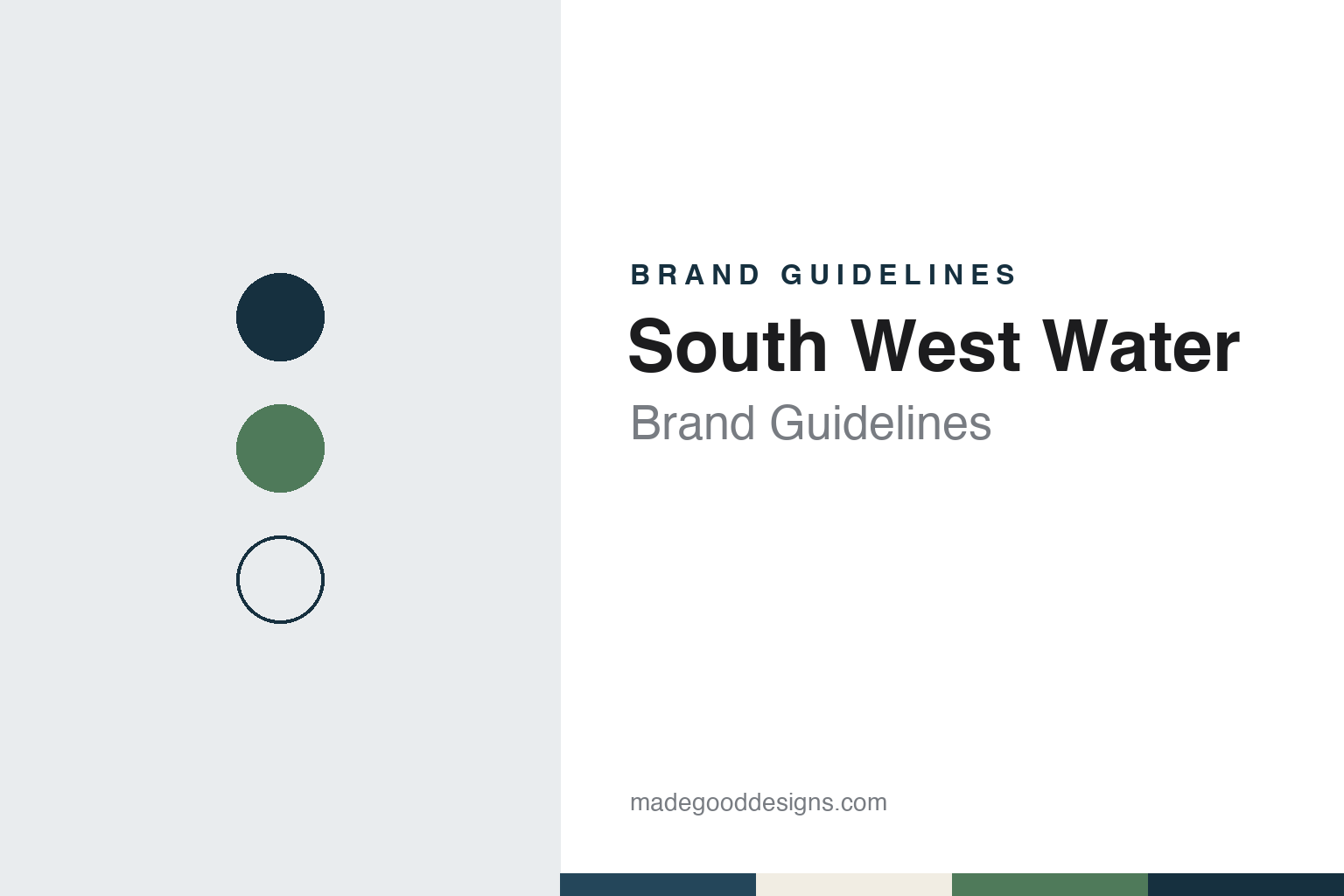
South West Water Brand Guidelines
Devon and Cornwall’s water company, formed in 1989 and part of Pennon.
Aa
Two constants: a South West Water slate, cream and moorland green palette and a Westcountry serif register. Abstract homage — not a South West Water asset or mark; no logo, livery or sign is reproduced.
South West Water Authority
From Drake’s Leat to a regional authority.
South West Water grew out of the South West Water Authority, formed under the Water Act 1973 as one of ten regional water authorities in England and Wales, English Wikipedia says. It brought together a long list of statutory and council water undertakings across Devon and Cornwall, and the company that followed it is responsible for sewage treatment as well as supply.
Some of those undertakings were very old. English Wikipedia traces Plymouth’s supply to Drake’s Leat, built by Plymouth Corporation under an Act of 1584. Others came from the Victorian period: the Falmouth Waterworks Company of 1862, the Exmouth and Budleigh Salterton Waterworks Company of 1864 and the Truro Water Company of 1869. In the twentieth century, county boards gathered these up: the North Devon Water Board under an Act of 1945, the East Devon Water Board of 1950, with offices in Honiton and Exeter Corporation’s waterworks, and boards for east, west, south, and north and mid Cornwall formed between 1959 and 1967.
The present company dates from privatisation. Companies House records South West Water Limited as incorporated on 1 April 1989, under the earlier name South West Water Services Limited, with its registered office in Exeter. Its parent, now Pennon Group plc, was incorporated on the same day as South West Water Plc and later took the Pennon name. Pennon says it was founded in 1989 and is listed in the FTSE 250.
Today South West Water supplies water and treats wastewater across Devon and Cornwall and in small parts of Dorset and Somerset. Pennon puts the population it serves there at about 1.8 million, rising with about 10 million seasonal visitors over the year.
Colour
Bournemouth, Bristol and SES.
Under Pennon, South West Water has grown by taking in neighbouring water-only companies. The first was Bournemouth Water. Pennon’s group history records its purchase from Sembcorp in 2015; the Competition and Markets Authority cleared the deal and the merger with South West Water on 5 November 2015, and Bournemouth Water was transferred to South West Water in April 2016. English Wikipedia says the company still supplies water in that part of southern England under the Bournemouth Water name; Pennon puts the population served there at about half a million, in parts of Dorset, Hampshire and Wiltshire.
The second was Bristol Water. Pennon announced the acquisition of the Bristol Water group on 3 June 2021 and received clearance from the CMA on 7 March 2022. The licence merger of South West Water and Bristol Water completed on 1 February 2023, leaving the combined water business operating under one licence, Pennon says. Bristol Water serves about 1.2 million people in and around Bristol, according to Pennon.
The third was SES Water, Sutton and East Surrey Water, the Surrey company Pennon calls SES Water. Pennon announced the acquisition on 10 January 2024 and says it received CMA clearance for the merger of SES Water with South West Water on 14 June 2024; SES Water supplies more than 750,000 people in parts of Surrey, Kent and south London, Pennon says.
The landscape is part of the brand. English Wikipedia says the company’s main sources are about twenty reservoirs it owns, with around 90 per cent of its water coming from reservoirs and rivers. Upper Tamar Lake is used for angling, watersports and model yachting, and the charity South West Lakes Trust manages some fifty inland water sites across Cornwall, Devon and West Somerset.
Typography
How water utilities present themselves.
Most of what the public sees of a water company is practical rather than promotional: the vans that turn up to fix a main, the signs on the gates of treatment works and pumping stations, the bill that arrives through the door, and the notices posted when roads are dug up. For a design reader, those everyday pieces carry the identity more often than any advertisement does, because they are seen by every household in a supply area.
A bill is a working document, setting out what is owed, how to pay and where to find help, and a customer campaign is usually a single request; for a design reader, both are worth studying as type, layout and tone. Group names matter too: Pennon, for example, lists South West Water, Bournemouth Water, Bristol Water and SES Water as separate businesses on its own website, so one owner can sit behind several regional brands.
Photography leans on the landscape the companies manage. Reservoirs, moorland catchments, rivers, coastlines and the buildings of treatment works appear again and again, and some sites double as visitor places: English Wikipedia notes public access to Southern Water’s Bewl Water and guided tours of the Victorian sewers of Brighton and Hove, and a charity, South West Lakes Trust, that manages inland water sites across Cornwall, Devon and West Somerset.
Corporate pages carry a different kind of information. In the UK, water companies sit under the economic regulator Ofwat and the Environment Agency, and the Environment Agency publishes dated press releases on prosecutions; owners, regulators and court outcomes are therefore part of the record. This guide treats them as dated facts, set out alongside the history of each company and the palette and type choices made for it.
Aa
A sturdy text serif with a regional feel. (Specimen set in Source Serif 4, a serif STAND-IN; NOT the South West Water logo or house typeface.)
Customers and regulators
WaterShare+, WaterFit and the Environment Agency.
Pennon’s group history records the launch of WaterShare+ on 18 September 2020, a scheme that shares outperformance with customers, with a second issue in April 2022 that included Bristol Water customers. In 2022 it announced WaterFit, a plan for 2022–25 setting out how it would work with partners on coastal and river water quality. Earlier, in January 2019, Ofwat awarded South West Water’s business plan for 2020–25 fast-track status, and in January 2025 Pennon announced that it accepted Ofwat’s final determinations for 2025–2030.
The company’s environmental record has also been tested in court. The Environment Agency says South West Water was prosecuted in 2023 on 13 charges covering July 2016 to August 2020. On 29 September 2026, at Plymouth Magistrates’ Court, it was sentenced on 18 charges to which it had pleaded guilty: 17 for illegal water discharge activities and one for failing to take reasonable remedial measures after a failure at a pumping station. The offences took place between January 2015 and July 2021 at Bodmin, Harlyn, Playing Place, Polperro and Plymouth, the agency said. Six further charges relating to the Holywell pumping station were left to a later hearing.
For a design guide, South West Water shows a regional water brand that now sits inside a group which still uses several regional names, Bournemouth Water, Bristol Water and SES Water among them. Compare SES Water, its sister company under Pennon, and Wessex Water, its neighbour to the east. For this guide we use an Atlantic slate, a warm cream and a moorland green with a serif, an unofficial interpretation; no product or logo is reproduced.
Explore & save
Keep South West Water’s identity on hand — save it to a board in the Made Good inspiration library.
South West Water identity set
Pin the South West Water slate, cream and moorland green palette and the Westcountry serif register to your own board.