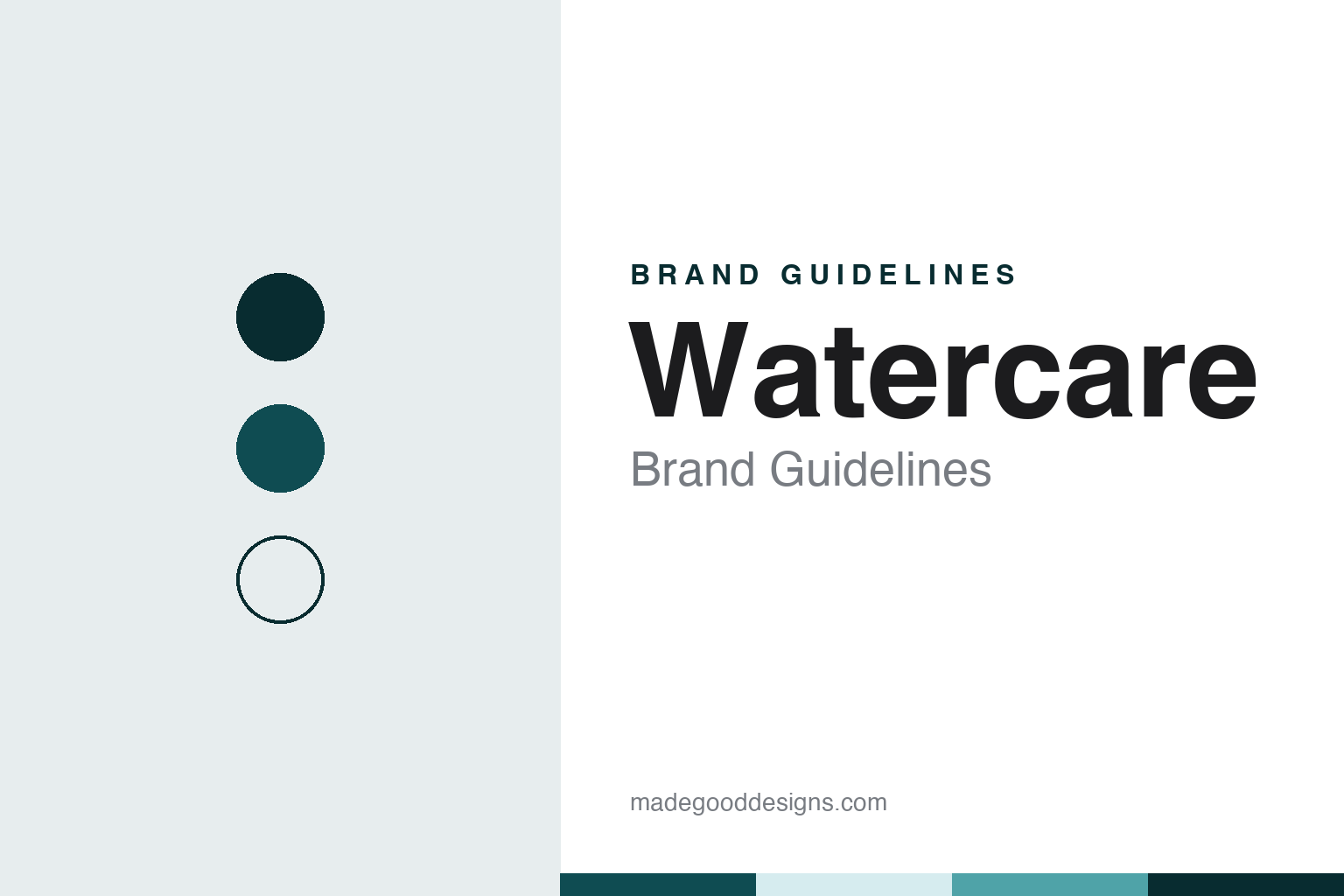
Watercare Brand Guidelines
Auckland’s 1992 water company, council-owned and separately funded.
Aa
Two constants: a Watercare deep teal and pale sky palette and a rounded sans register. Abstract homage — not a Watercare mark; no logo, sign or asset is reproduced.
A 1992 corporatisation
Auckland’s water company.
Watercare — registered as Watercare Services Limited — runs drinking water and wastewater services for the Auckland region of New Zealand. The company says it serves 1.7 million people, and it calls itself “New Zealand’s largest water utility”. The New Zealand Herald reported in March 2026 that its network stretches from Wellsford in the north to Tuakau in the south. Its head office is in Newmarket, Auckland, the company says.
The company was first incorporated in August 1991 and formed as a local-authority trading enterprise in 1992, according to English Wikipedia. Wikipedia’s article on the Auckland Regional Council describes how legislation required the council’s remaining operations to be corporatised and moved ownership of the resulting companies to a new, short-lived body, the Auckland Regional Services Trust; it calls Watercare the largest local government corporatisation in New Zealand. Watercare did not keep the catchment lands in the Waitākere and Hunua Ranges, the same article says: it leased only the dam, pipeline and lake areas, and the rest became the largest addition to the regional parks in the council’s history.
Today Watercare is a council-controlled organisation under the Local Government Act 2002, wholly owned by Auckland Council, and also a limited liability company under the Companies Act 1993, the company says. Wikipedia says the drinking water retailer Metrowater, founded in 1997, was integrated into Watercare in 2010, and that Watercare became a council-controlled organisation on 1 July 2012.
Colour
Separate finances, a new monitor.
Watercare’s position changed in 2025 under the Government’s Local Water Done Well legislation. The company says that from 1 July 2025 it has been fully financially separate and independent from Auckland Council while remaining 100 per cent council-owned: it may not pay a dividend to the council or receive financial support from it, and existing debt owed to the council must be repaid by 30 June 2030. The Government made a Watercare Charter in March 2025, in effect until 30 June 2028, under which the Commerce Commission acts as an interim Crown monitor, the company says; permanent economic regulation is due to apply from July 2028. The New Zealand Herald reported in March 2026 that the separation allowed the company to borrow more for a ten-year building plan organised into 13 programmes.
Its principal regulators include Auckland Council, the Commerce Commission, Waikato Regional Council and the water services regulator Taumata Arowai, Watercare says. At least two of its board meetings a year must be held in public, and in practice every board meeting has a public session, the company adds. In Papakura it supplies bulk services to Veolia, which runs the local network and retail service, and its Watercare Laboratory Services unit tests drinking water and wastewater for more than a third of New Zealand’s population, according to the company.
Its flagship project is the Central Interceptor, a 16.2-kilometre wastewater tunnel from Māngere to Point Erin in Herne Bay. The New Zealand Herald reported that the southern section went live in February 2025; the company’s chief executive told the paper the project would take close to 20 years from concept to opening. Wikipedia says the tunnel was in service by mid-2026 and was built by the Ghella–Abergeldie joint venture under a contract signed in March 2019. The Herald also listed upgrades at the Māngere treatment plant, which serves about 1.3 million people, and at the Rosedale plant on the North Shore.
The same report described a wider shift in how the company plans its work. Around 1,000 separate projects are being grouped into larger programmes, the paper said, including the Waitematā Water Quality Improvement Programme, a joint initiative with Auckland Council to reduce wastewater overflows in some of the city’s oldest suburbs, from Waterview and Point Chevalier to Herne Bay, and work on the Huia water supply. The company forecasts that the population it serves will grow by 215,000 over the next decade, the Herald reported, and it has warned developers that new connections cannot currently be guaranteed in some areas because of pressure on wastewater plants.
Typography
Design and documentation.
Most of what the public sees of a water company is practical rather than promotional: the vans that turn up to fix a main, the signs on the gates of treatment works and pumping stations, the bill that arrives through the door, and the notices posted when roads are dug up. For a design reader, those everyday pieces carry the identity more often than any advertisement does, because they are seen by every household in a supply area.
A bill is a working document, setting out what is owed, how to pay and where to find help, and a customer campaign is usually a single request; for a design reader, both are worth studying as type, layout and tone. Group names matter too: Pennon, for example, lists South West Water, Bournemouth Water, Bristol Water and SES Water as separate businesses on its own website, so one owner can sit behind several regional brands.
Photography leans on the landscape the companies manage. Reservoirs, moorland catchments, rivers, coastlines and the buildings of treatment works appear again and again, and some sites double as visitor places: English Wikipedia notes public access to Southern Water’s Bewl Water and guided tours of the Victorian sewers of Brighton and Hove, and a charity, South West Lakes Trust, that manages inland water sites across Cornwall, Devon and West Somerset.
Corporate pages carry a different kind of information. In the UK, water companies sit under the economic regulator Ofwat and the Environment Agency, and the Environment Agency publishes dated press releases on prosecutions; owners, regulators and court outcomes are therefore part of the record. This guide treats them as dated facts, set out alongside the history of each company and the palette and type choices made for it.
Aa
A rounded sans for a bilingual utility. (Specimen set in Figtree, a sans STAND-IN; NOT the Watercare logo.)
Watercare
Two languages on the page.
Watercare’s website pairs English page titles with te reo Māori ones: “About us” sits with “Mō mātou”, and “Our organisation” with “Tā mātou pakihi”. Its pages also use the Māori name for the region, Tāmaki Makaurau, when describing where its teams work.
Readers searching for the company should note that its legal name, Watercare Services Limited, is longer than the trading name, and that it does not run the retail service for Papakura households, which Veolia handles. Its website is watercare.co.nz.
The company frames its funding in plain terms on its own site: it says it receives no funding from Auckland Council or the government, pays no dividend to the council, and puts all the money it receives from customers into operating, maintaining and expanding its pipes, treatment plants, pump stations and other infrastructure.
For a design guide, Watercare shows how a council-owned utility presents itself in both English and te reo Māori while answering to a national economic regulator. Compare Sydney Water, a state-owned utility across the Tasman, and Veolia, which runs Papakura’s retail water service. For this guide we use a deep teal and a pale sky with a sans, an unofficial interpretation; no product or logo is reproduced.
Explore & save
Keep Watercare’s identity on hand — save it to a board in the Made Good inspiration library.
Watercare identity set
Pin the Watercare deep teal and pale sky palette and the rounded sans register to your own board.