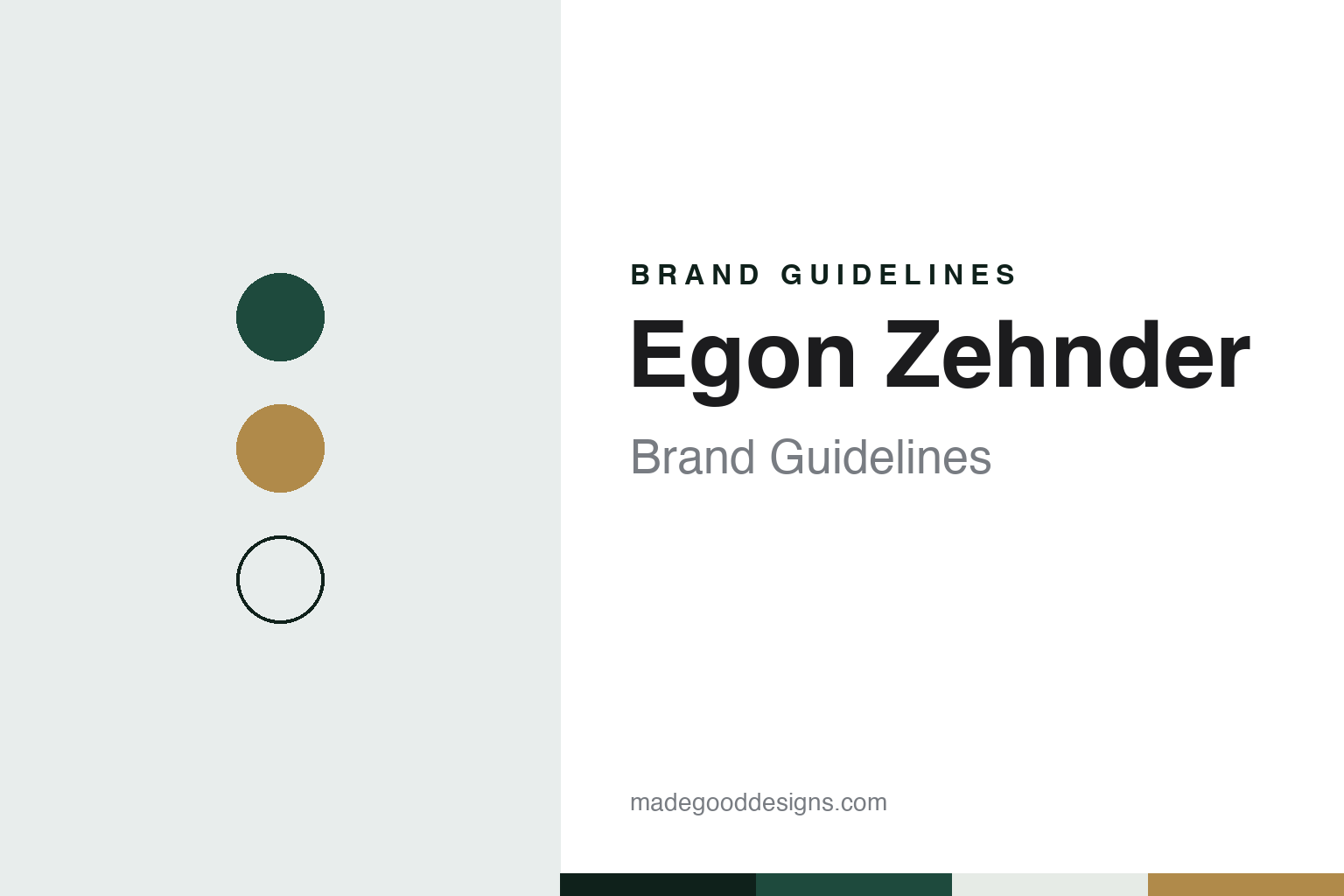
Egon Zehnder Brand Guidelines
Zurich’s 1964 search firm run as one equal partnership.
Aa
Two constants: an alpine green, mist and ochre palette and a partnership sans register. Abstract homage — not an Egon Zehnder asset or mark; no logo, report cover or photograph is reproduced.
Zurich, 1964
A Swiss firm named after its founder.
Egon Zehnder was founded in Zurich in 1964 by Egon Zehnder, according to German Wikipedia, which describes it as a Swiss consulting company working in executive search and leadership advisory. English Wikipedia, which gives the founder’s name in full as Egon P. S. Zehnder, agrees on the year, and a company press release distributed in Austria by the APA news agency’s OTS service in February 2019 also says the firm was founded in Switzerland in 1964.
The founder handed over day-to-day leadership in the early 1990s. English Wikipedia says that in 1992 he stepped back from running the firm and that A. Daniel Meiland, until then its regional director for North America, was named chairman of the executive committee and chief executive. By 2000, the same article says, Egon Zehnder had become the largest executive search firm in Europe. It also lists the firm’s later chief executives: Damien O’Brien from 2008 to 2014, Rajeev Vasudeva from 2014 to 2018, Edilson Camara from 2018 to 2024 and Francesco Buquicchio from 2024.
The firm grew steadily in size. The 2019 OTS release said Egon Zehnder had more than 460 consultants by the end of its 2018 financial year and was present in 40 countries with 68 locations. More recent figures differ a little between sources: German Wikipedia gives 71 locations in 37 countries with around 600 consultants, the firm’s “About Us” page gives 37 countries, and a company release from January 2026 gives 600 consultants across 70 offices in 36 countries.
Its services, as the website groups them today, run from CEO, executive and board successions and board reviews to executive search, executive assessment, coaching and longer leadership-development programmes for senior teams.
Colour
Equal partners, one profit centre.
The defining feature of Egon Zehnder is how it is owned and paid. German Wikipedia says the firm’s owners are its international partners, who hold equal stakes. The firm puts it in its own words: its “About Us” page says it operates globally “but always working as One Firm unified by a shared incentive system,” and its January 2026 chair announcement quoted the incoming chair describing an “equal partnership with a single global profit center.” Its standard company description says the firm is “built on a foundation that supports partnership in the truest sense of the word.”
That partnership also chooses the firm’s leader. According to the January 2026 release, distributed by Business Wire, the chair is elected by the firm’s worldwide partnership under an established three-year election cycle. German Herrera, who joined the firm in Bogotá in 1998 and had led its US market, was elected to take over on 1 March 2026, succeeding Michael Ensser, chair since 2022, in what the release called a planned succession at the end of a regular term. The release said the US business then had 15 offices and more than 150 consultants. German Wikipedia also records Herrera as chair from 1 March 2026.
Earlier elections followed the same pattern. The February 2019 OTS release said that in the summer of 2018 the partners elected Jill Ader as the first woman to lead Egon Zehnder, and that she took up the role of chair in November 2018. English Wikipedia lists her as chair from 2018 to 2022, after Damien O’Brien, who held the post from 2010 to 2018.
The partnership model shapes how the firm talks about itself. Its website sets out a short list of promises to clients, including “understanding and caring for leaders as people” and “guiding with truth and transparency,” and describes its consultants as people who bring “peer-level insight” from earlier careers in industry. Its press releases describe those consultants as former industry and functional leaders.
Typography
How search firms present themselves.
Executive search and staffing firms sell judgement about people, so their public material leans on people too. Spencer Stuart’s website points visitors to a directory where they can find an expert and to a list of global locations, while Egon Zehnder’s invites them to meet its consultants and find its offices. Consultant profiles and office pages, rather than products, carry most of the visual weight, and the photography on them is whatever each firm chooses to publish.
Candidate-facing design is one of the points this guide compares across the category: the job boards and application portals of staffing companies on one side, and on the other the careers pages, alumni network and client log-in that Spencer Stuart lists in its own site menus. Each site is described as the company presents it, without judging how well it works.
Thought leadership supplies much of the category’s printed and digital output. Spencer Stuart says it published its first US Board Index in 1987 and now produces more than 20 Board Indexes a year, and in October 2026 it released a survey of more than 1,400 board chairs, directors and CEOs. Egon Zehnder publishes CEO studies, a podcast and HBR Executive, a partnership with Harvard Business Review. Report covers, chart styles and survey branding therefore do much of the work that packaging does in consumer categories.
Ownership is part of the story, and each firm states it differently. Spencer Stuart says its founder offered his whole shareholding to a group of employees in 1974, and German Wikipedia says Egon Zehnder’s international partners own that firm in equal stakes. For listed staffing groups, investor and stock-listing pages form a further part of the corporate presentation this guide looks at. This guide sets out who founded each firm, who owns it and what it says about itself, and marks clearly what rests only on the company’s own word.
Aa
A quiet sans for a firm that speaks as one partnership. (Specimen set in Libre Franklin, a sans STAND-IN; NOT the Egon Zehnder logo.)
Egon Zehnder
Growing by offices, programmes and one purchase.
Most of the firm’s growth has come from opening offices. In October 2025 it announced an office in Minneapolis, serving Minneapolis, Saint Paul and the wider Midwest, which its release described as its 13th location in the United States; by January 2026 the firm gave its US count as 15 offices. The chair announcement of that month also listed recent openings in Canada, Saudi Arabia, Japan and several European markets.
It has also bought a firm. In July 2025 the trade title Private Banker International reported that Egon Zehnder had acquired The Prince Houston Group, a New York boutique that recruits for asset and wealth management, including asset managers, family offices, endowments, foundations, hedge funds, private equity funds and insurers. The publication quoted the firm’s then global executive chair saying the purchase was part of a strategy “to grow organically as well as through carefully selected expansion opportunities,” and said it would strengthen the firm’s Financial Services Practice in the United States. Hunt Scanlon Ventures acted as the buy-side adviser, it added.
Much of the firm’s public face is editorial. Its website carries CEO and board studies, including a global survey of more than 1,200 CEOs, a podcast about the experiences that shape leaders, and HBR Executive, a partnership with Harvard Business Review that the site describes as combining the magazine’s leadership material with the firm’s expertise. English Wikipedia also links to The Focus, which it describes as the firm’s corporate magazine. The company sums up its purpose in the phrase “leadership for a better world,” which recurs across its releases and its “About Us” page.
For a design guide, Egon Zehnder shows how a partner-owned firm can make its ownership model part of its message, presenting itself as “One Firm” rather than as a network of offices. Compare Spencer Stuart, which its founder turned into a partnership in 1974, and Russell Reynolds. For this guide we use an alpine green, mist and ochre with a sans, an unofficial interpretation; no product or logo is reproduced.
Explore & save
Keep Egon Zehnder’s identity on hand — save it to a board in the Made Good inspiration library.
Egon Zehnder identity set
Pin the Egon Zehnder alpine green, mist and ochre palette and the partnership sans register to your own board.