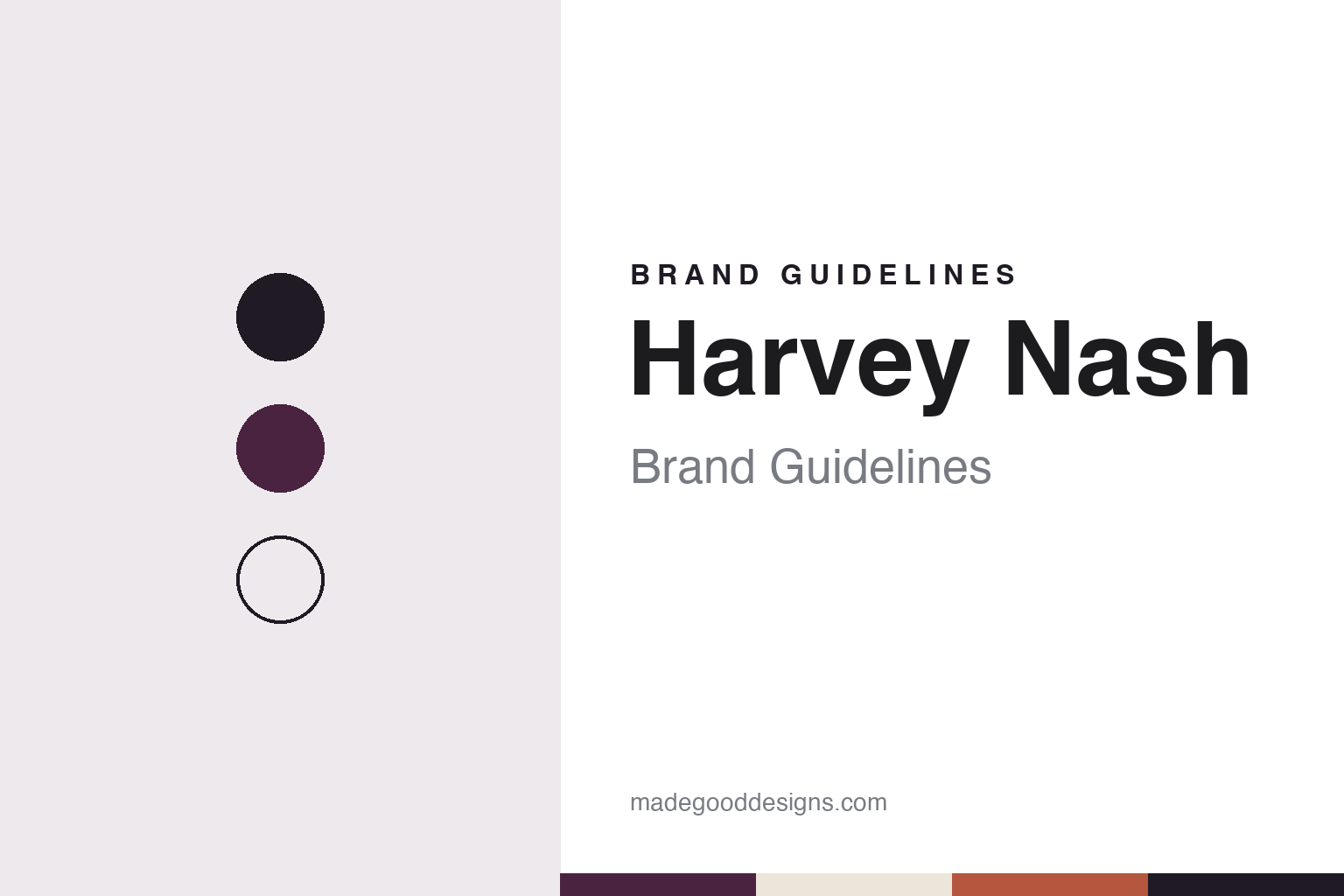
Harvey Nash Brand Guidelines
A 1988 technology recruiter, a 2018 buyout and a group called Nash Squared.
Aa
Two constants: a plum, coral and sand palette and an editorial serif register. Abstract homage — not a Harvey Nash asset; no logo, wordmark or brand mark is reproduced.
Established 1988
A recruiter built around technology hiring.
Harvey Nash says it was established in 1988 and that it has spent more than 35 years as a specialist technology recruitment partner. Its own pages describe a business that connects organisations with technology professionals for permanent, contract, interim and senior leadership roles, with named specialisms running from software engineering, cloud and DevOps to data and analytics, AI and machine learning, cybersecurity and product. Executive search for technology leaders is one of those named specialisms rather than a separate brand.
Harvey Nash Group’s shares traded in London until 2018, English Wikipedia says. By the time it left the market, Scotland’s Insider business site reported in December 2018, it had more than 9,400 contractors working from offices across the USA, Europe, Asia and Australia, among them offices in Edinburgh and Glasgow.
Today the company gives its size in its own terms: more than 600 employees in 21 locations across nine countries, it says, and its country selector names Belgium, Canada, Germany, Ireland, the Netherlands, Poland, the United Kingdom and the USA. It describes itself as having the reach and resources of a global organisation while keeping a culture of innovation and agility.
It also publishes a short list of values, each a single word: Entrepreneurial, Open, Human, Hungry and Collaborative. Each comes with a line of its own, from challenging ideas and pursuing excellence to listening and evolving together, and the company calls them its guiding principles and fundamental beliefs.
Colour
From a listed group to Nash Squared.
The 2018 deal took the group private. A bid company called The Power of Talent owned, or had valid acceptances for, about 51 per cent of the shares by 25 October 2018, Insider reported, and went on to reach 75 per cent, which allowed it to delist Harvey Nash from AIM, the London Stock Exchange’s growth market, in December 2018. diginomica, writing in October 2023, described the firm that took the business private as the Isle of Man investment company DBay Advisors, and English Wikipedia calls the deal a near-total buyout by DBAY Advisors.
The parent then took a new name. English Wikipedia describes Nash Squared as the former Harvey Nash Group, and by November 2022 the group was issuing its press releases under the Nash Squared name, with Harvey Nash as one brand within it. diginomica listed the group’s brands in 2023 as Harvey Nash, NashTech, Crimson, Spinks, Talent-IT and Flexhuis, operating from 49 offices in 17 countries.
Expansion came through purchases and new markets. The Dutch business Het Flexhuis, which provides recruitment as a managed service, was acquired in July 2022 and its offer was taken global in February 2023, diginomica reported, and a Canadian operation followed in October 2023. The group later narrowed again: NashTech, the software and IT services business founded in London in 2000, was acquired by the investment firm PAG in a deal announced on 23 December 2024, Outsource Accelerator reported in January 2025, as Nash Squared turned to its core talent business. Before the sale, diginomica noted, NashTech had opened delivery centres in Colombia, Costa Rica and El Salvador in 2022, alongside existing centres in Poland and Vietnam.
In November 2026 the Nash Squared site describes the group as the holding company for four brands: Harvey Nash, Flexhuis, Crimson and Talent-IT. Harvey Nash is the technology recruiter among them; Flexhuis sells managed-service and recruitment process outsourcing; and Talent-IT is a Belgian technology consultancy.
Typography
How staffing firms present themselves.
Executive search and staffing firms sell judgement about people, so their public material leans on people too. Spencer Stuart’s website points visitors to a directory where they can find an expert and to a list of global locations, while Egon Zehnder’s invites them to meet its consultants and find its offices. Consultant profiles and office pages, rather than products, carry most of the visual weight, and the photography on them is whatever each firm chooses to publish.
Candidate-facing design is one of the points this guide compares across the category: the job boards and application portals of staffing companies on one side, and on the other the careers pages, alumni network and client log-in that Spencer Stuart lists in its own site menus. Each site is described as the company presents it, without judging how well it works.
Thought leadership supplies much of the category’s printed and digital output. Spencer Stuart says it published its first US Board Index in 1987 and now produces more than 20 Board Indexes a year, and in October 2026 it released a survey of more than 1,400 board chairs, directors and CEOs. Egon Zehnder publishes CEO studies, a podcast and HBR Executive, a partnership with Harvard Business Review. Report covers, chart styles and survey branding therefore do much of the work that packaging does in consumer categories.
Ownership is part of the story, and each firm states it differently. Spencer Stuart says its founder offered his whole shareholding to a group of employees in 1974, and German Wikipedia says Egon Zehnder’s international partners own that firm in equal stakes. For listed staffing groups, investor and stock-listing pages form a further part of the corporate presentation this guide looks at. This guide sets out who founded each firm, who owns it and what it says about itself, and marks clearly what rests only on the company’s own word.
Aa
An editorial serif for a recruiter that publishes as much as it advertises. (Specimen set in Newsreader, a serif STAND-IN; NOT the Harvey Nash logo.)
Research as a face
A recruiter that leads with articles and surveys.
Much of Harvey Nash’s public face is editorial. Its homepage gives as much room to articles as to job search, with pieces in 2026 on the changing role of the chief information officer, routes into the technology boardroom and the effect of AI on career ladders, alongside a “Thought leadership” section in the main menu. The job seeker and the hiring manager are addressed on the same page, through two quick links: find a job, or submit a vacancy.
The group’s largest piece of research is a survey. The Nash Squared Digital Leadership Report, produced in 2022 in collaboration with the technology-leaders network CIONET, was described by Nash Squared that November as the largest and longest-running survey of senior technology decision makers. The 2022 edition reported that 52 per cent of the digital leaders surveyed expected their technology budgets to rise and 12 per cent expected them to fall, and that investment in cloud remained strong while spending on newer areas such as AI and big data had slowed. Reports like it give a recruiter something to say between vacancies, and they put the group name, rather than any single trading name, on the cover.
The naming tells the same story. The group name Nash Squared keeps the word Nash from Harvey Nash, so the recruiter and its parent still share a root even after the parent added other brands beside it.
For a design guide, Harvey Nash shows how a recruiter can lead with values, country pages and research rather than with vacancies alone, and how a parent name can grow out of a brand name. Compare SThree, a London-listed technology and engineering recruiter, and PageGroup, another British recruiter with several brands under one group name. For this guide we use deep plum, brick coral and warm sand with an editorial serif, an unofficial interpretation; no product or logo is reproduced.
Explore & save
Keep Harvey Nash’s identity on hand — save it to a board in the Made Good inspiration library.
Harvey Nash identity set
Pin the Harvey Nash plum, coral and sand palette and the editorial serif register to your own board.