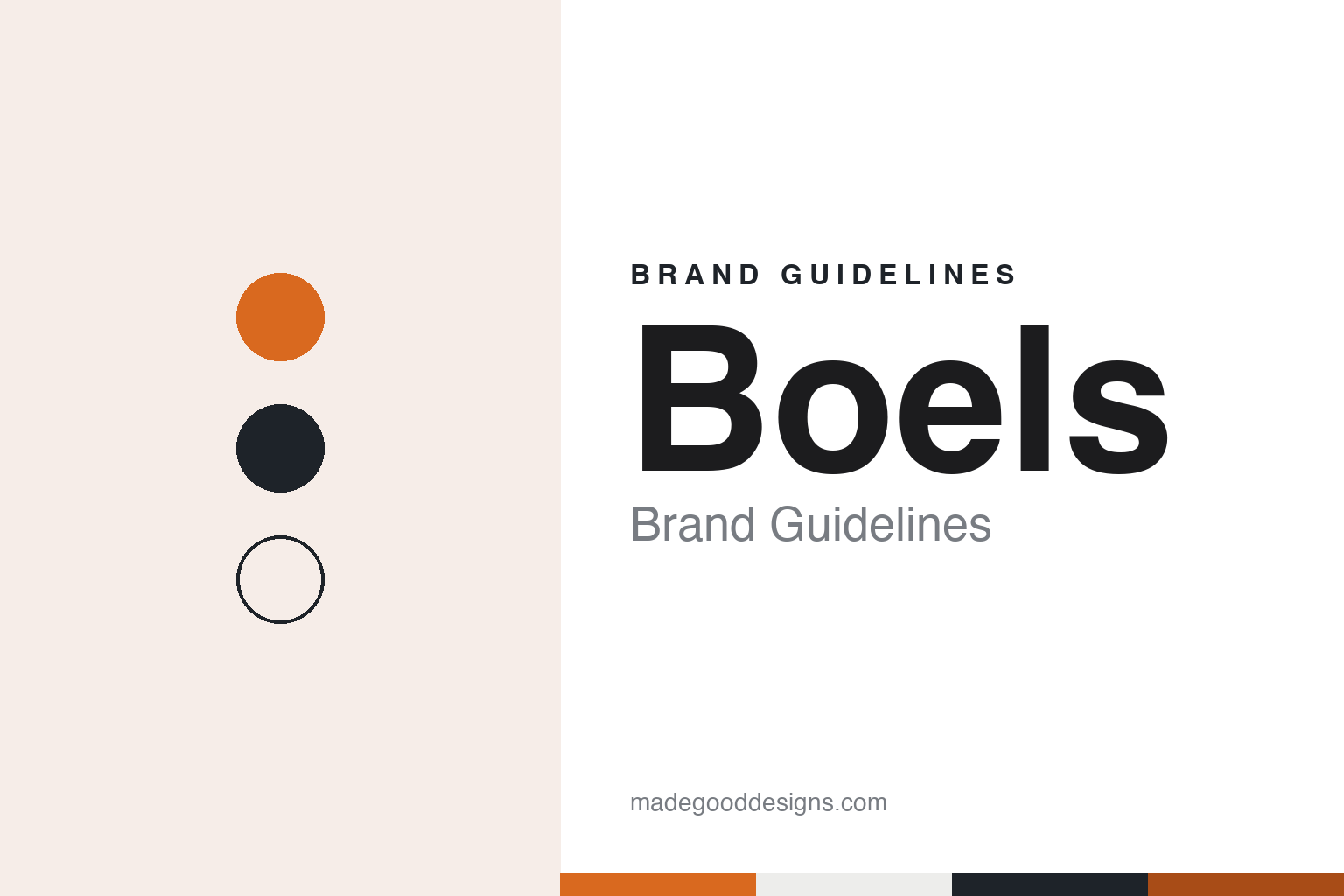
Boels Brand Guidelines
A Limburg family rental firm that grew into a European group.
Aa
Two constants: an orange, ink and grey palette and a plain grotesque register. Abstract homage — not a Boels asset; no logo, machine livery or sign is reproduced.
Amstenrade, 1977
A family business in the south of the Netherlands.
Boels started small, in the far south of the Netherlands. Dutch Wikipedia says the company was founded in 1977 in Amstenrade, a village in the province of Limburg, by Pierre Boels Sr. In 1996 his son, Pierre Boels Jr., took over the day-to-day running of the business, and English Wikipedia says he has managed it since then. The group’s head office is in Sittard, also in Limburg, and Dutch Wikipedia describes Boels as still a family business.
Growth came from the start through both new branches and takeovers. Dutch Wikipedia says that when the company turned 25 it had 65 branches in three countries, and that it opened its 100th branch in 2004. By November 2019, when it announced the deal that would double its size, Boels described itself in its offer announcement, as reported by Rental Equipment Register, as a company with more than 4,200 employees and more than 450 depots in 11 countries, and said its volume had doubled roughly every five years since its founding.
That 2019 statement also set out how the company saw itself: a generalist rental company that had over the years set up specialised divisions, and the leading rental business in the Benelux countries, by its own account. Its network then covered the Benelux, the United Kingdom and the German-speaking DACH region of Germany, Austria and Switzerland. Pierre Boels, as chief executive, said the aim was to build a European leader in equipment rental by building scale locally in each country where it worked.
Boels rents a wide range of machines and tools for construction, industry, infrastructure and events. Its website for the Netherlands groups its offer by expertise, from earthmoving, concrete, power and air to site accommodation, cherry pickers and construction hoists, and adds services such as training, on-site rental and the sale of used equipment.
Colour
The Cramo takeover, 2019 to 2020.
The deal that changed the company was the purchase of Cramo, the Finnish-based rental group. On 10 November 2019, Rental Equipment Register reported, Boels Topholding B.V. and Cramo Plc agreed that Boels would make a recommended public cash tender offer for all of Cramo’s shares, which were listed on Nasdaq Helsinki. Cramo’s board recommended the offer. At the time Cramo served about 150,000 customers through around 300 depots in 11 countries, and had just separated from its modular-space business, which was demerged as Adapteo on 1 July 2019.
Cramo brought a long history of its own. A September 2026 Cramo press release says the company has roots going back to 1953 and became a brand in 1969 through the merger of a Finnish and a Swedish rental company. In 2019 Boels said Cramo would become the Scandinavian platform for the enlarged group.
The takeover was completed in February 2020, Rental Equipment Register reported in June 2020. In the following months Boels gained title to all remaining Cramo shares under the Finnish Companies Act, and Cramo’s shares were removed from Nasdaq Helsinki in early June 2020. English Wikipedia says the takeover made Boels the second-largest construction equipment rental company in Europe.
Boels kept buying after that. Dutch Wikipedia says it took over Eekels Pompen, a pump rental firm founded in 1914, early in 2022, and in April 2023 Rental Equipment Register reported that Boels had bought the Norwegian company BAS Maskinutleie to strengthen Cramo in Norway; Boels then had more than 725 branches in 18 countries. Pierre Boels said the aim was a top-three position in all of its markets.
The two names have now begun to merge. According to Cramo’s Norwegian press release of September 2026, Cramo began a gradual move to the Boels Rental brand that month, in stages across the Nordic and Baltic countries, with both names shown side by side on branches, machines, vehicles, signs and digital channels during the change. The campaign launching it on 16 September 2026 was called “Welcome to more.”
Typography
How equipment rental companies present themselves.
Equipment rental and hire companies sell access rather than ownership, so their public identity is spread across depots, machines, vans and screens. This guide looks at the places where those identities appear as the companies publish them: photographs of depots and fleets, livery colours on machines and vans, online hire catalogues and apps, and the corporate pages that describe branches, listings and owners. No product or mark of any company is reproduced.
Much of the business has moved online. Sunbelt Rentals launched a mobile app in March 2022 that lets customers find, reserve and manage equipment and view invoices, the company said at the time. United Rentals added Equipment Fit, an augmented-reality feature for placing 3D models of machines on a jobsite, in August 2025, and an AI-based Equipment Agent for choosing equipment in March 2026, according to its own announcements. Sunbelt Rentals’ own website lists more than 14,000 product types, sorted into groups such as aerial work platforms, compaction and concrete equipment.
Corporate pages tell a different story: depots, listings and owners. Branch counts are a common headline figure, and they change with each takeover, so this guide gives them only as dated sources state them. Ownership changes are frequent too. In February 2025, Transport Topics reported that Herc Rentals had outbid United Rentals for H&E Equipment Services, and in March 2026 Sunbelt Rentals moved its primary listing from London to the New York Stock Exchange, the company said.
Each guide that follows sets out who founded the company, who owns it now and how it presents itself, and marks clearly what rests only on the company’s own word. Rental prices, fleet values and revenue are left out throughout.
Aa
A plain grotesque for a family firm that grew from one Limburg village. (Specimen set in Barlow, a sans STAND-IN; NOT the Boels logo.)
Boels Rental
Riwal, Manlift and an orange campaign.
The second large deal came in 2024. In March 2024 the trade publisher KHL reported that Boels had agreed to buy Riwal, a Netherlands-based aerial platform rental company owned by the investment business ProDelta, which KHL described as the largest aerial platform renter in Europe. Riwal brought 65 branches in 14 countries across Europe, the Middle East and South Asia, and with them Boels’ first locations in Spain and France and its first outside Europe, in the United Arab Emirates, Kazakhstan, Qatar and India. KHL said the deal took Boels from about 35,000 aerial platforms to about 55,000.
Riwal also brought Manlift, its brand for aerial platform rental in India and the Middle East. International Rental News reported in April 2026 that since the Riwal acquisition Boels has owned the Manlift business, with depots in Dubai, Abu Dhabi and Qatar and three rental locations in India. Cramo’s September 2026 release lists the group as Boels Rental, Cramo, Riwal and Manlift, with more than 800 branches in 27 countries and over 8,800 employees, the same figures International Rental News gave in April 2026. International Rental News calls Boels Europe’s second-largest rental business after Loxam.
The brand has been visible beyond building sites. English Wikipedia says that from 2012 to 2020 Boels was, together with Dolmans Landscaping, title sponsor of the Boels–Dolmans women’s road cycling team, and from 2013 main sponsor of the Boels Ladies Tour and of the Ardennes classics La Flèche Wallonne and Liège–Bastogne–Liège. Dutch Wikipedia adds that Boels stopped as main sponsor of the team and of the Ladies Tour in 2020 but stayed involved as a sponsor of the large classics, the Amstel Gold Race among them.
Colour is part of how the company talks about itself. Dutch Wikipedia says Boels ran a campaign under the line “Oranje is het nieuwe groen” — orange is the new green — to present itself as the rental partner for zero-emission machines and sustainable advice.
For a design guide, Boels shows how a family firm can carry one name and one colour across a growing set of acquired brands. Compare Loxam, the French group that International Rental News ranks ahead of it in Europe, and Ramirent, another Nordic rental name now owned by a larger European group. For this guide we use an orange, a deep ink and a light grey with a sans, an unofficial interpretation; no product or logo is reproduced.
Explore & save
Keep Boels’s identity on hand — save it to a board in the Made Good inspiration library.
Boels identity set
Pin the Boels orange, ink and grey palette and the plain grotesque register to your own board.