Ramirent Brand Guidelines
The Finnish construction man who turned into a rental company.
Aa
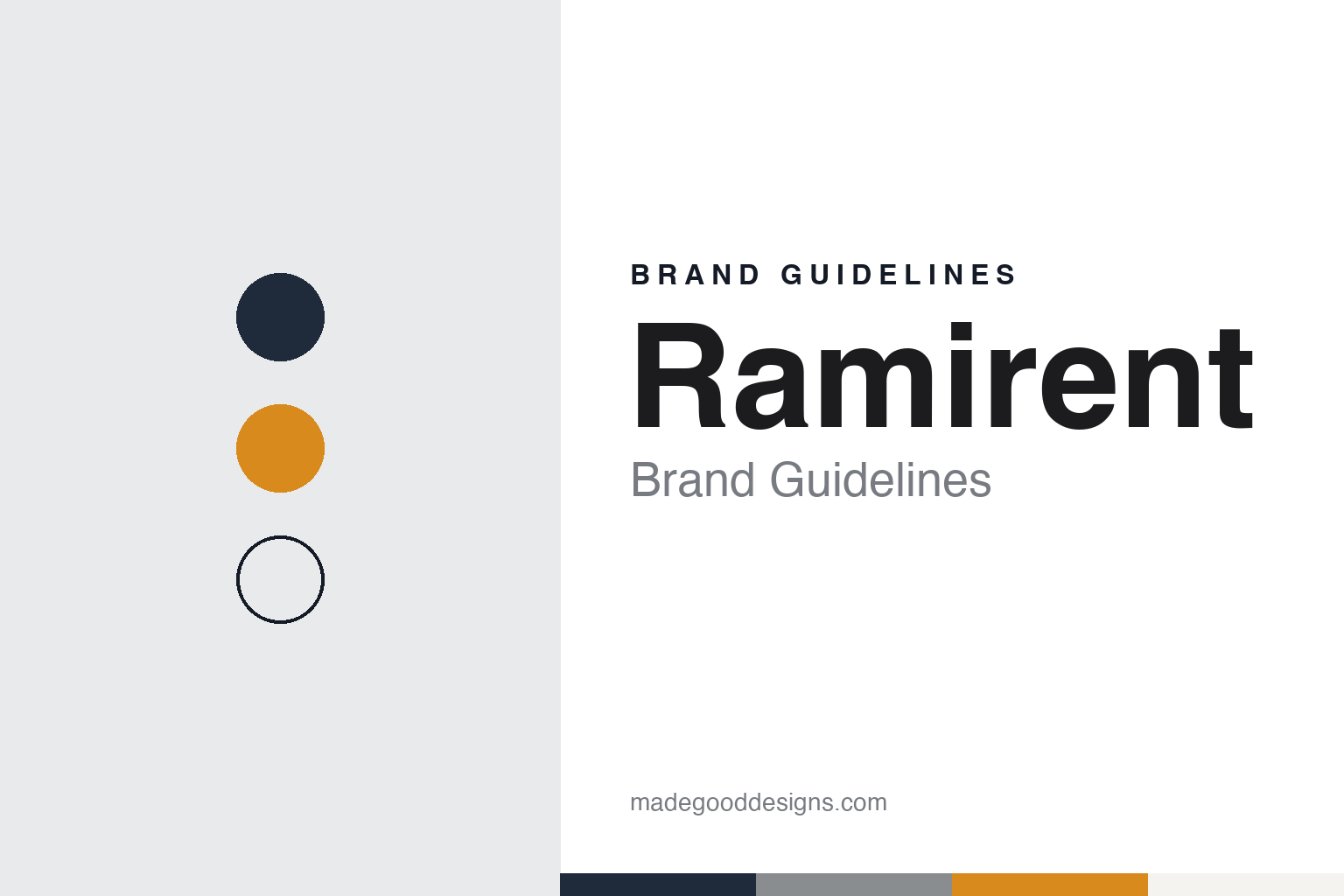
Two constants: an ink blue, concrete grey and signal amber palette and a Sturdy grotesque register. Abstract homage — not a Ramirent product or mark; no machine, logo or character is reproduced.
Rakennusmies
Three engineers, steel nails and a cartoon builder.
Ramirent began in Finland in 1955. The company’s own history says three engineers, Lauri Jämsä, Kauko Rastas and a third partner it names as Heljo Lepäsmaa, formed a partnership called Rakennusmies, “the construction man”; Finnish Wikipedia gives the third founder as Reijo Lepäsmaa. The company says the venture started as a side job and first marketed steel nails. Finnish Wikipedia adds oil heaters and formwork clamps, and says the firm then began importing tower cranes from the French maker Potain as prefabricated building spread in Finland.
A sister company, A-Elementti Oy, followed to develop and make prefabricated building elements. Finnish Wikipedia says the letter A was chosen so that the company would appear among the first names in telephone directories. In the 1960s the two firms merged as A-Elementti Oy Rakennusmies, and the business began to use a character and a mark called Rami, a short form of Rakennusmies, according to Finnish Wikipedia. The company still tells its history in the voice of this “Rami man,” who it says was born in the 1960s.
By the 1970s, the company says, the firm imported, manufactured, sold and rented machinery and equipment, and offered installation and maintenance, with production sites in Helsinki, Hyvinkää, Kajaani and Lohja. In 1983 the Finnish concrete group Partek bought the company’s shares. The element business was folded into Partek, and the rest carried on as A-Rakennusmies, selling and importing construction machinery and equipment, Finnish Wikipedia says.
Colour
From seller to renter, and a new name.
The turn to rental came in the recession of the early 1990s, when Finland’s construction boom stopped. Finnish Wikipedia says A-Rakennusmies bought struggling competitors, and that the purchase of Monivuokraus of Kuopio in 1992 made it the largest company in its field in Finland. By 1995, it says, the business had become purely an equipment renter, and Partek sold it to its management; the company dates that buyout to 1995, with key staff and capital investors becoming shareholders. Work abroad had begun with a joint venture in Moscow in 1988, followed by St Petersburg and Tallinn in 1993, Riga in 1997 and Lithuania in 1998. A-Rakennusmies listed on the Helsinki Stock Exchange in 1998; by then, Finnish Wikipedia says, it was Finland’s largest renter of construction machinery, working in more than 50 Finnish towns.
The name Ramirent arrived in 2001, when the company became Ramirent Oyj. Finnish Wikipedia explains the coinage: the first letters of Rakennusmies, the old Rami, joined to the English word “rent.” The company says the short name suited an international market better. Through the 2000s it entered Poland in 2000, bought Bautas in Norway and Stavdal in Sweden, added Altima in Sweden and Denmark in 2004, and started up in the Czech Republic in 2006 and Slovakia in 2008. In 2013 it formed Fortrent, a joint venture with Cramo, another Finnish rental company, covering Russia and Ukraine; the company says it completed its exit from Russia in 2023.
Slogans carry much of the brand’s voice. For its 60th anniversary in 2015, the company says, it adopted “More than machines.” In 2016 it introduced the mission “Smooth service with a smile” with the slogan “Gear up,” aimed partly at small and medium-sized customers; Finnish Wikipedia still lists “Gear up” as the company’s motto. Its brand story page ends on a plainer line: “Equipment rental at your service.” It describes its customers as “builders, creators, makers” and sets out a vision in which renting makes owning machines unnecessary.
Typography
How rental companies present themselves.
Equipment rental and hire companies sell access rather than ownership, so their public identity is spread across depots, machines, vans and screens. This guide looks at the places where those identities appear as the companies publish them: photographs of depots and fleets, livery colours on machines and vans, online hire catalogues and apps, and the corporate pages that describe branches, listings and owners. No product or mark of any company is reproduced.
Much of the business has moved online. Sunbelt Rentals launched a mobile app in March 2022 that lets customers find, reserve and manage equipment and view invoices, the company said at the time. United Rentals added Equipment Fit, an augmented-reality feature for placing 3D models of machines on a jobsite, in August 2025, and an AI-based Equipment Agent for choosing equipment in March 2026, according to its own announcements. Sunbelt Rentals’ own website lists more than 14,000 product types, sorted into groups such as aerial work platforms, compaction and concrete equipment.
Corporate pages tell a different story: depots, listings and owners. Branch counts are a common headline figure, and they change with each takeover, so this guide gives them only as dated sources state them. Ownership changes are frequent too. In February 2025, Transport Topics reported that Herc Rentals had outbid United Rentals for H&E Equipment Services, and in March 2026 Sunbelt Rentals moved its primary listing from London to the New York Stock Exchange, the company said.
Each guide that follows sets out who founded the company, who owns it now and how it presents itself, and marks clearly what rests only on the company’s own word. Rental prices, fleet values and revenue are left out throughout.
Aa
A sturdy grotesque — a coined name built from Rami and rent. (Specimen set in Archivo, a sans STAND-IN; NOT the Ramirent logo.)
Ramirent
Part of Loxam since 2019.
Ownership changed in 2019. In April that year, Rental Equipment Register reported, Ramirent signed an agreement to buy Stavdal AB, a general equipment rental company operating in 11 Swedish cities and the Oslo area. In June 2019 the French rental group Loxam made a public tender offer for all of Ramirent’s shares. On 23 July 2019 the French trade publisher JDL Groupe reported that Loxam had confirmed acceptances representing 96.2 percent of Ramirent’s capital, and the company says its shares were delisted from Nasdaq Helsinki on 20 December 2019. Erik Bengtsson, previously head of its Swedish business, became chief executive at the start of 2020, Finnish Wikipedia says.
Under Loxam, Ramirent kept its own name and kept buying. The company lists the event-power business Festivaalisähkö in Finland in 2021, then WasaTrade in Finland and JIAB in Sweden in 2023. On Women’s Day in 2023, it says, it introduced a new character, Ramina, beside the long-running Rami man. Its website lists operations in Finland, Sweden, Norway, Estonia, Latvia, Lithuania, Poland, Slovakia and the Czech Republic; Finnish Wikipedia, citing the company, counted close to 290 outlets in nine countries in 2022.
The name itself is now in transition. On 19 February 2026 Ramirent AB, the Swedish company, announced that Ramirent would become a fully integrated part of Loxam and market itself under the Loxam name, and that the change was starting with the Loxam brand being added to Ramirent’s marketing and websites. At the time of writing the Ramirent name is still in use on its sites.
For a design guide, Ramirent shows how a coined name and a cartoon builder can carry a company through recessions, a listing and new owners. Compare Loxam, its French owner since 2019, and Boels, another European rental group. For this guide we use an ink blue, a concrete grey and a signal amber with a sans, an unofficial interpretation; no product or logo is reproduced.
Explore & save
Keep Ramirent’s identity on hand — save it to a board in the Made Good inspiration library.
Ramirent identity set
Pin the Ramirent ink blue, concrete grey and signal amber palette and the Sturdy grotesque register to your own board.